Aa
  • Read, Watch, Listen
  • TJI Series
  • Community Action
  • Events
  • Zedi
Follow us and continue the conversation
  • LinkedIn
  • Instagram
  • FaceBook
  • X
  • YouTube
Test yourself with the TJI Quiz!

Adjust size of text

Aa

Follow us and continue the conversation

  • LinkedIn
  • Instagram
  • FaceBook
  • X
  • YouTube

Your saved articles

You haven't saved any articles

What are you looking for?

Original reporting, insightful analysis and diverse views, delivered straight to your inbox

  • LinkedIn
  • Instagram
  • FaceBook
  • X
  • YouTube
Your support fuels our mission to inform, entertain and inspire.

The Jewish Independent is bound by the Standards of Practice of the Australian Press Council. If you believe the Standards may have been breached, you may approach The Jewish Independent or make a complaint to the Australian Press Council in writing at www.presscouncil.org.au. The Council may also be contacted on 1800 025 712.

  • Our Story
  • Contact us
  • Our Team
  • Support us
  • Guidelines
  • Pitch your idea
  • Republishing us
  • Community Action
  • Our Awards
  • LinkedIn
  • Instagram
  • FaceBook
  • X
  • YouTube
Aboriginal FlagTorres Strait Islanders Flag

The Jewish Independent acknowledges Aboriginal and Torres Strait Islander peoples as the Traditional Owners and Custodians of Country throughout Australia. We pay our respects to Elders past and present, and strive to honour their rich history of storytelling in our work and mission.

© The Jewish Independent 2026All Rights Reserved
Website design and development by Your Creative, MelbourneTerms & ConditionsPrivacy Policy
HomeRead, Watch, ListenAustralia
Royal CommissionNewsAustralia

Security challenges on the road back to safety

From legislation to security at community events and schools, the Royal Commission has heard testimony of complex and invisible changes to Jewish life that have passed under the public radar
Peter Kohn
Print this
Mark Dreyfus RC main

Mark Dreyfus giving evidence

Published: 23 July 2026

Last updated: 23 July 2026

Speaking with a latitude he says he did not have as Australia’s attorney-general and as a cabinet minister, Mark Dreyfus made it clear to the Royal Commission (RC) this week that Australia needs broader protection from hate speech at the federal level.

The longstanding MP for the Melbourne seat of Isaacs was the opening witness in the Commission’s Hearing Block 5.

This phase is examining the security aspects of the rise in antisemitism – the financial, cultural and psychological burden of transforming a Jewish community accustomed to an open, Western democratic society; moving it behind high walls and advanced electronics, a corps of community security volunteers and a net of police patrols.

The RC was told it’s an experience that no other Australian faith or cultural community has been forced to endure. The survivor heritage of a large percentage of the Jewish community in Australia deepens the fear and pain.

Rabbi Levi Wolff of Central Synagogue in Sydney became emotional during his testimony when he spoke of a pastoral visit with an elderly Holocaust survivor whose early years had been affected by the horrors of persecution and whose final days were “under that same dark cloud”. And Dr George Foster, president of Southern Sydney Synagogue, described a “golden age” for Jews in Australia that he fears is ending.

This sense of foreboding was captured by testimony from Jason Steinberg, president of the Queensland Jewish Board of Deputies, when he spoke of activists banging on a Brisbane bookshop window at a community event.
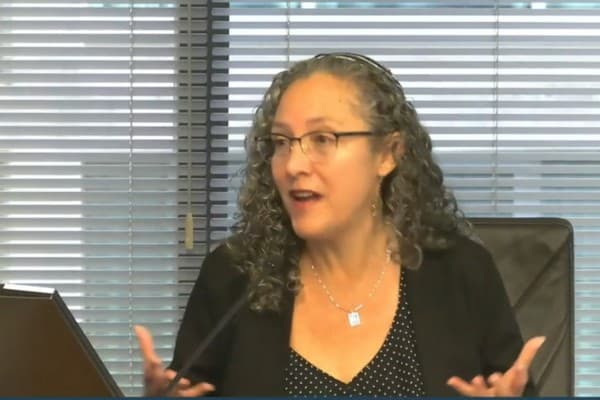
Rabbi Allison Conyer

Rabbi Allison Conyer, representing the Union for Progressive Judaism (UPJ), stated: “You can’t underestimate the impact of intergenerational trauma.” Detailing a litany of random slurs her congregants have endured in the streets, she observed, “It’s real, it’s scary, and it starts like this.”

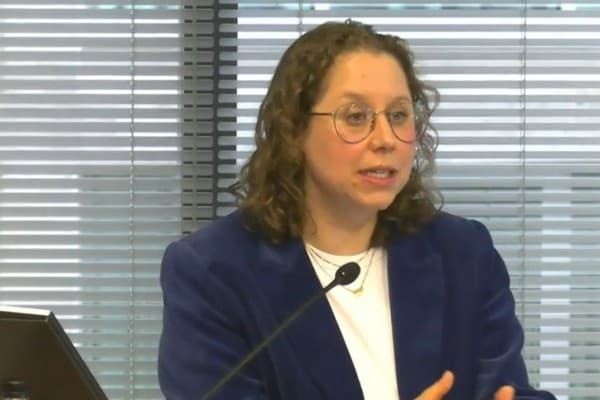
Rabbi Conyer emphasised that Jews worldwide felt like “a big family, a tribe”. When child hostages were among the abducted in Israel on October 7, 2023, she said, “it’s as if someone had taken my children.”

The scope of this week’s witness testimony ranged from security needs and arrangements, the role of Community Security Groups (CSGs) in various states, coordination between CSGs and law enforcement, government funding and police data collection.

‘Genocidal Zionist’

Dreyfus opened his testimony with a reference to his grandparents, who had escaped to Australia before the war, and to his great-grandparents who had perished in the Holocaust. He spoke about the trust that Jewish Australians had developed over generations in an Australia that was a tolerant, open and multicultural haven. And about the shock he felt, when eight decades later, after the October 7 attacks in Israel, Jewish Australians were faced with “a breach of that sense of safety”.

In his own experience, it was gut-wrenching – a member of the public called him a “genocidal Zionist” and his electoral office was daubed with a canard about Jewish dual loyalties. Until the aftermath of October 7, “no-one had ever hurled abuse at me because I’m Jewish,” he said.

Asked by Commissioner Virginia Bell how he defined “Zionist”, Dreyfus described it as “support for the continued existence of the State of Israel as a home for the Jewish people. It’s not a complicated concept … I’m proud to say I’m a Zionist.”

In her testimony, Rabbi Conyer said: “I need to say for the record that Zionism is not the eradication of the Palestinian people. Zionism is the right for self-determination in the ancestral homeland for the Jewish people.”

Dreyfus told the RC:  “The line is crossed when criticism is directed at Jewish Australians simply because they are Jews or, equally bad, when Jewish Australians are held responsible for the actions of the government of Israel.” Or as Rabbi Levi Wolff, from Central Synagogue in Sydney, put it to the RC, when activists chorus “Death to Israel”, Jewish Australians “don’t hear a nuanced debate”.

US-born Rabbi Wolff described an Australia he had never known in three decades of living here. He has become accustomed to a string of random threats of violence. He said he was told by a congregant that after the Bankstown nurses incident, the individual declined to state their religion on hospital admission documents.

He was stunned when a congregant left a mezuzah in the rabbi’s letterbox with a note apologising that he was no longer “brave enough” to display it on his doorpost. “No-one in Australia should have to have courage to simply place a symbol of their faith on the doorpost of their very own home,” the rabbi testified.

A Sydney youth movement leader, testifying under the pseudonym ACV, spoke of journeys home from Jewish summer camps during which participants are told not to wear Jewishly identifying camp merchandise for safety reasons. Camp stays no longer include visits to public pools and cinemas. And attendees are told to switch off location services on their phones so the campsite can’t be tracked.

‘Never allow this to become normal’

Rabbi Wolff picked up a theme expressed by Benjamin Klein, president of Adass Synagogue in Melbourne, which was badly damaged in an arson attack in 2024. “Jewish Australians shouldn’t have to justify their place in a country where they have lived loyally and peacefully for generations,” Rabbi Wolff stated. “We should never allow this to become Australia’s ‘normal’.”

Rabbi Wolff said on visits back to the US, he was continuously asked about Australia’s antisemitism problem. Asked by Commissioner Bell, he emphasised that Australia may not necessarily have become a worse place to live than comparable democracies. But there’s shock at how the stereotype of the big, sunny land of hospitality squares with new international perceptions of its hostility towards Jews.

He said a brain drain of Jewish professionals has already begun, with some 100 doctors he knows making plans to resettle in Israel. On a positive note, he expressed hope that Australia’s current inquiry (the first of its kind in the world) will become a model for other countries to examine local antisemitism.

Call to criminalise vilification

A grandson of Holocaust survivors, Mark Dreyfus, described himself as now being a father of a CSG volunteer who guards a Jewish school where his grandchildren attend. It was from these wellsprings that the former attorney-general brought his legal and legislative acumen to the table. His message: federalise the broader state-level protections against vilifying speech.

Criminalisation of hate speech has been “a long debate” in Australia, he admitted. However, he suggested that the more far-reaching legislation enacted in NSW and Victoria, criminalising the vilification of religious and racial attributes, even if they do not meet the test of inciting violence, should be adopted by the Federal Government. That would carry federal law beyond the legislation he introduced in 2024 around the “incitement to violence” standard.

“More recently, both Victoria and NSW have legislated in a more general way, to criminalise serious vilification, that is hate speech focusing on particular attributes, and I’ve urged in the witness statement for the Commission to consider whether or not the Commonwealth should move to that more broad criminal offence.”

And to a question from Richard Lancaster SC, counsel assisting, Dreyfus said consideration should be given to a legal carve-out of Jewish centres to protect them from activist events in their vicinity, similar to Victoria’s legal protections around abortion clinics that have been upheld by the High Court.

CSG duty’s emotional toll

Victoria Police Assistant Commissioner Chris Gilbert, Southern Metro Region, gave testimony describing the CSG in Victoria as “a core community stakeholder” in maintaining security. But testimony from CSG volunteers this week demonstrated that serving on the CSG has come at a considerable emotional cost.

The RC heard from a CSG volunteer, under the pseudonym ACS, who spoke of his team burying its emotions, in order to continue juggling the intense daily caseload of antisemitic incidents.

It heard from witness ACR that CSG service has become a “second life”, and from ACS that CSG has, sometimes debilitatingly, become a second full-time job. And that, for ACS, his CSG peers have become virtually his sole social circle, not only because of wariness against spilling confidential information, but because “only they understand the true scope” of the task. He has undergone psychological counselling, although he would like to see resources made available to enable such support to become more widespread among CSG volunteers.

Another witness, ACU, the mother of a CSG volunteer, related how, since the 2025 Yom Kippur terrorist attack on a synagogue in Manchester in the UK, and since Bondi Beach, “every [CSG] shift carries a different emotional weight” for mother and daughter. “That burden that my daughter carries, I carry with her.”

Financial burdens

Dan Sztrajt, principal of Mount Scopus

The cost burden of maintaining hyper-vigilant security has been huge, witnesses from synagogues and schools reported in their testimonies. Dan Sztrajt, principal of Melbourne’s Mount Scopus Memorial College, cited the operational costs of security as more than $1,800 per student, outstripping the school’s security level of $1,130 per student.

He said government security funding covered less than one-third of security needs. Moreover, grants earmarked for physical security and excluding security personnel, meant parents had to bear up to 85 per cent of the cost of guards.

Linda Emms, principal of Sydney’s Emanuel School, made the point that if other Australian schools had to provide the level of security needed at Jewish schools, “there would be uproar”. It’s a conclusion she drew from the astonished reactions that some representatives of 45 independent schools expressed to her after Emanuel hosted them at a conference on its campus.

Benjamin Klein, of Adass Synagogue, spoke of an increasingly common practice of Jewish organisations now hiring full-time consultants to navigate the complex, time-consuming process of applying for government security grants, using financial resources that could otherwise be directed towards education and other services.

Both Klein and the Rabbinical Council of Victoria president, Rabbi Moshe Kahn, emphasised that synagogue venues are not just used on Shabbat and holidays but on a daily, almost around-the-clock basis, so that providing security represents an enormous financial burden.

Policing antisemitism

Naomi Levin, head of JCCV

Naomi Levin, executive director of the Jewish Community Council of Victoria (JCCV), said she regretted Victoria Police not clearly communicating to the state communal roof body in 2024 that ASIO had raised Australia’s terrorist threat level to “probable”, the information only coming to her organisation through the CSG. (It was a telling point, in light of the next witness, Dr Josh Roose, a terrorism expert from Deakin University, who emphasised the importance of a “layered” approach to security, with “communications between different organisations that aren’t seen and yet form a really critical part of the layered approach.”)

Levin said Jewish people in the CBD were perturbed when police asked them to vacate areas into which pro-Palestine activists were about to march, not understanding why they were being asked to leave, when these activists were permitted to occupy the CBD almost every Sunday. And when Jewish visitors to the CBD were targeted with vitriol, “police didn’t step in and do what needed to be done,” she stated.

Levin observed that police and security personnel can’t be everywhere and can’t protect Jews from frequent antisemitic incidents in the streets and on public transport. However, when it comes to reporting antisemitic incidents to police, the RC heard that Victoria Police data interpolation can allow reports from members of the public to slip through the cracks.

Superintendent Amanda Bowden of Victoria Police’s Corporate Support Unit explained that an antisemitic incident does not constitute an offence unless it is related to a crime. She described the Law Enforcement Assistance Program (LEAP) reporting module in which police members can log an incident as a Prejudice Motivated Crime, with a “religious” and “Jewish” subcategory.

But she said if the incident isn’t reported under those categories in the first instance, going back to update the module can be challenging, as can retracing individual reports to analyse the “narrative” information logged with that report.  She said antisemitic incidents not logged into LEAP because they were not categorised as “crimes” are entered into another database, the Interpose case management and intel platform. This meant that LEAP does not give an exhaustive picture of the volume of antisemitic incidents that have been reported.

Asked by Tamara Phillips, counsel assisting, if a system which enabled a universal snapshot of where most incidents of a particular type occurred – and to what segment of the community – would be an asset in the fight against antisemitism, Bowden said that it would. In separate testimony, Assistant Commissioner Gilbert said data capture of antisemitic incidents is already effective, but conceded it could be improved.

Richard Lancaster SC, counsel assisting, asked Gilbert if, since the Bondi attack, there have been any changes to Operation Park, Victoria Police’s taskforce on hate crimes and incidents stemming from the Israel-Gaza conflict.

Gilbert said the past two-and-a-half years (since October 7) have seen Victoria Police “collecting far more resources, far more often, relevant to the safety of the Jewish community”. After Bondi, “resources have remained at higher levels [with] more consistency,” he added. “We’ve certainly escalated those deployments since December 14.”

You might also like
  • When the state faltered, civil society and Diaspora Jewry stepped up
    Shahar Burla
  • The case for leaving graffiti up for a while
    Adam Slonim
  • New ‘spoken word’ festival in Sydney offers stories directly from creators
    Miriam Hechtman
logomark.67a07ee3
We believe in the free flow of information

Republish our articles for free, online or in print, by using our Creative Commons licence

You might also like

    ANNIKA WELLS PRESSER
    Israel Hamas WarNewsAustralia

    No action to stop Hezbollah ally beaming antisemitic and anti-Israel content into Australia

    Michael Visontay
    Generation Change: Rachel Moshel
    Generation ChangeInterviewArts & Culture

    Rachel Moshel: Creating a space for Jewish art and joy

    Gideon Cohen
    neo-nazis white supremacists corowaTEST
    Royal CommissionOpinionAustralia

    Antisemitism, homophobia and a radical response to both

    Dennis Altman

About the author

Peter Kohn

Peter Kohn

Peter Kohn is an Australian journalist who began his career at the Herald & Weekly Times. For 43 years, he was associated with The Australian Jewish News. For the past decade, he held the title of Senior Journalist at the newspaper. He is the author of two novels. Rachel’s Chance is the story of his family’s experiences as Jewish refugees in Shanghai during World War II, and View From A Sandcastle is based on his own story, growing up in Melbourne suburbia during the 1960s and 1970s.

More from the author

FeatureWorld

‘Your help is extremely needed’: Jewish aid group on the ground after Nepal flood

NewsAustralia

Strategies for cohesion final focus of Royal Commission hearings

NewsAustralia

Evidence of declining social cohesion and the efforts to turn it around

NewsAustralia

Hate preachers, polarised debate, counter-terrorism

Comments

No comments on this article yet. Be the first to add your thoughts.