Published: 6 February 2017
Last updated: 5 March 2024
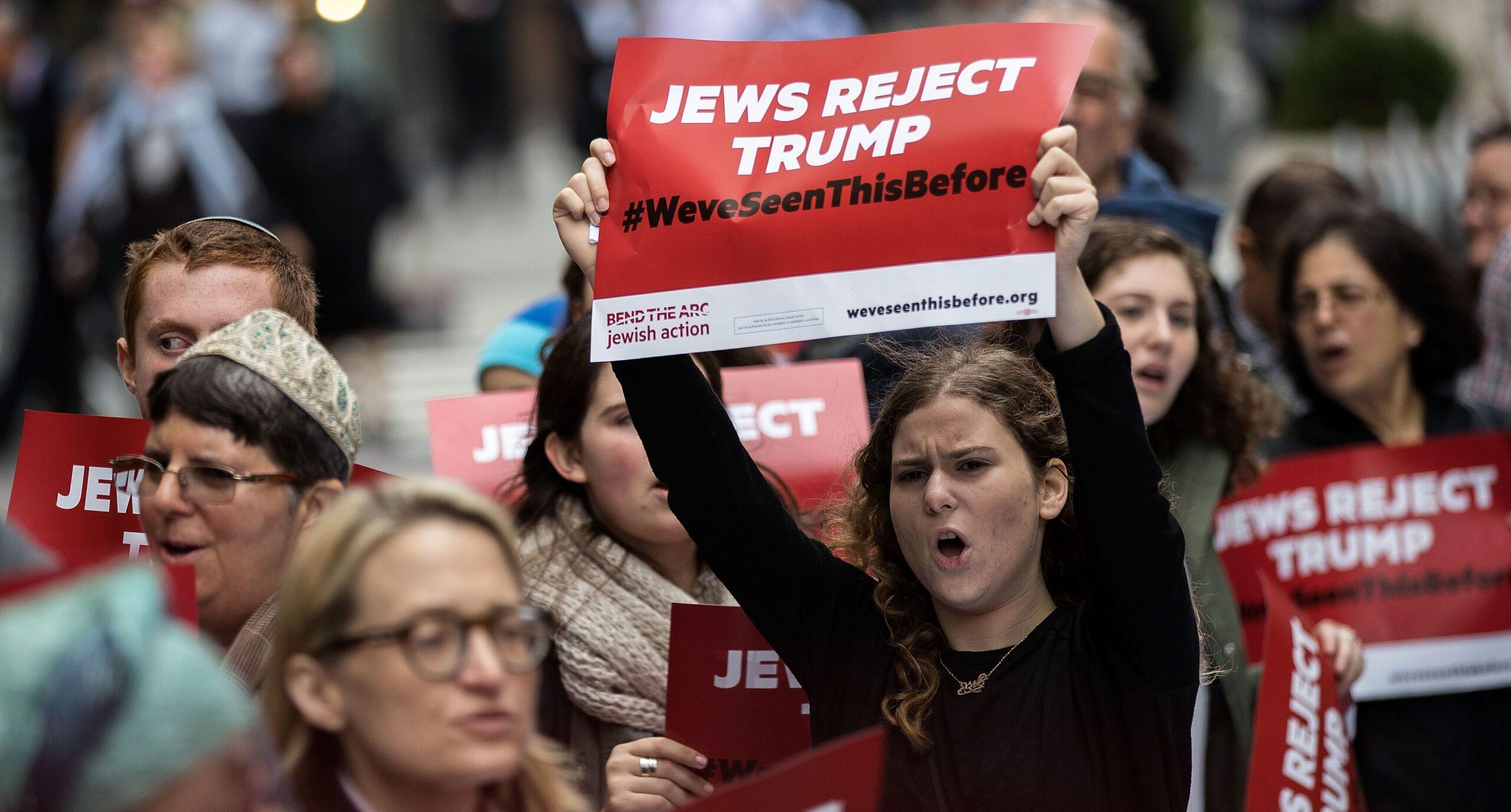
For a while, I couldn’t understand why I had been so irritated by that post. It wasn’t explicitly offensive; it didn’t gloat about Trump’s win or express approval of his misogyny or racism. But we’ve now experienced the first week after inauguration. On reflection, what had really got to me was the inherent condescension, the implied accusation of alarmism. Women being hysterical. Jews being paranoid. It was the sentiment that there was nothing to worry about, that the rest of us should pull ourselves together. It was the way it diminished the impact of the election, effects that are already being felt globally and in life-changing ways for some. It was the realisation of David Remnick’s warning in The New Yorker that commentators would try to downplay the ‘virulence of the nationalism’ and hail the wisdom of democracy. And it was the obliviousness to the lessons of history, the refusal to hear the echoes of populism, ultra-nationalism and scapegoating, of which the Jewish community should, arguably, be especially conscious.
Trump’s election has triggered potent and polarised reactions in Jewish communities around the world. Australia is no exception. These responses tend to fall along political lines, with Isi Leibler representing those who believe Jewish ‘bleeding-heart psuedo-liberals’ are not only overreacting but causing damage to their own community. The accusation of petulance and melodrama is now a common reply from Jewish and non-Jewish Trump-apologists. In an opinion piece in The Australian last week that sought to justify a cruel and illogical immigration and entry policy as a ‘defence of freedom’, Melanie Phillips actually wrote ‘Can everyone please calm down now?’
Well, no. It is not an overreaction to point out the language of populism and prejudice in an election campaign. Nor is it alarmist to highlight precursors of dictatorship in a new government, such as rushed policy implementation and a disinclination to seek frank and strategic advice, or the immediate firing of anyone who dares ask questions. Far from being undemocratic, as some critics have suggested, calling out the harbingers of an authoritarian government fixated on ideology at the expense of rational, ethical and evidence-based policy, is a crucial act of early intervention, awareness-raising and resistance. Genocide scholarship has shown that persecution of groups based on their ethnicity, nationality or religion is often foreshadowed by demonising language and the categorisation of particular groups as a threat to ‘our way of life’. If I’ve learned anything about violence and conflict, it is that prevention is impossible when warning signs go unacknowledged or ignored. Regardless of individual political leanings, members of the Jewish community cannot cover their ears to the familiar rhetoric of the Trump administration. We know where it can lead. We certainly ought to.
Trump’s son-in-law, Jared Kushner, says he knows. He invoked his status as the grandson of Holocaust survivors to prove that he can ‘tell the difference between actual, dangerous intolerance versus these labels that get tossed around in an effort to score political points.’ If that is the case, the indicators of actual, dangerous intolerance should now be quite clear to him. Perhaps it wasn’t quite proof enough that Trump has a large and loyal neo-Nazi and white supremacist fan-base, or that antisemitic graffiti, replete with Nazi symbolism, was sprayed across the US in the days after the election. Mr Kushner would do well to take into account the analysis by the world’s most respected expert on Holocaust denial, Deborah Lipstadt. She has argued that Trump’s administration is engaging in softcore Holocaust denial by intentionally omitting any mention of Jews in his statement on International Holocaust Remembrance Day, a position confirmed by the praise Trump’s statement elicited from alt-right leader, Richard Spencer.
It seemed to ring no bells of irony on the community Facebook page that Denial was the first film to screen at the Jewish Film Festival. It tells the story of Lipstadt’s court battle against David Irving and effectively portrays so many of the notions that antisemitic Trump supporters hold dear – that Jews have exaggerated the Holocaust to gain sympathy and profit, that it never happened, or that it didn’t go far enough.
Those Jews who see parallels between the stories of their own relatives seeking sanctuary from the Nazis and the circumstances facing refugees today are not creating false analogies. They are tapping into the warning signs evident in Trump’s election campaign and his first week of office. They rightly sense that his administration, giddy with power, represents a dangerous form of politics that can hurt Jews and others alike. This is backed up by history, and it is why those Jews who minimise the seriousness of Trump’s ideology and actions are misguided.
Trump’s win has been a cause for celebration among increasingly popular rightwing parties in Europe and many analysts are predicting the swing will be repeated there in elections to be held this year. It is imperative for Jewish communities to be willing to hear the echoes of history. We should all defy those patronising calls to calm down.
Nikki Marczak is a genocide scholar with the Australian Institute for Holocaust and Genocide Studies. See also her previous review for The Jewish Independent of ‘Hanns and Rudolf: The German Jew and the Hunt for the Kommandant of Auschwitz’
This The Jewish Independent article may be republished if acknowledged thus: ‘Reprinted with permission from www.thejewishindependent.com.au ’
And see: How to Build an Autocracy – David Frum – The Atlantic March 2017 Issue
The conditions are present in the US today. Here’s the playbook Donald Trump could use to set the country down a path toward illiberalism.