Aa
  • Read, Watch, Listen
  • TJI Series
  • Community Action
  • Events
  • Zedi
Follow us and continue the conversation
  • LinkedIn
  • Instagram
  • FaceBook
  • X
  • YouTube
Test yourself with the TJI Quiz!

Adjust size of text

Aa

Follow us and continue the conversation

  • LinkedIn
  • Instagram
  • FaceBook
  • X
  • YouTube

Your saved articles

You haven't saved any articles

What are you looking for?

Original reporting, insightful analysis and diverse views, delivered straight to your inbox

  • LinkedIn
  • Instagram
  • FaceBook
  • X
  • YouTube
Your support fuels our mission to inform, entertain and inspire.

The Jewish Independent is bound by the Standards of Practice of the Australian Press Council. If you believe the Standards may have been breached, you may approach The Jewish Independent or make a complaint to the Australian Press Council in writing at www.presscouncil.org.au. The Council may also be contacted on 1800 025 712.

  • Our Story
  • Contact us
  • Our Team
  • Support us
  • Guidelines
  • Pitch your idea
  • Republishing us
  • Community Action
  • Our Awards
  • LinkedIn
  • Instagram
  • FaceBook
  • X
  • YouTube
Aboriginal FlagTorres Strait Islanders Flag

The Jewish Independent acknowledges Aboriginal and Torres Strait Islander peoples as the Traditional Owners and Custodians of Country throughout Australia. We pay our respects to Elders past and present, and strive to honour their rich history of storytelling in our work and mission.

© The Jewish Independent 2026All Rights Reserved
Website design and development by Your Creative, MelbourneTerms & ConditionsPrivacy Policy
HomeRead, Watch, ListenIsrael
OpinionIsrael

Israel’s death penalty law degrades its democracy and global standing

The only positive thing that has emerged in the passing of this law has been the speed with which it has been rightly condemned.
Sara Kowal
Print this
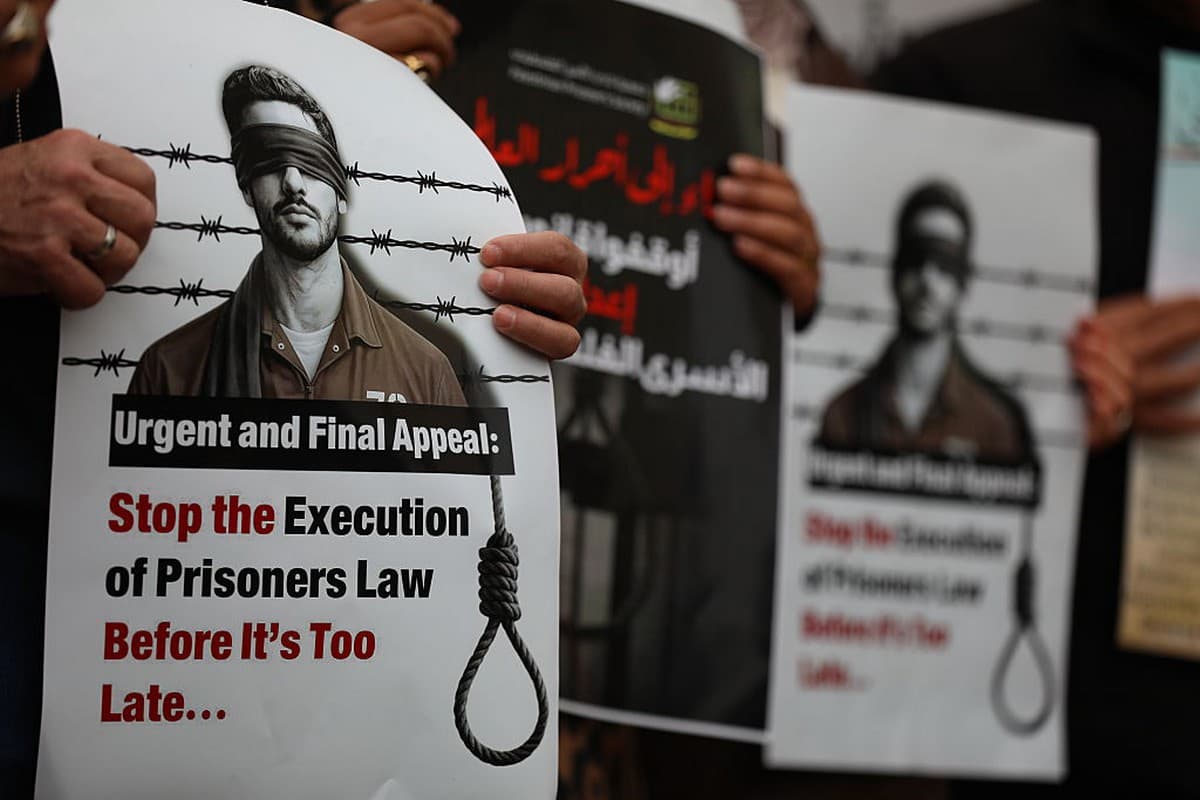
Protest in West Bank, Palestine against Israeli death penalty law for Palestinian prisoners

Demonstrators outside the International Committee of the Red Cross (ICRC) office in the West Bank protest the death penalty law (Wisam Hashlamoun/Anadolu/Getty Images)

Published: 7 April 2026

Last updated: 7 April 2026

As Jews across the globe were deep in Passover preparations, Israel’s Knesset reintroduced the death penalty - dormant for more than six decades, since the execution of Adolf Eichmann, its only recipient.

Aside from the immorality of employing the death penalty, the ‘Death Penalty for Terrorists’ law is deeply flawed. This should not be surprising, given that it is sponsored by MK Limor Son Har-Melech, an Otzma Yehudi party colleague of Security Minister Itamar Ben-Gvir.

Firstly, the law is inherently discriminatory: in the West Bank, “Israeli citizens or residents” are explicitly exempt from prosecution by the military tribunal. Meanwhile, for those convicted of the same offence within Israel, a civilian court judge can choose between the death penalty or life imprisonment if there is sufficient evidence to show their actions were intended to “negate the existence of the State of Israel”.

Son Har-Melech has confirmed that Palestinians will be the main targets, asserting that “there is no such thing as a Jewish terrorist”.  The Association for Civil Rights is Israel (ACRI) noted this creates “a dual and discriminatory legal system based on ethnicity, deepening racial segregation”.

Secondly, by not only re-introducing the death penalty but also expanding its scope, Israel is clearly breaching a number of sections in the International Covenant on Civil and Political Rights (ICCPR), in particular articles on the Right to Life, Fair Trial Rights, Right to non-discrimination and Equality before the law.

While the mandatory death penalty has been removed from earlier versions of this law, military judicial panels are still required to opt for the death penalty unless they can find “special circumstances”, a vague term that offers no judicial guidance and very little wriggle room. In such situations, judges are likely to defer to the status quo — in this case, the quasi-mandatory death penalty – resulting in arbitrary executions taking place.

Under the legislation, there is no need for the military judges’ verdict to be unanimous, and there are no provisions for a condemned person to be pardoned – another clear breach of the ICCPR. The timeline is tight: unless the prime minister applies to the court for a delay, executions are required to take place within 90 days of the death sentence being confirmed.

Executions within 90 days of sentence

This is an unprecedented and draconian requirement which increases the risk of a miscarriage of justice where the stakes are life and death.

The method of execution will be hanging — the Israeli Prison Service has flagged that it intends to consult with an unnamed country in East Asia for guidance on the logistics of this method. In other circumstances, they might have found a “mentor” much closer to home: the most “qualified” experts with the gallows are found in the Islamic Republic of Iran, whose use of the death penalty in 2025 was described by United Nations (UN) experts as being “at an industrial scale”, with conservative estimates of around 1,600 executions in a single year.

Speaking of Iran, the recent war didn’t stop Ben-Gvir’s National Security Committee from pushing forward this law; it resorted to marathon online hearings, pausing frequently as sirens directed Israelis to their bomb shelters. Opposition was fierce: over 2,000 reservations against the bill were filed by Members of Knesset.

The legal adviser to the National Security Committee advised that the bill was discriminatory and unconstitutional — a position supported by former leaders of Israel’s Shin Bet security service. The current Shin Bet Director — a recent Netanyahu appointee —supported the bill (albeit not the mandatory sentencing element), marking a departure from Shin Bet’s previous position on the death penalty. 

Whilst the 'Death Penalty for Terrorists' law focuses on future offending, a second bill is also moving through the Knesset. The Constitution, Law and Justice Committee has passed the ‘Tribunals' Law’ Bill, which establishes a special tribunal within the military courts to prosecute perpetrators of the October 7 massacre — and includes provisions for the death penalty.

Deterrence argument ill-founded

Proponents of these laws say that Israel needs this to deter future terrorists and prevent the kidnapping of Israeli citizens. The trauma of the October 7 massacre on Israeli society is understandably, still raw, and the fear of future offending is unsurprising. But solutions to trauma and fear must be grounded in evidence. 

Politicians and lawmakers love to adopt “tough on crime” positions for political gain, even when subject matter experts and empirical research highlight the need for an entirely different approach. Years of study have indicated that capital punishment does not uniquely deter crime or keep societies safer.

This is particularly so when dealing with an offence where those who undertake extreme acts of political and ideological violence risk their own lives in the process.

Having only ever executed one person in 1962, Israel has long met the UN’s criteria of being “abolitionist in practice”. Last year, Amnesty International reported the lowest number of countries actively carrying out executions it had ever recorded. Meanwhile, the world continues to move towards abolition. In 2024, the UN General Assembly saw more than two-thirds of all member-states — including Israel — supporting a moratorium on global executions. In fact, Israel has voted in favour of this moratorium resolution since it was initiated in 2007.

Perhaps the only positive thing that has emerged in the passing of this law has been the speed with which it has been rightly condemned. Multiple governments – including Australia – have spoken out strongly before and after the passage of the law. Within hours of its passage, several petitions calling for the law to be repealed were filed at the Supreme Court by multiple civil society organisations and MKs in Israel including ACRI, Adalah – The Legal Center for Arab Minority Rights in Israel, the Public Committee Against Torture in Israel (PCATI) and a number of other co-petitioners.

In Australia, the Executive Council of Australian Jewry noted “the Otzma Yehudit party’s campaign for this legislation represents a troubling departure from the principles that have guided Israeli law and Jewish tradition” and the Zionist Federation of Australia raised  serious concerns with the discriminatory law  noting that “Israel’s own Attorney-General’s office, its security establish and its Foreign Ministry raised objections to the bill”. Capital Punishment Justice Project, an Australian NGO, described the law as “a regressive step in a world that is moving away from the death penalty” and called on the Knesset to repeal this law.

States must never be given the power to decide whether individuals live or die. As Holocaust survivor and author Elie Wiesel said, “death should never be the answer in a civilised society”. It is wishful thinking at best to believe that the death penalty will “solve” the extremely difficult problem of terrorism. Meanwhile, Israel’s democratic nature and global standing have undergone yet another assault.

READ MORE

Australian Jewish groups criticise Israel’s new death penalty law (TJI)
‘The only execution law in modern history against one ethnic group’ (TJI)

You might also like
  • Fear of Netanyahu victory may drive big surge in Palestinian voter turnout
    Ben Lynfield
  • Because of my Zionist values, I’m joining an Arab party
    Yoav Segalovitz
  • Israel is cementing its control over the West Bank and East Jerusalem while the world is distracted
    Martin Kear
logomark.67a07ee3
We believe in the free flow of information

Republish our articles for free, online or in print, by using our Creative Commons licence

You might also like

    haredi street guitar
    Photo EssayArts & Culture

    Jerusalemites through the lens

    Sharon Gabay
    Protest against settler violence in Jerusalem
    DebateAustralia

    Sanctioning settlements is a defence of Israel, not an attack

    Elisheva Madar 2
    Btselem
    NewsIsrael

    ‘Israel is systemically eliminating Palestinian collective life’:  Israeli human rights report

    Deborah Stone 1

About the author

Sara Kowal

Sara Kowal

Sara Kowal is a criminal lawyer and the Director of Eleos Justice, at the Law Faculty at Monash University, which aims to limit the scope and use of the death penalty in Asia. She is also the Vice-Chair of Capital Punishment Justice Project, an Australian NGO which advocates against the death penalty.

Comments3

  • Avatar of Ralph Pliner

    Ralph Pliner12 April at 07:49 pm

    An excellent article. One of the clearest expositions of the law and how it applies both in the military tribunals in the West Bank and the courts in Israel.

  • Avatar of Joseph Silver

    Joseph Silver12 April at 12:50 am

    I personally oppose this law – it won’t significantly deter terrorist attacks. For Islamist terrorists, death can carry more meaning than life; those involved in such attacks often assume they will not survive anyway. The Israeli High Court may still rule the law incompatible with Israel’s Basic Laws.
    Which countries condemn Israel’s proposed law?
    Saudi Arabia carried out 347 executions in 2025 and 345 in 2024. Many of these were for offenses such as drug trafficking, smuggling, and even apostasy (leaving Islam). Executions are often carried out by beheading.
    Egypt has carried out dozens of executions in recent years, executing civilians by hanging and military personnel by firing squad.
    Jordan lifted a moratorium on capital punishment in 2014 and since more than 20 individuals have been executed.
    Indonesia retains the death penalty, with executions carried out by firing squad.
    Turkey considered reinstating the death penalty, particularly for terrorism-related offenses. How is that fundamentally different from what Israel is attempting?
    Pakistan has one of the largest death row populations in the world and since 2014 there have been more than 500 executions.
    Even Afghanistan, under the Taliban, criticized Israel.
    Hypocrisy remains the global currency, growing more pervasive with each passing day.

  • Avatar of Rachel Sussman

    Rachel Sussman10 April at 07:50 am

    I do not like the death penalty anywhere.
    And while I understand the unease about it I find it hypocritical for all who jump in to criticize Israel while they have been silent for decades about other countries – including the USA and all Muslim countries – who have the death penalty.
    Why does no one raise a concern or object to all death penalties wherever it is practiced?
    Again it seems that there is one rule that applies to Israel and another to all other States/Countries.
    And no, whether one likes it or not, it is not discrimination nor unlawful since the Palestinians living in the West Bank chose to be under the Palestinian Authority Rule and not under Israel laws, so by law, different laws applies to them.
    The point is that one can say they do not like the death penalty and they are free to object to it, but if so, one needs to raise a voice also about the death penalty everywhere else, otherwise, it is simply another form of anti-Israel expression!