Aa
  • Read, Watch, Listen
  • TJI Series
  • Community Action
  • Events
  • Zedi
Follow us and continue the conversation
  • LinkedIn
  • Instagram
  • FaceBook
  • X
  • YouTube
Test yourself with the TJI Quiz!

Adjust size of text

Aa

Follow us and continue the conversation

  • LinkedIn
  • Instagram
  • FaceBook
  • X
  • YouTube

Your saved articles

You haven't saved any articles

What are you looking for?

Original reporting, insightful analysis and diverse views, delivered straight to your inbox

  • LinkedIn
  • Instagram
  • FaceBook
  • X
  • YouTube
Your support fuels our mission to inform, entertain and inspire.

The Jewish Independent is bound by the Standards of Practice of the Australian Press Council. If you believe the Standards may have been breached, you may approach The Jewish Independent or make a complaint to the Australian Press Council in writing at www.presscouncil.org.au. The Council may also be contacted on 1800 025 712.

  • Our Story
  • Contact us
  • Our Team
  • Support us
  • Guidelines
  • Pitch your idea
  • Republishing us
  • Community Action
  • Our Awards
  • LinkedIn
  • Instagram
  • FaceBook
  • X
  • YouTube
Aboriginal FlagTorres Strait Islanders Flag

The Jewish Independent acknowledges Aboriginal and Torres Strait Islander peoples as the Traditional Owners and Custodians of Country throughout Australia. We pay our respects to Elders past and present, and strive to honour their rich history of storytelling in our work and mission.

© The Jewish Independent 2026All Rights Reserved
Website design and development by Your Creative, MelbourneTerms & ConditionsPrivacy Policy
HomeRead, Watch, ListenAustralia
Australia

From Kyiv to Sydney: Stories of refuge

Special Correspondent
Print this

Published: 20 June 2023

Last updated: 5 March 2024

For World Refugee Day, The Jewish Independent spoke with families that escaped the Russian invasion in the freezing Ukrainian winter and found warmth and Jewish community support in Bondi.

Olga Hanna-Dzyubchyk

“For months we were moving – in Europe and Australia. I didn’t know where we will sleep tomorrow.”

Olga Hanna-Dzyubchyk recounts how she rounded up her husband Anatoliy, 42, and three children, Melany, Stephanie and Lionel into the car, only hours after the Russian invasion of Kyiv. They headed from their newly renovated five-bedroom home in Lviv to the Polish border, and into a long and stressful journey into the unknown, which has found temporary reprieve in a one-bedroom flat in Bondi.

Hanna-Dzyubchyk and her family are in Australia on three-year refugee visas, but she fears that this could be taken away from her at any time. The joy of being able to call Australia home is shadowed by a fear that she will need to uproot again at any time, after her children have now become settled.

“The kids want to stay here. They already have a life here and friends. My oldest daughter wants to be a lawyer. The middle one wants to be a doctor and help people.”

Her youngest, Leo, had the hardest transition, finding it difficult to pick up a new language, but “last week, for the first time in over a year, he said that he feels at home.”

“Bondi is a dream because I knew there would be a Jewish community.” When Hanna-Dzyubchyk arrived in Australia, her priority was to find a Jewish school.

“I am Ukrainian, but I am also Jewish, and I want my children to know about their history and tradition because I didn’t have that. My mother hid from it me.” Hanna-Dzyubchyk discovered her maternal Jewish line at age 14. A discovery that led her to move to Israel at 16, alone, in search of heritage.

“My grandmother spoke Yiddish as her ‘secret’ language to my mother, when they didn’t want me to understand. I didn’t make the connection”.

Arriving as refugees in Australia with limited resources, her family was at the mercy and generosity of whoever would take them in for a few nights here, a few weeks there. From Melbourne to Bendigo to the Gold Coast, they travelled in search of some affordable stability and her dream of a Jewish school for the kids.

Hanna-Dzyubchyk becomes emotional when she recalled how months of rental applications all ended in rejection.

Finally, Hanna-Dzyubchyk sought the assistance of a rabbi in Lviv who they knew well, and, through mutual contacts he connected her to Kevin Kalinko, who provided them with accommodation in Bondi.

“After so many nos - everyone said no - suddenly there was sun in the middle of night,” she said.

She cannot speak more highly of the group of volunteers in Sydney’s Jewish community that banded around them. Among their achievements, they arranged for Melany, Stephanie and Leo to attend Moriah College on scholarships, crowdsourced from the community and the school.

"I UNDERSTAND THAT IT DOESN’T MATTER HOW MUCH YOU HAVE, HOW MUCH MONEY OR CONTACTS, IN ONE DAY YOUR LIFE CAN CHANGE AND YOU CAN’T DO ANYTHING ABOUT IT. IT’S NOT JUST ME, IT'S 40 MILLION UKRAINIANS"

An estimated 3800 Ukrainian refugees have entered Australia, but Hanna-Dzyubchyk explains why some have returned. Men with less than three children were forbidden from leaving Ukraine so the woman have arrived alone with their children. “As a family we can survive but not everyone can handle the stress of moving.”

Hanna-Dzyubchyk works as a receptionist for a Ukrainian-born GP who has a steady stream of Jewish and Ukrainian patients at her Bondi clinic.

“Many patients that come to the clinic are under huge mental stress. I want to help people like us.”

Hanna-Dzyubchyk has been studying mental health support at TAFE. “Being able to go and study for free is an honour. If I wasn’t a refugee, I wouldn’t have had that opportunity. My husband is learning English at TAFE.”

While Hanna-Dzyubchyk’s family moved from their hometown of Zaporoje, now under Russian occupation, to Israel many years ago, Anatoliy’s parents and brother have remained in Ukraine, refusing to leave.

“Every morning we read the news; we are worried about our family that stayed there. I cry nearly every morning. Initially the pain was about leaving home. Now, I try to help and support others, when they tell me what they are going through, I forget my problems.

“I also meet refugees from other countries like Afghanistan. I understand them deeply.”

Being a refugee has changed her, she says. “I’m new now. I understand that it doesn’t matter how much you have, how much money or contacts, in one day your life can change and you can’t do anything about it. It’s not just me, it's 40 million Ukrainians that had everything and now have nothing. You have to find yourself and start over and that’s the hardest part.”

Kiril Fox

When the war broke out, Kiril Fox and his partner Larissa Stepanenko were living in central Kyiv, while completing the building project they had hoped would provide their retirement income one day. The pair had met in Australia a number of years prior, where he had been living for over 20 years and she was visiting as part of her education business.

When the invasion of Kyiv began, they didn’t think it would go on for a long time, just for a few days so they stayed inside. “We ended up two weeks in the apartment almost without leaving,” Fox said.

“Eventually our building started to shake. My wife became pale, so I bought train tickets because they had already bombed the airport,” he recalls. They collected some food supplies on the way and boarded the train with passports, whatever cash they had at home, jewellery and their 13-year-old cat, and cat food. What was usually a six-hour train ride became a 48-hour journey, as the train switched tracks and zigzagged across the country to avoid fighter jets.

Fox feared that he would be stopped as a suspected Chechen terrorist because of his darker complexion. Those who had weapons were quick to pull them on those they suspected, and he stuck close to his fair-complexioned wife as evidence of being on the "right" side.

By the time they crossed the Polish border he was wearing only a coat in the height of Ukrainian winter, as he had used his shirt for sanitary purposes and looking after the cat.

In Poland, they found refuge at hotels run by Jewish organisations, and spent a month preparing themselves, waiting for Fox’s 92-year-old uncle to cross the border as well. Larissa’s parents have remained behind with a carer, too infirm to travel.

He arranged a visa for Larissa and arrived in Sydney “just with our underpants,” he says. “I arrived without anything. We had built our lives there. In the beginning, Kevin gave us a place to stay, and another doctor gave us a granny flat. We received a lot of help through the [Jewish] community but it was difficult to find a place to live.”

“We were in shock. I can’t explain what it’s like to sleep for 15-minute intervals and wake up screaming and confused. We went through psychological trauma, which comes in waves.

"We get up, go for a walk in Bondi, then Larissa calls her mother and hears bombing in the background.

“To start over at age 50. Everything we worked for and end up in your underpants. It’s especially hard for Larissa, who had built a business, had investments and it was all lost in seconds. We just want some stability and to be able to sleep without nightmares.”

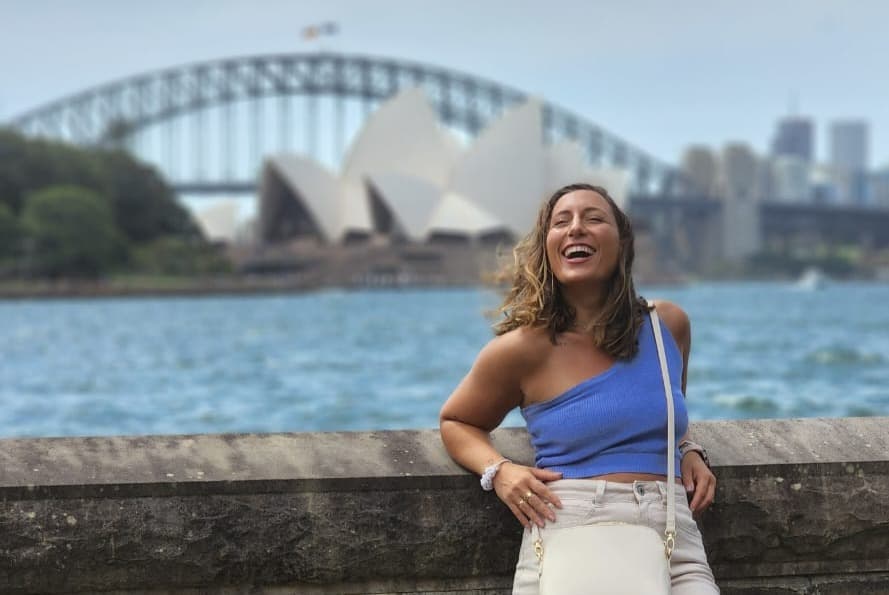
Photo: Olga Hanna-Dzyubchyk and her family departing Berlin airport on their way to Australia as refugees (courtesy).

You might also like
  • Confronting Richard Flanagan and the myth of the Israel lobby
    Mary Garden
  • Facing a new year with the knowledge life can be better
    The Jewish Independent
  • No action to stop Hezbollah ally beaming antisemitic and anti-Israel content into Australia
    Michael Visontay
logomark.67a07ee3
We believe in the free flow of information

Republish our articles for free, online or in print, by using our Creative Commons licence

You might also like

    neo-nazis white supremacists corowaTEST
    Royal CommissionOpinionAustralia

    Antisemitism, homophobia and a radical response to both

    Dennis Altman
    Beinart Doogue 600
    Israel Hamas WarNewsAustralia

    Beinart takes a wrecking ball to Israel

    Michael Visontay 2
    Albanese Bondi
    Royal CommissionAnalysisAustralia

    Prime minister’s absence exposes weakness in Royal Commission hearings

    Michael Visontay

About the author

Special Correspondent

More from the author

OpinionAustralia

I’m being gaslighted – and I’m too scared to put my name to this article

FeatureArts & Culture

When Shane met Mina: the making of a (non-Jewish) Yiddish star

Three federal politicians attended rally where antisemitic speech given