Aa
  • Read, Watch, Listen
  • TJI Series
  • Community Action
  • Events
  • Zedi
Follow us and continue the conversation
  • LinkedIn
  • Instagram
  • FaceBook
  • X
  • YouTube
Test yourself with the TJI Quiz!

Adjust size of text

Aa

Follow us and continue the conversation

  • LinkedIn
  • Instagram
  • FaceBook
  • X
  • YouTube

Your saved articles

You haven't saved any articles

What are you looking for?

Original reporting, insightful analysis and diverse views, delivered straight to your inbox

  • LinkedIn
  • Instagram
  • FaceBook
  • X
  • YouTube
Your support fuels our mission to inform, entertain and inspire.

The Jewish Independent is bound by the Standards of Practice of the Australian Press Council. If you believe the Standards may have been breached, you may approach The Jewish Independent or make a complaint to the Australian Press Council in writing at www.presscouncil.org.au. The Council may also be contacted on 1800 025 712.

  • Our Story
  • Contact us
  • Our Team
  • Support us
  • Guidelines
  • Pitch your idea
  • Republishing us
  • Community Action
  • Our Awards
  • LinkedIn
  • Instagram
  • FaceBook
  • X
  • YouTube
Aboriginal FlagTorres Strait Islanders Flag

The Jewish Independent acknowledges Aboriginal and Torres Strait Islander peoples as the Traditional Owners and Custodians of Country throughout Australia. We pay our respects to Elders past and present, and strive to honour their rich history of storytelling in our work and mission.

© The Jewish Independent 2026All Rights Reserved
Website design and development by Your Creative, MelbourneTerms & ConditionsPrivacy Policy
HomeRead, Watch, ListenIsrael
Israel Hamas WarExplainerIsrael

Gaza hospital bombing: global outrage, Israeli indifference

At least five journalists were among 20 people killed in Israel’s “double-tap” bombing of Gaza’s Nasser Hospital. The war is the deadliest ever for journalists.
TJI Wrap
Print this
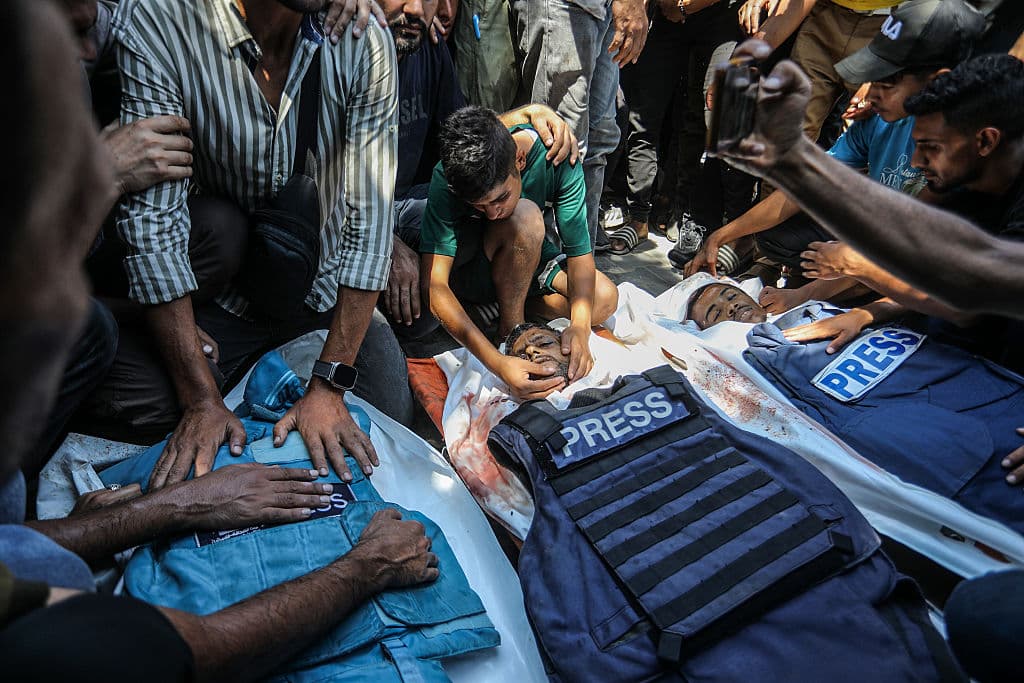
3 bodies, covered with Press vests, surrounded by mourners.

A funeral ceremony in the courtyard of Nasser Hospital for Reuters photojournalist Hossam al-Masri, Al Jazeera cameraman Mohammed Salameh, journalist Maryam Abu Deqqa, journalist Moaz Abu Taha, all of whom were killed in an Israeli attack on the hospital in Khan Yunis, Gaza on August 25, 2025 (Abed Rahim Khatib/Anadolu via Getty Images)

Published: 28 August 2025

Last updated: 9 September 2025

Israel bombed the main hospital in southern Gaza on Monday and then struck the same spot again as rescuers and nearby journalists rushed to help the wounded. The strikes killed at least 20 people, including five journalists, according to Gazan health officials.

The first strike hit the top floor of a building at Nasser Hospital, killing Reuters journalist Hussam al-Masri and others. Journalists and rescuers then rushed to the scene, where a second bomb struck the same spot 15 minutes later.

A live video from Al Ghad TV captured the moments of the killings, showing civil defence workers in bright orange vests and journalists raising their hands to shield themselves seconds before the second bomb hit. A second video showed the aftermath, with the bodies of first responders and journalists lying on top of one another, bloody and covered in dust.

According to Hamas’ government-run Ministry of Communications, the journalists killed were Hussam al-Masri, a Reuters photographer in Gaza; Muhammad Salama, a photographer for Al Jazeera; Moaz Abu Taha; and independent journalist Mariam Abu Daka, who had more than 200,000 Instagram followers. The ministry said they were killed while covering events at the hospital. Sources in Gaza reported that two additional strikes followed in the same area as civil defence teams were evacuating victims from the first explosion.

Prime Minister Benjamin Netanyahu issued a statement in English calling the strike a “tragic mishap”. He said Israel “deeply regrets” the loss of life, values the work of journalists and medical staff, and is conducting a “thorough investigation”. He added: “Our war is with Hamas terrorists. Our just goals are defeating Hamas and bringing our hostages home.”
IDF preliminary investigation raises questions

Shooting at a hospital requires authorisation from someone with the rank of major general. According to initial IDF inquiries, it appears no such approval was granted Ynetnews reported. The army said the strike was directed at people holding cameras on the roof, who had been seen there several times in recent days. The assumption was that this was a Hamas observation post monitoring Israeli troops.

Hebrew media later reported that IDF Southern Command had only authorised a drone strike on a Hamas surveillance camera but had not approved the use of tank shells, which ultimately caused the deaths, including those of journalists. According to reports, Golani Brigade troops first identified the Hamas-installed camera, believed to be monitoring troop movements. Southern Command approved a drone strike to neutralise it. Shortly afterwards, troops spotted what they thought was a rifle scope, assessed it as an immediate threat, and urgently sought approval to fire.

The division commander authorised tank fire, but Southern Command had not. In the end, two shells were fired at the site, followed by two more after armed men were identified, for a total of four. Footage from the scene showed rescuers engulfed in smoke after a second blast struck those rushing to aid victims of the initial strike.

Israel did not provide evidence for its claim, nor explain why the first strike was followed minutes later by a second. The site is regularly used by reporters and news outlets for live streaming, and Israel did not clarify whether it had attempted to distinguish between journalists’ cameras and the alleged Hamas device. Following these findings, IDF Chief of Staff Lt. Gen. Eyal Zamir ordered the probe expanded to scrutinise the strike approval process, including timing, munitions used, and the chain of decision-making. A military spokesperson later told Reuters that the journalists killed were not “a target of the strike”.

International outrage

The UN has demanded accountability, with spokesperson Thameen Al-Kheetan saying: “There needs to be justice. The killing of journalists in Gaza should shock the world — not into silence, but into action.”

The Foreign Press Association also condemned the strike, saying the shells “hit the exterior staircase of the hospital where journalists frequently stationed themselves with their cameras” and “came with no warning.”

US President Donald Trump said he was “not happy about it” but had not yet been briefed while UK Foreign Secretary David Lammy wrote on X: “Horrified by Israel’s attack on Nasser Hospital. Civilians, healthcare workers and journalists must be protected. We need an immediate ceasefire.”

Indifference in Israel

While Prime Minister Benjamin Netanyahu and the Israeli army apologised for Monday’s shelling of Nasser Hospital in Gaza’s Khan Younis, the incident drew mixed reactions inside Israel. Several Israeli journalists cast doubt on the victims’ status as journalists, with some even justifying or praising the strike.

Haaretz’s Amos Harelwrote that after nearly two years of war — which began with Hamas’ massacre on 7 October and continued through months in which large numbers of Palestinian civilians were killed daily by IDF fire without official explanations — the hospital incident was met with near indifference within Israel.

Responding belatedly to Western condemnation and critical international coverage, Netanyahu issued an expression of regret — but only in English. The IDF Spokesman, Brig. Gen. Effie Defrin, also conveyed regret in English. Observers noted that neither addressed the Israeli public directly in Hebrew, suggesting little interest in fostering domestic accountability.

Instead, Israeli television channels framed the event differently: Channel 12 reported that eight of the dead were identified as terrorists and reminded viewers that hostages had once been held at the hospital.  Channel 14, unusually, criticised Netanyahu for a “delusional announcement” — though the criticism came from a commentator rather than the channel itself. On i24NEWS, Arab affairs analyst Zvi Yehezkeli went further, arguing that the slain journalists were “Nukhba terrorists in every sense” because of their professional work documenting the war. He suggested that by filming hunger and highlighting Hamas’s narrative, they inflicted severe “cognitive damage” on Israel. He stated “It may be that the message in striking the so-called ‘journalists’ is the realisation in Israel of how much damage was done by those who broadcast the images of hunger and Hamas’ one-sided narrative, continuing the legacy of Yahya Sinwar in the guise of journalism.” Yehezkeli described the Palestinian reporters as “Nukhba-journalists” who shaped international perceptions of the conflict in ways that helped Hamas gain legitimacy. He concluded: “If Israel has decided to eliminate the journalists, better late than never.”

Journalists in Gaza

Foreign journalists have been banned from entering Gaza since October 2023, leaving Palestinian reporters to cover events. Reporters Without Borders has declared Gaza the most dangerous place in the world for journalists and called for an emergency UN Security Council meeting.

The deadliest day for journalists in the war was two weeks ago, when six — five of them with Al Jazeera — were killed in a targeted Israeli strike. Other high-profile casualties include Hamza Dahdouh, Ayat Khadoura, Hossam Shabat, and Fatima Hassouna, a photojournalist killed in May just a day after learning that a documentary about her life was to premiere at Cannes.

READ MORE

Israel's latest attack in south Gaza has taken the death toll of Palestinian journalists to 240 (ABC)

'Exhausted, hungry, and scared': What it's like to be a journalist in Gaza (BBC)

Was the ‘double tap’ attack on Gaza’s Nasser hospital a war crime? Here’s what the laws of war say (James Sweeney, The Conversation)

'Better late than never': Israeli journalists hail killing of Palestinian colleagues in Gaza (Haaretz)

Despite Israelis' indifference, deadly strike on Gaza hospital could change the course of the war (Amos Harel, Haaretz)

IDF probe finds troops acted without authorization in Gaza hospital strike (Ynetnews)

You might also like
  • Israel election explainer: the main parties
    Shahar Burla
  • Sanctioning settlements is a defence of Israel, not an attack
    Elisheva Madar
  • Sanctions must influence, not just perform disapproval
    Adam Slonim
logomark.67a07ee3
We believe in the free flow of information

Republish our articles for free, online or in print, by using our Creative Commons licence

You might also like

    ISRAEL-LGBTQ-PRIDE-PARADE-PALESTINIAN-CONFLICT-HOSTAGES
    NewsIsrael

    LGBT asylum seekers caught between Palestinian violence and Israeli bureaucracy

    Jarod Rhine-Davis
    Erdogan Turkey
    AnalysisIsrael

    Turkey emerges as military threat to Israel

    Dror Doron
    Woman with land and houses behind her
    NewsAustralia

    Australia to increase sanctions against West Bank settlements

    Deborah Stone 2

About the author

TJI Wrap

TJI Wrap

TJI wraps consolidate essential news and analysis from multiple sources into digestable summaries.

More from the author

NewsAustralia

War crimes allegations against Australian IDF soldier

NewsWorld

Wave of attacks on Jewish sites sparks international alarm

AnalysisIsrael

Gaza, Lebanon, Syria, Iran: Israel’s tense security landscape

AnalysisIsrael

Middle East on edge as Iran and Israel inch closer to another war

Comments

No comments on this article yet. Be the first to add your thoughts.