Aa
  • Read, Watch, Listen
  • TJI Series
  • Community Action
  • Events
  • Zedi
Follow us and continue the conversation
  • LinkedIn
  • Instagram
  • FaceBook
  • X
  • YouTube
Test yourself with the TJI Quiz!

Adjust size of text

Aa

Follow us and continue the conversation

  • LinkedIn
  • Instagram
  • FaceBook
  • X
  • YouTube

Your saved articles

You haven't saved any articles

What are you looking for?

Original reporting, insightful analysis and diverse views, delivered straight to your inbox

  • LinkedIn
  • Instagram
  • FaceBook
  • X
  • YouTube
Your support fuels our mission to inform, entertain and inspire.

The Jewish Independent is bound by the Standards of Practice of the Australian Press Council. If you believe the Standards may have been breached, you may approach The Jewish Independent or make a complaint to the Australian Press Council in writing at www.presscouncil.org.au. The Council may also be contacted on 1800 025 712.

  • Our Story
  • Contact us
  • Our Team
  • Support us
  • Guidelines
  • Pitch your idea
  • Republishing us
  • Community Action
  • Our Awards
  • LinkedIn
  • Instagram
  • FaceBook
  • X
  • YouTube
Aboriginal FlagTorres Strait Islanders Flag

The Jewish Independent acknowledges Aboriginal and Torres Strait Islander peoples as the Traditional Owners and Custodians of Country throughout Australia. We pay our respects to Elders past and present, and strive to honour their rich history of storytelling in our work and mission.

© The Jewish Independent 2026All Rights Reserved
Website design and development by Your Creative, MelbourneTerms & ConditionsPrivacy Policy
HomeRead, Watch, ListenIsrael
Israel Hamas WarAnalysisIsrael

Gaza, Lebanon, Syria, Iran: Israel’s tense security landscape

Clashes have increased in Gaza this week but the most dramatic action came on the northern border in Israel's targeted killing of a top Hezbollah leader.
TJI Wrap
Print this
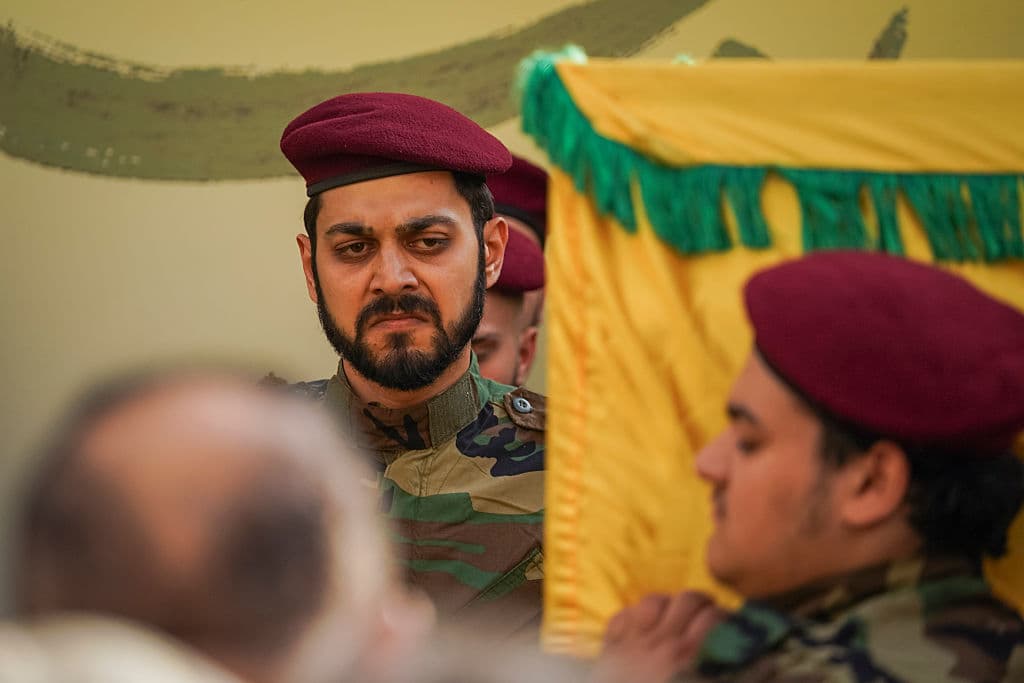
Hezbollah funeral Beirut

Hezbollah militants carrying a coffin of one of Israel’s November 24, 2025 strike on Beirut, which killed Lebanon. Hezbollah confirmed that its top military commander Haytham Ali Tabatabai (Adri Salido/Getty Images)

Published: 27 November 2025

Last updated: 27 November 2025

Despite the October ceasefire, violence is continuing in Gaza, Lebanon, Syria and through Iran’s regional networks, underscoring how fragile and incomplete the truce remains.

While negotiations over Gaza’s “day after” are stalled, armed clashes, targeted assassinations and regional political manoeuvring have shaped a tense and volatile landscape.

Fighting continues in Gaza

Although a ceasefire formally took effect in early October, clashes between the IDF and Hamas have persisted, and humanitarian conditions remain dire. UNICEF reported on Friday that 280 Palestinians, including at least 67 children, have been killed by Israeli strikes since the truce began, mostly near the Yellow Linedividing Israeli-controlled eastern Gaza from the western area where Hamas is reasserting control. More than 4,000 children require urgent medical evacuation, according to the agency.

Over the past week, the fighting intensified. Heavy tank and armoured fire was reported east of Khan Younis, alongside at least ten airstrikes in the city’s southeast. In eastern Rafah, the IDF conducted a series of operations, including a major strike on Wednesday that killed six militants emerging from a tunnel, followed by ground forces eliminating four more inside a nearby building. Two suspects were arrested. The IDF says it is pushing deeper into Rafah’s tunnel network; over the past week alone, more than 20 militants were killed and eight arrested as they attempted to flee underground infrastructure. Additional cells were caught emerging from shafts on Tuesday and over the weekend.

The ongoing clashes prompted mixed messages from Hamas. Saudi-owned Al Arabiya reported that Hamas warned US envoy Steve Witkoff that the ceasefire “was over” unless fully mutual, declaring “Gaza will not become another Lebanon.” Hours later, Hamas denied issuing any such threat. A US official told Walla that Hamas “has not given up yet” but cannot absorb further Israeli attacks.

Meanwhile, on Tuesday Hamas transferred to Israel, via the Red Cross, the remains of Dror Or, an Israeli hostage abducted on 7 October 2023. Two deceased hostages, one Israeli and one Thai, remain in Gaza.

“Day after” talks stalled

Political progress on Gaza’s future remains frozen. Palestinian and Arab sources told Haaretz that plans for a multinational stabilisation force have stalled because no country is willing to deploy soldiers who might face direct confrontation with Hamas. Without a clear mandate, a political framework or decisions on who governs Gaza, “no country will send soldiers to serve US and Israeli interests,” one Arab source said.

Although Washington continues to promote the multinational-force idea, Haaretz reports that the US has focused on technical aspects while major political disagreements remain unresolved. In Cairo, a senior Hamas delegation is holding talks with Egyptian intelligence, but Palestinian sources say discussions are “going nowhere” without agreement on governance. Many now anticipate a de facto division between areas under Israeli control and zones where Hamas maintains influence.

The Palestinian Authority remains largely sidelined. A proposed committee of senior officials failed to progress due to internal disputes and scepticism about its viability without Arab and international backing, especially from the US, and without clarity on who will assume responsibility for Gaza’s security.

Gaza’s food situation improves slightly, but remains acute

While more food has reached Gaza since the ceasefire, the humanitarian picture remains severe. The UN World Food Programme told Reuters that deliveries still fall far short of need, and winter storms have spoiled and washed away stored supplies.

WFP spokesperson Martin Penner said conditions had improved but were still “dire,” with hundreds of thousands of Palestinians reliant on aid and earlier assessments indicating famine-level hunger for around 500,000 people. Since October, the WFP has brought in 40,000 tonnes of food, but earlier logistical delays mean only 30% of distribution targetshave been met so far.

Hezbollah under pressure

Israel’s strike in Beirut on Sunday, killing Hezbollah’s second-in-command Ali Tabatabai, underscored its determination to dismantle the group’s military infrastructure. A senior Israeli security official described the assassination to Al-Monitor as “a very thick hint” that Israel will not tolerate Hezbollah’s continued rearmament.

It was Israel’s first targeted killing of a top Hezbollah figure since the 2024 ceasefire. As Haaretz’s Amos Harel notes, ceasefire with Hezbollah has been a “relative term”: Israeli strikes resumed almost immediately afterwards, focusing on Hezbollah positions south of the Litani River. Nearly 400 people have been killed in Israeli airstrikes in Lebanon over the past year, mostly Hezbollah operatives, though a strike on a Hamas target in the Ein al-Hilweh refugee camp last week killed 14 Palestinians.

Under the US-mediated agreement, Hezbollah is meant to be disarmed by the end of 2025. But Lebanon’s military has struggled to enforce the terms, and Israel says the group has been accelerating its rearmament. Despite this, Hezbollah has refrained from launching attacks on Israel since the ceasefire, a stance its leadership describes as strategic restraint.

Israeli officials acknowledge the Beirut strike carries risks. Hezbollah’s new leader, Naim Qassem, argues that the future of the group’s weapons must be decided domestically, not imposed by external actors. Israeli analysts warn the assassination could inflame Lebanese anger and pressure Hezbollah to retaliate.

Risk of retaliation rises

Though weakened by the past year’s conflict, with depleted rocket stockpiles and many senior commanders killed, Hezbollah retains the capacity to retaliate. Israeli assessments suggest any response is more likely to occur against Israeli or Jewish targets abroad, avoiding direct confrontation and satisfying domestic pressure for action.

On Monday, the IDF held a high-profile drill along the Lebanon border in the presence of Chief of Staff Eyal Zamir. “We are prepared for any scenario,” he said. “I suggest they don’t try us.”

The Syrian front: politics and pressure

Events in Lebanon are intertwined with developments in Syria, where the Trump administration is trying to promote a normalisation agreement between Israel and Damascus. But Netanyahu has reportedly resisted US pressure. His recent visit to the Syrian side of the Golan Heights, seen by many as deliberately provocative, heightened tensions with the new Syrian regime and served political aims at home. Analysts note that stirring multiple fronts allows Netanyahu to control the public agenda ahead of elections and creates pretexts for delays in his criminal trial. 

Iran’s central role

Across all these theatres Iran remains a central actor. Beni Sabti of Israel’s Institute for National Security Studies told Maariv that Tehran remains in “complete denial” about the consequences of its regional adventures and the result of the "12 days war". While billions flow to Hezbollah, Hamas and other proxies, Iran’s own water, electricity and pollution crises worsen, he said, with a frustrated public lacking organised opposition. “They simply didn’t understand the message of the war,” Sabti explained “Because the leadership remained alive and in office, they tell themselves, ‘We were hit, but nothing happened. The regime is stable, we can continue.’”

Recent intelligence assessments indicate that June’s Israeli and American strikes caused significant damage to Iran’s nuclear program but did not destroy it. Sabti, however, notes that the assassination of several nuclear scientists during the war has slowed Iran’s ability to resume key work. He argues that Iran is now cautious about accelerating its nuclear activities, aware that doing so could provoke the United States.

READ MORE 

Airstrikes, hunger, waiting for evacuation: Gaza's children face a fragile ceasefire (Haaretz) 

Latest Lebanon escalation is an Israeli initiative that serves Netanyahu's interests - and has Trump's blessing (Amos Harel, Haaretz) 

As it prepares for Hezbollah’s retaliation, Israel anticipates limited fighting in Lebanon (Paywall, Ben Caspit, Al-Monitor) 

Gaza's 'day after' talks stalled as death toll mounts (Jack Khoury, Haaretz)

Tense calm in far north as Israel prepares to ‘finish the job’ against Hezbollah (The Guardian) 

You might also like
  • New evidence Netanyahu was warned about October 7
    Shahar Burla
  • Turkey emerges as military threat to Israel
    Dror Doron
  • No action to stop Hezbollah ally beaming antisemitic and anti-Israel content into Australia
    Michael Visontay
logomark.67a07ee3
We believe in the free flow of information

Republish our articles for free, online or in print, by using our Creative Commons licence

You might also like

    haredi street guitar
    Photo EssayArts & Culture

    Jerusalemites through the lens

    Sharon Gabay
    Rozana Beit Oula
    PeacebuildingOpinionIsrael

    Peacebuilding through the eyes of a sceptic

    Ron Finkel
    altalena
    Israel Votes 2026OpinionIsrael

    The Altalena should be a warning, not a political weapon

    Shahar Burla 1

About the author

TJI Wrap

TJI Wrap

TJI wraps consolidate essential news and analysis from multiple sources into digestable summaries.

More from the author

NewsAustralia

War crimes allegations against Australian IDF soldier

NewsWorld

Wave of attacks on Jewish sites sparks international alarm

AnalysisIsrael

Middle East on edge as Iran and Israel inch closer to another war

Comments

No comments on this article yet. Be the first to add your thoughts.