Aa
  • Read, Watch, Listen
  • TJI Series
  • Community Action
  • Events
  • Zedi
Follow us and continue the conversation
  • LinkedIn
  • Instagram
  • FaceBook
  • X
  • YouTube
Test yourself with the TJI Quiz!

Adjust size of text

Aa

Follow us and continue the conversation

  • LinkedIn
  • Instagram
  • FaceBook
  • X
  • YouTube

Your saved articles

You haven't saved any articles

What are you looking for?

Original reporting, insightful analysis and diverse views, delivered straight to your inbox

  • LinkedIn
  • Instagram
  • FaceBook
  • X
  • YouTube
Your support fuels our mission to inform, entertain and inspire.

The Jewish Independent is bound by the Standards of Practice of the Australian Press Council. If you believe the Standards may have been breached, you may approach The Jewish Independent or make a complaint to the Australian Press Council in writing at www.presscouncil.org.au. The Council may also be contacted on 1800 025 712.

  • Our Story
  • Contact us
  • Our Team
  • Support us
  • Guidelines
  • Pitch your idea
  • Republishing us
  • Community Action
  • Our Awards
  • LinkedIn
  • Instagram
  • FaceBook
  • X
  • YouTube
Aboriginal FlagTorres Strait Islanders Flag

The Jewish Independent acknowledges Aboriginal and Torres Strait Islander peoples as the Traditional Owners and Custodians of Country throughout Australia. We pay our respects to Elders past and present, and strive to honour their rich history of storytelling in our work and mission.

© The Jewish Independent 2026All Rights Reserved
Website design and development by Your Creative, MelbourneTerms & ConditionsPrivacy Policy
HomeRead, Watch, ListenAustralia
Australia

‘I had never seen anything like them before’: Sydney’s mysterious rimmomim

Steve Meacham
Print this

Published: 14 December 2021

Last updated: 4 March 2024

Dr Jana Vytrhlik, curator of the Great Synagogue museum in Sydney, takes Steve Meacham on a tour of the collection and waxes lyrical about one of its gems

CZECH-BORN DR Jana Vytrhlik - curator of one of Australia’s least known cultural museums - doesn’t look like a detective. But appearances can be deceptive.

She recently completed her doctoral thesis at the University of Sydney researching the visual legacy of Jewish Sydney in the 19th century and hopes to publish a book on the subject.

Jana’s research began in 2014, when she was still working at Sydney’s Powerhouse Museum, preparing for a lecture about Jewish ornaments for the Silver Society of Australia.

Knowing little about the collection at Sydney’s Great Synagogue, the academic rang the founding curator of the synagogue’s AM Rosenblum Museum to ask if it had any relevant examples she could use to illustrate her talk.

It was then Jana became aware of a mysterious pair of striking rimmonim, the symbolic ritual silverware that adorns the twin poles of the Torah scroll as it is ceremonially dressed and paraded around the synagogue.

Having already gained her first doctorate in her native country while working with the world’s largest Judaica collection in Prague, Jana was astonished when she first spied the Great Synagogue’s rimmonim.

“I had never seen anything like them before,” Jana recalls. “In Prague and central Europe, most of the objects are Ashkenazic. These were very different. More elaborate, gilded and with more little bells, closer to the Sephardic style. “But no-one knew when they had been made, who for, or how they got to Australia.”

Jana resigned from the Powerhouse Museum, where she had worked since she arrived in Australia in 1986 (and had curated Precious Legacy, a 1998 exhibition featuring objects from Prague’s Jewish Museum) to begin a second doctorate.
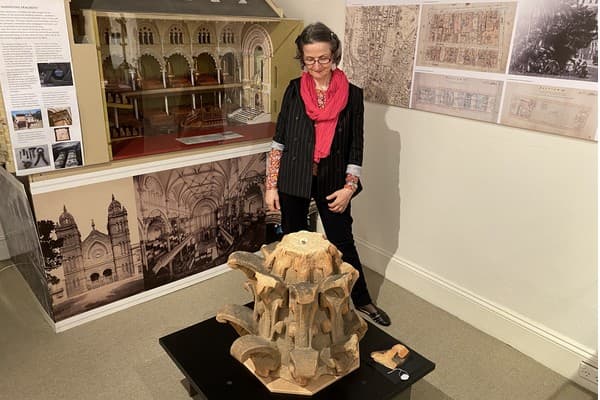
She quickly discovered when and where the rimmonim were made, from the silversmith’s hallmark (Johannes Schouten, 1739–1791). They were crafted crafted in Amsterdam in 1773 for the city’s famous Portuguese Synagogue, serving the Sephardic Jews who fled to the Low Countries after being banished from the Iberian peninsula in 1490.

Dr Vytrhlik with a piece of sandstone that once adorned the centrepiece of the Great Synagogue’s roof until pollution and pigeons took their toll (Steve Meacham)

Research into Jewish community archives in Sydney finally revealed the possibility that in 1842, Sydney’s small Jewish community had purchased two large Torah scrolls and silver ornaments from a London congregation.

The first Jews (at least 15) had arrived in Australia on the First Fleet in 1788, but it wasn’t until 1828 that the first public Jewish service was conducted by Phillip Joseph Cohen in a private house in George Street.

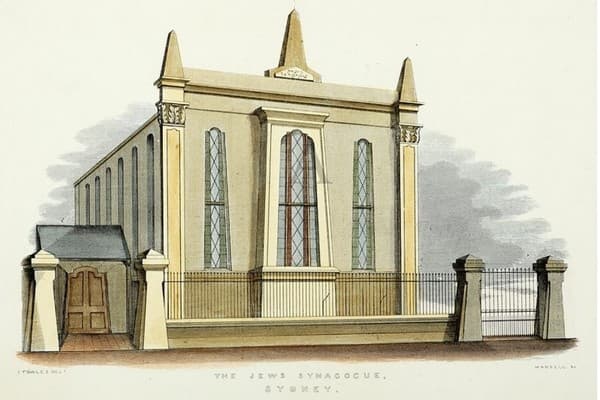
By 1842 Sydney’s Jewish community was sufficiently large and affluent (with major benefactors including former convicts) to lay the cornerstone of the city’s first purpose-built synagogue. Designed by James Hume in the Egyptian style, it was in York Street, near the current Queen Victoria Building.

York Street Synagogue, 1848: Joseph Fowles included this hand-coloured etching in his book Sydney in 1848

“I haven’t discovered the shipping details, but I know how much the rimmonim cost the community and that they arrived in time for the consecration of the Sydney synagogue in 1844,” says Jana.

Sadly, nothing seems to remain of Hume’s synagogue. Once the Great Synagogue was opened in 1878, it became the offices of an insurance company and like much of Australia’s heritage, has since been “redeveloped”.

Once the Great Synagogue was opened in 1878, the York Street synagogue became the offices of an insurance company.

The synagogue’s collection has now grown to around 1200 pieces, ranging over many disciplines: silverware, stonework, textiles, paintings, books and works on paper, photographs and Jewish memorabilia.

“It’s a very mixed collection, but it is unsustainable without more resources,” the curator admits. “Textiles need different conservation practices than works on paper. And we need money to digitise a collection as culturally significant as this.”

She lays out several photographs from the museum’s collection which show the significance of the Great Synagogue when it opened. At the time it was by far the most imposing building in Elizabeth Street, admired by all those strolling in neighbouring Hyde Park.

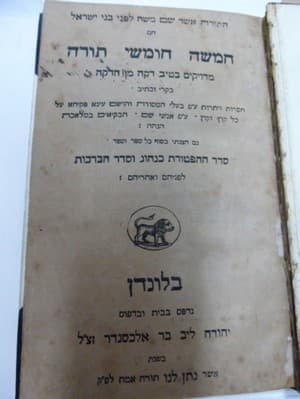
Leather-bound Pentateuch, 1799: Used by Phillip Joseph Cohen for Sydney’s first public Jewish service in 1828.

Over the years, though, it has been dwarfed by the commercial buildings around it. 

One press photo from the museum’s collection shows a policeman signalling tram drivers to slow down as they pass the synagogue to drop off shoppers so the tram’s squealing brakes didn’t interrupt the Shabbat service.

The curator admits it took her time to love the Great Synagogue: “I felt it was too ornate, too much. I grew up going to the old synagogues in Prague. They are more subdued, more melancholic.”

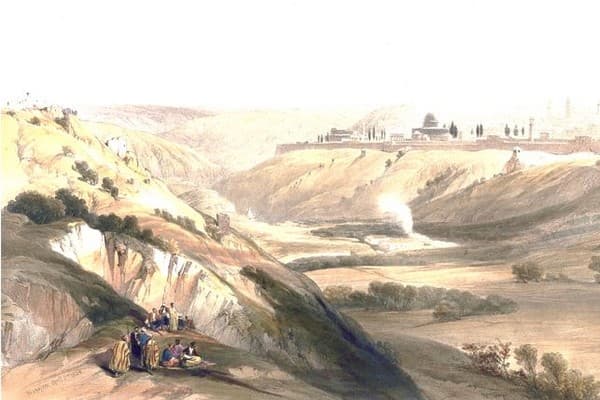
Lithograph of Jerusalem, 1839, by British artist painter David Roberts (1796–1864)

Its architect Thomas Rowe, who also designed Sydney Hospital, was an Anglican, not Jewish, for the simple reason that there were no Jewish architects in Australia back then.

Rowe designed many other churches, though never another synagogue - and the Great Synagogue has often been compared to an ostentatious Baroque-style church.

The AM Rosenblum Museum - named after Abraham and his wife Sadie, and founded by their son Rodney - opened in 1982.

“Jewish museums in Europe usually begin as a result of destruction of the Jewish community - pogroms, deportation, ghetto clearance - gathering items to commemorate something that was lost,” the curator says.

“This museum grew out of growth, out of enthusiasm and a desire to safeguard the objects for future generations.”

As an academic, Jana Vytrhlik is reluctant to talk about herself, rather than the collection which she finds infinitely more fascinating. “I grew up in Prague in a family of Holocaust survivors and in a country where only a few Jews were left. By working with this great Judaica collection, I have come a full circle.”

The academic and curator has her own refugee story. She and her first husband fled Czechoslovakia (as it then was) in 1981.

Their escape showed guile. They booked a one-week group tour to Austria using Jana’s maiden name. Then they married a week before their departure.

“I travelled on my old passport, which was invalid since I was now married,” Jana recalls. “The Czech authorities would never have allowed a young couple to cross the border. 

“We hid our wedding rings but were still virtually strip searched at the border. We arrived in Vienna, just with our backpacks, and we never went back.”

And yes, Jana has now grown to love the Great Synagogue. “I discover something new every time I’m there.”

Main photo: Dr Jana Vytrhlik and the rimmomim, silverware that dresses the twin poles of the Torah

All historical images, courtesy The Great Synagogue

You might also like
  • When the state faltered, civil society and Diaspora Jewry stepped up
    Shahar Burla
  • The case for leaving graffiti up for a while
    Adam Slonim
  • New ‘spoken word’ festival in Sydney offers stories directly from creators
    Miriam Hechtman
logomark.67a07ee3
We believe in the free flow of information

Republish our articles for free, online or in print, by using our Creative Commons licence

You might also like

    vandalism car woollahra fuk israel farhat
    Australia

    Court decision fails to understand when ‘Fuk Israel’ becomes antisemitic

    Jeremie Bracka 2
    ANNIKA WELLS PRESSER
    Israel Hamas WarNewsAustralia

    No action to stop Hezbollah ally beaming antisemitic and anti-Israel content into Australia

    Michael Visontay
    Beinart Doogue 600
    Israel Hamas WarNewsAustralia

    Beinart takes a wrecking ball to Israel

    Michael Visontay 1

About the author

Steve Meacham

Steve Meacham

Steve Meacham is a senior features writer whose work has appeared in many Australian and British publications. He has also written several authorised biographies.

More from the author

Australia

‘Never seen anything like this’: Aussies watched war from their balcony

Arts & Culture

Is this show still funny after so many years? Well, it helps if you’re Jewish

FeatureAustralia

Living – and dying – with motor neurone disease: one family’s story

FeatureArts & Culture

A musical about lynching a Jew is striking a new chord