Aa
  • Read, Watch, Listen
  • TJI Series
  • Community Action
  • Events
  • Zedi
Follow us and continue the conversation
  • LinkedIn
  • Instagram
  • FaceBook
  • X
  • YouTube
Test yourself with the TJI Quiz!

Adjust size of text

Aa

Follow us and continue the conversation

  • LinkedIn
  • Instagram
  • FaceBook
  • X
  • YouTube

Your saved articles

You haven't saved any articles

What are you looking for?

Original reporting, insightful analysis and diverse views, delivered straight to your inbox

  • LinkedIn
  • Instagram
  • FaceBook
  • X
  • YouTube
Your support fuels our mission to inform, entertain and inspire.

The Jewish Independent is bound by the Standards of Practice of the Australian Press Council. If you believe the Standards may have been breached, you may approach The Jewish Independent or make a complaint to the Australian Press Council in writing at www.presscouncil.org.au. The Council may also be contacted on 1800 025 712.

  • Our Story
  • Contact us
  • Our Team
  • Support us
  • Guidelines
  • Pitch your idea
  • Republishing us
  • Community Action
  • Our Awards
  • LinkedIn
  • Instagram
  • FaceBook
  • X
  • YouTube
Aboriginal FlagTorres Strait Islanders Flag

The Jewish Independent acknowledges Aboriginal and Torres Strait Islander peoples as the Traditional Owners and Custodians of Country throughout Australia. We pay our respects to Elders past and present, and strive to honour their rich history of storytelling in our work and mission.

© The Jewish Independent 2026All Rights Reserved
Website design and development by Your Creative, MelbourneTerms & ConditionsPrivacy Policy
HomeRead, Watch, Listen
Opinion

‘I remember looking across the synagogue in Jerusalem and thinking: “That’s why Reform Judaism has it wrong. I can’t stop looking at this girl”’.

Miriam Hechtman
Print this

Published: 4 May 2021

Last updated: 4 March 2024

Australians talk about love, life and Judaism: MIRIAM HECHTMAN asks Mark Morris and Judith Belnick about their journey through life

Mark

Judaism didn’t play a prominent role in my childhood in London. My mum and dad separated when I was five. Mum had converted to Judaism but Dad was never very interested in it. Mum was from France and a lot of her friends were Jewish.

I think she liked that their families were quite strong; her family wasn’t. I think she was always attracted to Judaism. After the separation my mother continued to send me to synagogue, and I had a barmitzvah and all that sort of stuff. But it just didn’t interest me.

Later, I made friends with some Jewish guys and ended up getting involved in the youth movement, Netzer, which changed my life. Going to Israel when I was 16 was a big change for me. Prior to that my only conception of Israel was war.

When I visited, I thought, “here’s this history and culture that is mine and I can link into that”. At the time, I was with a crowd back in London doing stupid things and I wanted out of that.

So this became a way of giving me an identity, something to grab on to and tether me. I felt like my cultural identity was being played out on a state level and a country level, rather than in England where I was a minority.

I met Jude on Shnat (year-long immersion program) in 1990, in a Reform synagogue in Jerusalem. I remember looking across and thinking: “that’s why Reform Judaism has it wrong. I can’t stop looking at this girl, I’m not going to be concentrating on any form of prayer”.

I was 19 she was just 18. We spent three months together and then it hit the first hurdle and there was no conception of how to work on a relationship. I was going back to England, she was going back to Australia. We broke up before that year ended.
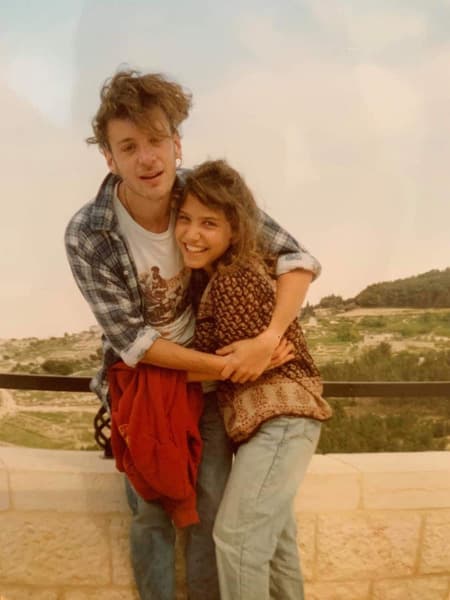
Then in 1995 we met in Israel again, at the same time. I remember thinking “I still really like this girl”. I’ve always had this feeling that she’s a very special person. I wrote Jude a letter saying if we were in the same city, I’d want to give it a go. She wrote back and said she didn’t think we’d be right for each other.

The Jewish Independent

I got on with my life. I made Aliyah but after six years I left Israel and moved back home. Then in 2006, I Googled her. For a few months we emailed. She was in a serious relationship with a guy and he had proposed to her. 

In 2009 I travelled to Melbourne for a wedding. Jude walked into my friend Ravi’s house and Ravi said, ‘Mark tells me you’re married and she says “no, we didn’t get married; we broke it off a year ago”.

There was this explosion in my stomach. Something physical happened to me and then it went straight to the thought of “ah, I could”.

After a few days together, I said, “maybe I could come back and we could check this out.” She replied, “I don’t think we’re destined to be together in this lifetime.’”

I went back to England. Over the next few months we Skyped all the time and eventually she said she would come to England and spend a few weeks together.

We had a really good time and by the end she said, “you should probably come to Australia”. So I booked for three weeks later and we moved in together. Then I was reminded why I was 39 and hadn’t settled down with anybody. I went straight into doubt. I couldn’t commit and I couldn’t not commit.

After two years Jude told me to go back to England to work out what I wanted. Two nights before I left, I found out Jude was pregnant. It was almost like panic, but very quickly I knew “I definitely want this child” and I think that’s what I needed to step into this relationship fully.

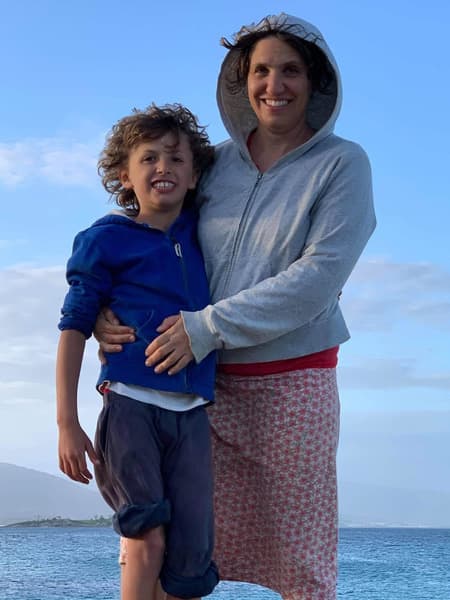
Lev was born and we’ve been together ever since. We’ve moved to Bellingen (on the mid-north coast of NSW) and I really love it here. Jude’s a person with a lot of depth. She’s shown me lots of things about being in the world that have impacted my life. I feel at ease with her.

Judith

Judaism very much played a part in my childhood. When I was five years old we immigrated to Sydney from this little Afrikaaner town called Rustenburg where there were no Jews. We always had Friday night dinners, we weren’t religious but there was a cultural sense of being Jewish. We celebrated all the Jewish festivals. I had a very strong identity.

In Sydney, we were very involved in the Reform synagogue and as soon as I was old enough I started going to Netzer.

I think Mark and I first met in a pub in Jerusalem. I remember seeing this really cute, quirky guy and just being interested. “I want to get to know more,” I thought.

I was very shy. He had already been six months in Israel and I was just finding my feet. I never really found my groove and I think that’s why we didn’t work out then. And I think Mark had this fantasy of who I was and he didn’t really get to know me because there wasn’t much of me to get to know.

When it ended, it was a relief. It was mutual. I was never really comfortable in it. Soon after that I became happier and made more connections. But there was something that connected us because I had a feeling of warmth for him whenever I thought back to him.

I think the person I know him as now is very different to then. I think he had lots of fantasy about who I was. For me that feels really good because he knows me in a real way and I know him in a real way so there’s more chance of connection and intimacy. I think it’s an emotional maturing for both of us.

The things that attracted me when we were younger are still what I like about Mark now. He was funny, he didn’t seem self-conscious. He can be silly without worrying. That’s the complete opposite of me. I love his honesty and I love his sensitivity. He’s very self-perceptive and always strives to be better and do better and I probably didn’t see that so much in him then, as I do now.

Judith and Lev
Judith and Lev

After Mark decided to return to England in 2011, I went to a meditation retreat and I went through a process of letting go of our relationship, of having a potential family. It was letting go of a lot of things and coming to terms with the understanding that my life might not be on the trajectory that I had always wanted it to be on.

I remember calling up Mark and just feeling really at peace with his decision to leave and whatever happened. Whether he came back or not.

Then I got back and found out I was pregnant. It changed Mark completely and utterly. There was no going back for him. That was it, which was amazing. When Lev was born it was the best time in our relationship. We were more in love than we’ve ever been.

We’re very committed to making it work and to doing our own work within that. We communicate really well. We don’t leave things to fester. We balance each other in some way. I’m looking forward to having more time to connect with Mark again.

You might also like
  • Growing up Jewish in regional Australia
    Noa Granek
  • Speedy Shatari: a leader for LGBTQ+ visibility
    Ruby Kraner-Tucci
  • Controversy over pro-Palestinian advocate judging multicultural award
    Michael Visontay
logomark.67a07ee3
We believe in the free flow of information

Republish our articles for free, online or in print, by using our Creative Commons licence

You might also like

    Feature

    Israel bows to pressure by restoring water flow, ICC investigates both sides

    TJI Wrap
    tame kostakidis west
    AnalysisAustralia

    How not to apologise

    Zac Klugman
    Israel Hamas War

    IDF: Hamas will steal fuel for tunnel ventilation systems and rockets

    TJI Wrap

About the author

Miriam Hechtman

Miriam Hechtman

Sydney-based Miriam Hechtman is an Australian writer, creative producer and poet. She is the founder and creative director of Poetica, a live poetry and music initiative and co-presenter and producer of WORDSMITH – the poetry podcast.

More from the author

FeatureArts & Culture

Yiddish poetry finds new audience through Bashevis Singers

FeatureArts & Culture

New ‘spoken word’ festival in Sydney offers stories directly from creators

FeatureArts & Culture

A circle of communal healing on stage, with a dash of humour

FeatureArts & Culture

Not so secret mother’s business