Aa
  • Read, Watch, Listen
  • TJI Series
  • Community Action
  • Events
  • Zedi
Follow us and continue the conversation
  • LinkedIn
  • Instagram
  • FaceBook
  • X
  • YouTube
Test yourself with the TJI Quiz!

Adjust size of text

Aa

Follow us and continue the conversation

  • LinkedIn
  • Instagram
  • FaceBook
  • X
  • YouTube

Your saved articles

You haven't saved any articles

What are you looking for?

Original reporting, insightful analysis and diverse views, delivered straight to your inbox

  • LinkedIn
  • Instagram
  • FaceBook
  • X
  • YouTube
Your support fuels our mission to inform, entertain and inspire.

The Jewish Independent is bound by the Standards of Practice of the Australian Press Council. If you believe the Standards may have been breached, you may approach The Jewish Independent or make a complaint to the Australian Press Council in writing at www.presscouncil.org.au. The Council may also be contacted on 1800 025 712.

  • Our Story
  • Contact us
  • Our Team
  • Support us
  • Guidelines
  • Pitch your idea
  • Republishing us
  • Community Action
  • Our Awards
  • LinkedIn
  • Instagram
  • FaceBook
  • X
  • YouTube
Aboriginal FlagTorres Strait Islanders Flag

The Jewish Independent acknowledges Aboriginal and Torres Strait Islander peoples as the Traditional Owners and Custodians of Country throughout Australia. We pay our respects to Elders past and present, and strive to honour their rich history of storytelling in our work and mission.

© The Jewish Independent 2026All Rights Reserved
Website design and development by Your Creative, MelbourneTerms & ConditionsPrivacy Policy
HomeRead, Watch, Listen
Feature

‘If our children leave, there is no future for Palestine. I want them to stay’

Michael Visontay
Print this

Published: 5 April 2022

Last updated: 4 March 2024

Huda Abu Arqoub was keynote speaker at Pathways to Hope, a public discussion in Sydney about building peace from conflict in Northern Ireland and the Middle-East

“THE AVERAGE AGE in the West Bank is 20; in Gaza it is 16. Our children have seen no peace; they know no peace. At the first chance they get, they want to leave.

“I don’t want my 33 nieces and nephews to leave Palestine. I want them always to know that they are Palestinians and they have the right to live in Palestine.

“And my way of doing that, of taking responsibility, is to liberate myself and in the process of doing that, liberate the oppressor.

These were the dramatic opening sentences of Huda Abu Arqoub’s stirring address at the Pathways to Hope public discussion held in Sydney last Thursday that explored how to build peace out of intractable conflict, in Northern Ireland and the Middle-East.
The Jewish Independent

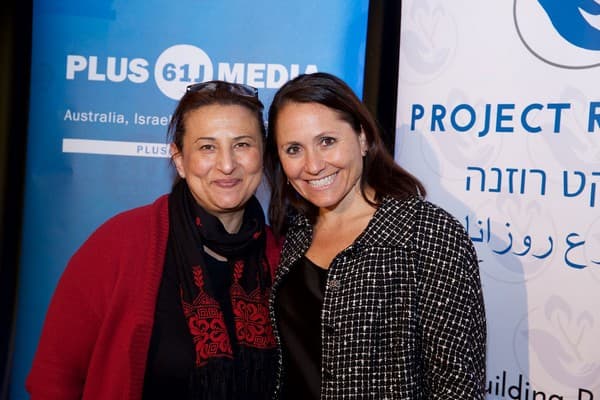
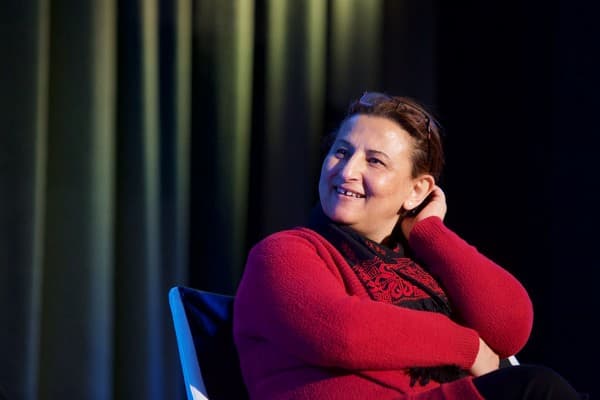
Abu Arqoub is the Regional Director of the Alliance for Middle East Peace (ALLMEP) and was the keynote speaker at a lively panel discussion in Bankstown, hosted by Rotary District 9675, in partnership with The Jewish Independent and Project Rozana.

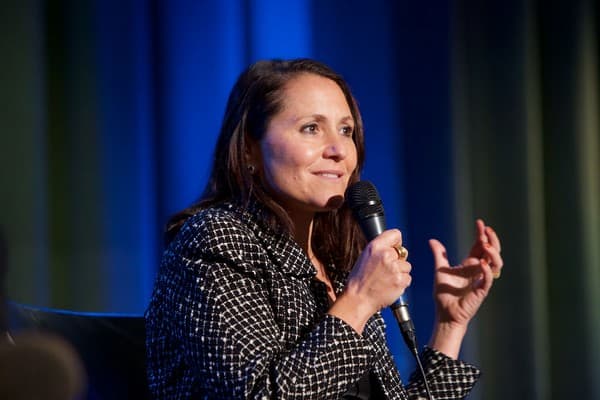
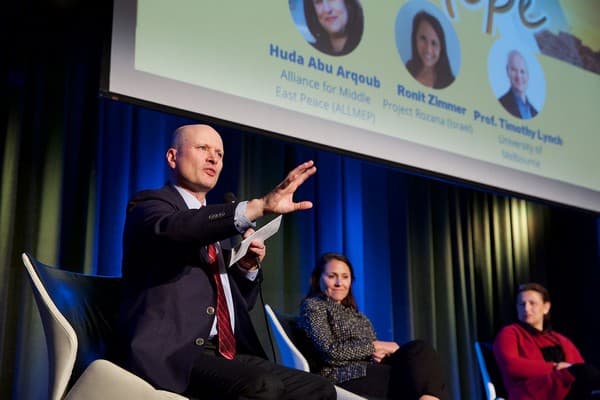
In her first visit to Australia, Abu Arqoub, who represents 160 members of ALLMEP who work in people-to-people peacebuilding, was joined on stage by Ronit Zimmer, the Executive Director of Project Rozana in Israel, and Professor Timothy Lynch, from Melbourne University, who is a scholar of the Northern Ireland peace process.
“The Palestinians are not victims; the Palestinians are survivors,” Abu Arqoub continued. “They are strong proud people and they deserve peace.

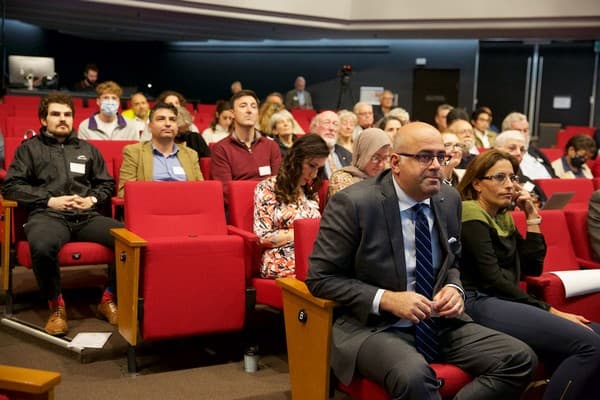
The audience at Pathways to Hope

“As a Palestinian, as a Muslim, and informally as a Christian and Jew, and I have no conflict with any of those values, I urge you to stand by the Palestinians and by the Israelis in their journey to be liberated. We are still in that desert trying to find a way out of it.”

One of ALLMEP’s key peacebuilding initiatives is Project Rozana, which brings Palestinians and Israelis together through health. “That is where we can make a difference, when [Palestinians] need access to the health system,” Ronit Zimmer told the audience.

Project Rozana, an Australian-founded NGO has initiated many innovative people-to-people peacebuilding projects, during the first wave of the Covid pandemic, raising funds to provide ventilators to the first ever dedicated Covid-19 Intensive Care Unit in the town of Dura, near Hebron in the West Bank.

More recently, the work of Project Rozana and ALLMEP led to the opening of a medical care facility in Dura which involved co-operation with the Palestinian Ministry of Health and the Palestinian Foreign Ministry.

The Jewish Independent

Professor Timothy Lynch (above), from Melbourne University, used his knowledge of Northern Ireland to provide an insightful counterpoint to the Middle-East.

Why did the Northern Ireland peace process work, he asked rhetorically?

He named several reasons: there was an overseas country (the US) to unlock the conflict (“it was Bill Clinton’s signal foreign policy achievement”) and there was the release of political prisoners on both sides.

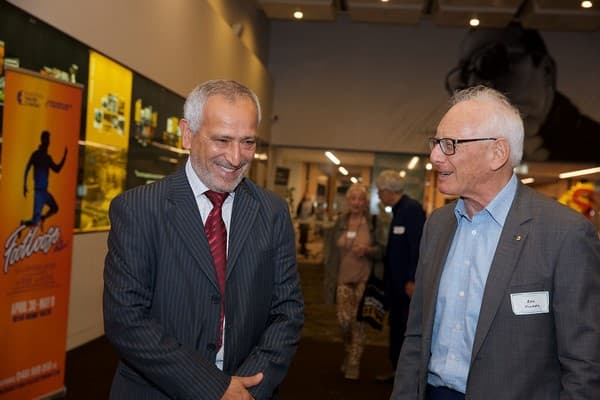
Sydney Muslim community leader Dr Jamal Rifi (left) and Project Rozana founder Ron Finkel

Lynch also said “sheer exhaustion” was an important factor that brought both sides to the table in Northern Ireland. “Men saw their sons doing the same thing they had done, and they thought ‘this is not working’,” he told the audience.

However, he was sanguine about whether the lessons of Northern Ireland could be applied to the Israeli-Palestinian conflict. “In the Middle East the stakes are much higher: they are existential.”

“It’s hard to believe Hamas and Likud could be in government together and trust each other.”

The Jewish Independent

Lynch said the question of trust is central. “In a peace process the important part is not peace but the process. The process is the peace.

“You must recognise that the process causes the peace.”

Photo: Huda Abu Arqoub (far right) speaks at the panel discussion, with Professor Timothy lynch (left) and Ronit Zimmer, from Project Rozana (centre)

All photos by Giselle Haber

You might also like
  • Peacebuilding through the eyes of a sceptic
    Ron Finkel
  • When the state faltered, civil society and Diaspora Jewry stepped up
    Shahar Burla
  • The case for leaving graffiti up for a while
    Adam Slonim
logomark.67a07ee3
We believe in the free flow of information

Republish our articles for free, online or in print, by using our Creative Commons licence

You might also like

    Web Banner – Andrew Casey Internship

    Andrew Casey Memorial Internship Program

    Paul Amato
    Australia’s Prime Minister Albanese Speaks After Bondi Shootings
    News

    What PM, Premier, Police say about Bondi antisemitic attack

    The Jewish Independent 1
    tame kostakidis west
    AnalysisAustralia

    How not to apologise

    Zac Klugman

About the author

Michael Visontay

More from the author

NewsAustralia

Matt Chun’s hate speech prompts change in arts funding policy

AnalysisAustralia

Mishandled antisemitism education is not just ineffective, it’s dangerous

FeatureLifestyle

Where Shtisel meets The Jetsons

ReviewIsrael

Beinart’s utopian vision ignores awkward truths