Aa
  • Read, Watch, Listen
  • TJI Series
  • Community Action
  • Events
  • Zedi
Follow us and continue the conversation
  • LinkedIn
  • Instagram
  • FaceBook
  • X
  • YouTube
Test yourself with the TJI Quiz!

Adjust size of text

Aa

Follow us and continue the conversation

  • LinkedIn
  • Instagram
  • FaceBook
  • X
  • YouTube

Your saved articles

You haven't saved any articles

What are you looking for?

Original reporting, insightful analysis and diverse views, delivered straight to your inbox

  • LinkedIn
  • Instagram
  • FaceBook
  • X
  • YouTube
Your support fuels our mission to inform, entertain and inspire.

The Jewish Independent is bound by the Standards of Practice of the Australian Press Council. If you believe the Standards may have been breached, you may approach The Jewish Independent or make a complaint to the Australian Press Council in writing at www.presscouncil.org.au. The Council may also be contacted on 1800 025 712.

  • Our Story
  • Contact us
  • Our Team
  • Support us
  • Guidelines
  • Pitch your idea
  • Republishing us
  • Community Action
  • Our Awards
  • LinkedIn
  • Instagram
  • FaceBook
  • X
  • YouTube
Aboriginal FlagTorres Strait Islanders Flag

The Jewish Independent acknowledges Aboriginal and Torres Strait Islander peoples as the Traditional Owners and Custodians of Country throughout Australia. We pay our respects to Elders past and present, and strive to honour their rich history of storytelling in our work and mission.

© The Jewish Independent 2026All Rights Reserved
Website design and development by Your Creative, MelbourneTerms & ConditionsPrivacy Policy
HomeRead, Watch, ListenIsrael
NewsIsrael

Israel is cementing its control over the West Bank and East Jerusalem while the world is distracted

Israel plans to build 1,200 housing units in the West Bank's E1 area, a move that threatens to bisect the territory and undermine a future Palestinian state.
Martin Kear
Print this
settler outpost west bank

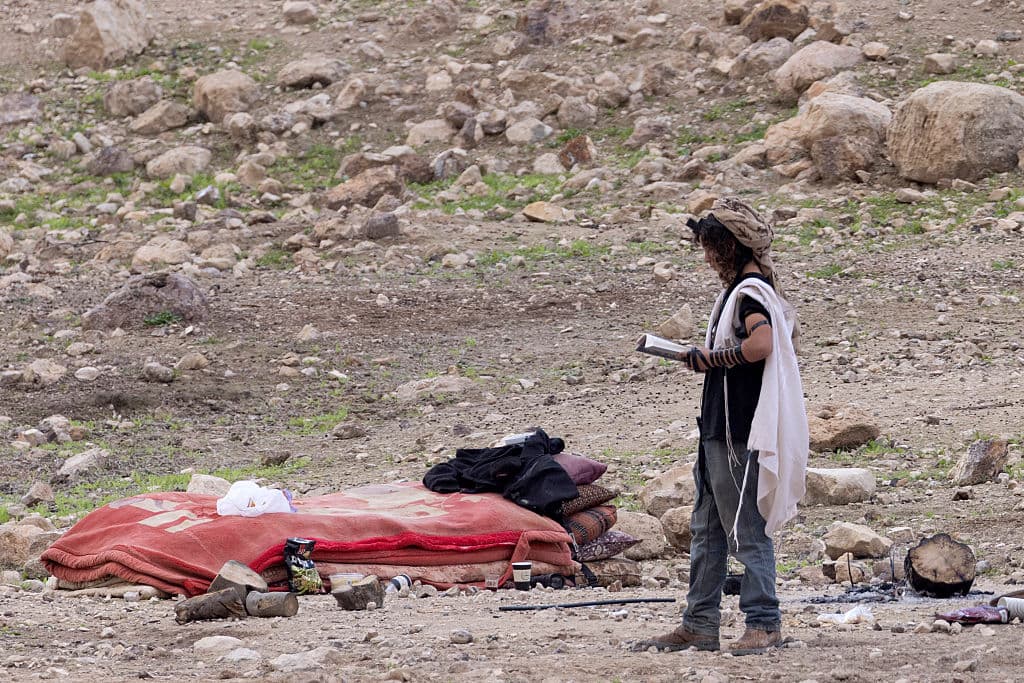
An Israeli right-wing settler prays near his belongings in an outpost, erected inside the land of a Palestinian Bedouin community in Ras Ein al-Auja near the city of Jericho in the West Bank (ILIA YEFIMOVICH / AFP via Getty Images)

Published: 31 August 2026

Last updated: 31 August 2026

With the world’s attention focused on the ongoing US-Iran conflict and the delicate negotiations over the fate of Gaza, it’s easy to overlook what’s happening in the other occupied Palestinian territories.

In recent days, the Israeli government has given final approval to a plan to build a new settlement in an area of the West Bank known as E1, east of Jerusalem. The government has opened up tenders for the construction of some 1,200 housing units.

Settlements in E1 would effectively split the West Bank into two parts, cutting off the Palestinian city of Ramallah in the north from Bethlehem in the south. It would also separate East Jerusalem from the rest of the West Bank. Palestinians consider East Jerusalem an indispensable part of any future Palestinian state.

Israel’s far-right finance minister, Bezalel Smotrich, indicated this was precisely the point. He said every new settlement in the West Bank puts “another nail in the coffin” of a Palestinian state.

Israel has held off on approving settlements in E1 for decades due to international pressure, particularly from previous US administrations that have tried to maintain the possibility of a future Palestinian state, however remote.
A joint statement by nearly two dozen Western nations condemned the move to develop E1 last week and called “for its immediate reversal in the strongest terms”.

However, with Prime Minister Benjamin Netanyahu’s political fortunes waning in the lead-up to elections in October, it appears he is willing to risk international opposition to shore up votes at home, with the belief the Trump administration will shield Israel diplomatically.

The move comes amid rising violence from Israeli settlers against Palestinians in the West Bank, which has led to at least 80 deaths this year.https://flo.uri.sh/story/3801560/embed

Earlier this month, settlers laid siege to the homes of Palestinian families in the village of Qusra. They cut off water and electricity supplies, damaged orchards and prevented the families from leaving their homes.

The international reaction was swift. Even the US ambassador to Israel, Mike Huckabee, a longtime supporter of Israeli settlements, denounced what he called the “inexcusable and repugnant” actions of the settlers in Qusra.

The Israeli police, however, didn’t make any arrests. And the Israeli soldiers sent to the area threw clothing belonging to a families out of the window of their homes.

Expanded settlements in West Bank

The situation in Qusra is emblematic of a rapidly deteriorating security situation for Palestinians across the West Bank since the October 2023 attacks by Hamas and Israel’s invasion of Gaza.

The United Nations estimates thousands of Palestinian homes have been demolished, seized or sealed by Israeli soldiers or settlers. Tens of thousands of people have been displaced.

In June, Amnesty International published a report arguing settler attacks are not being conducted by rogue extremists, but are instead an integral part of an organised state policy. The report concludes the Israeli government is actively engaged in the ethnic cleansing of Palestinians in the West Bank.

Since October 2023, Israel has also expropriated more Palestinian land and expanded the construction of settlements that are considered illegal by many states under international law.

In 2024, Peace Now, an Israeli activist group that tracks settlement expansion, revealed that Israel had declared 23 square kilometres of the West Bank as state land. This was the largest transfer of land to Israeli control in decades. Such declarations mean Palestinians cannot own the land; instead, the government can lease it to Israelis.

And earlier this year, the Israeli Security Cabinet approved 34 new settlements in the West Bank. This brings the total number of settlements established since Netanyahu’s right-wing government came to power in 2022 to more than 100.

Steady incursions at East Jerusalem holy site

In addition to the proposed building of settlements in the E1 area, Israel is also seeking to assert its sovereignty over Haram al-Sharif/Temple Mount, the site of the al-Aqsa Mosque compound and Western Wall. The site in the Old City of Jerusalem is sacred for Jews, Muslims and Christians.

Israel captured East Jerusalem from Jordan in 1967. In their 1994 peace agreement, Israel agreed that Jordan would retain custodianship of the site.

Under the agreement, only Muslims have the right to pray in the compound that contains the al-Aqsa Mosque. Jews are permitted to pray at the Western Wall.

The issue of access to the compound is so sensitive that Palestinians consider any entry by Israelis to be extremely provocative. It’s seen as an assertion of Israeli sovereignty over the third-holiest site in Islam and an essential part of any future Palestinian state. https://www.youtube.com/embed/aWWt_tH7lZs?wmode=transparent&start=0 Right-wing Israeli rabbi accused of provocation at Jerusalem holy site.

For example, when then-Opposition Leader Ariel Sharon visited the compound in 2000 accompanied by hundreds of police, it was considered one of the sparks of the Second Intifada (2000–05).

In 2021, when Israeli security forces prevented thousands of Palestinians from praying at the compound during Ramadan, it triggered a brief, deadly conflict between Israel and Hamas in Gaza.

And last month, Israeli National Security Minister Itamar Ben-Gvir, accompanied by armed police and more than 4,000 supporters, entered the Temple Mount site to pray and wave Israeli flags. Ben-Gvir said “everywhere, people understand that the State of Israel is the sovereign authority” at the site.

Jordan has been very concerned by these persistent Israeli incursions. On August 5, it convened an emergency meeting of Arab and Muslim foreign ministers to discuss what it called the “imminent” threat of an Israeli takeover of the site.

Jordan’s foreign minister also warned that any attempt by Israel to alter the status quo at the site “could trigger a religious conflict that could reverberate beyond Palestine and Jordan into the whole Muslim world”.

What all of this means

This pattern of events shows the Israeli government is trying to change the “facts on the ground” in the the West Bank and East Jerusalem. It is doing this by expelling Palestinians from what little territory they still inhabit and asserting sovereignty over Palestinian lands and religious sites. This would make any future Palestinian state impossible.

If these actions continue, they will be the death knell for any chance at peace between Israel and the broader Muslim world.

This article is republished from The Conversation under a Creative Commons license. Read the original article.

You might also like
  • Abuse by IDF soldiers humiliates Muslim Palestinians
    Ben Lynfield
  • Beinart takes a wrecking ball to Israel
    Michael Visontay
  • Zomi investigation delivers new low in Australia-Israel relations
    Michael Visontay
logomark.67a07ee3
We believe in the free flow of information

Republish our articles for free, online or in print, by using our Creative Commons licence

You might also like

    Palestinians Inspect Fire-Damaged Home Following Settler Attack Near Nablus
    OpinionIsrael

    The West Bank After Tel: a line in the sand has been crossed

    Mohammad Asideh
    Protest government election
    Israel Votes 2026FeatureIsrael

    ‘Elections are not a civil war’: the democracy threats worrying Israelis

    Shahar Burla 1
    fly to vote
    Israel Votes 2026OpinionIsrael

    Flying to vote is an act of love, not impudence

    Shahar Burla

About the author

Martin Kear

Martin Kear

Martin Kear is a lecturer in the Department of Government and International Relations at the University of Sydney.

Comments

No comments on this article yet. Be the first to add your thoughts.