Aa
  • Read, Watch, Listen
  • TJI Series
  • Community Action
  • Events
  • Zedi
Follow us and continue the conversation
  • LinkedIn
  • Instagram
  • FaceBook
  • X
  • YouTube
Test yourself with the TJI Quiz!

Adjust size of text

Aa

Follow us and continue the conversation

  • LinkedIn
  • Instagram
  • FaceBook
  • X
  • YouTube

Your saved articles

You haven't saved any articles

What are you looking for?

Original reporting, insightful analysis and diverse views, delivered straight to your inbox

  • LinkedIn
  • Instagram
  • FaceBook
  • X
  • YouTube
Your support fuels our mission to inform, entertain and inspire.

The Jewish Independent is bound by the Standards of Practice of the Australian Press Council. If you believe the Standards may have been breached, you may approach The Jewish Independent or make a complaint to the Australian Press Council in writing at www.presscouncil.org.au. The Council may also be contacted on 1800 025 712.

  • Our Story
  • Contact us
  • Our Team
  • Support us
  • Guidelines
  • Pitch your idea
  • Republishing us
  • Community Action
  • Our Awards
  • LinkedIn
  • Instagram
  • FaceBook
  • X
  • YouTube
Aboriginal FlagTorres Strait Islanders Flag

The Jewish Independent acknowledges Aboriginal and Torres Strait Islander peoples as the Traditional Owners and Custodians of Country throughout Australia. We pay our respects to Elders past and present, and strive to honour their rich history of storytelling in our work and mission.

© The Jewish Independent 2026All Rights Reserved
Website design and development by Your Creative, MelbourneTerms & ConditionsPrivacy Policy
HomeRead, Watch, ListenIsrael
ReflectionIsrael

‘Israelis aren’t thinking about peace or what Gaza will look like the day after’

I saw a country united by trauma and unable to see past its collective pain. My visit was a stinging reminder of how privileged we are in the diaspora.
Ziggy Enoch
Print this
What we know about the hostage deal

Published: 26 February 2024

Last updated: 21 March 2024

I saw a country united by trauma and unable to see past its collective pain. My visit was a stinging reminder of how privileged we are in the diaspora.

On February 1, I arrived in Tel Aviv feeling a complicated mix of emotions. I had the privilege to join 16 Australian Jewish Youth Leaders on a week-long tour of post-October 7 Israel. We hoped to help our communities at home understand the Israeli experience of the war.

Since October 7, I have struggled to cohere my many conflicted feelings about the war. The constant stream of violence and scale of destruction has horrified me, but I share in the anxiety and pain felt by my community in the wake of the massacres and the world’s response to them.

In Israel I felt honoured by the opportunity to represent my community, but constantly guilty that I wasn’t doing enough. As an Israeli citizen living abroad, I am exempt from military service until I return to the country permanently. My final experience before departing was an acute reminder of the privilege of that exemption.

When I tried to get through passport control departing Ben Gurion airport, I was told that the army was looking for me. The woman behind the desk took my passport and glanced dryly down at my exemption document before instructing me to sit and wait. Convinced that I would miss my flight, I sat anxiously for 40 minutes before they eventually waved me through without an issue. So ended a very challenging week.

I hadn’t been back to Israel since my year-long Shnat program in 2020. I arrived to find a country that was deeply changed. The atmosphere was one of sobriety and pain. Wounds are still fresh. People are still processing. Many talked about the country falling into a “conception”: arrogance and denial had led the nation into a false confidence, and at the most socially-divided point in Israel’s history, its citizens paid an enormous price for their complacency. 
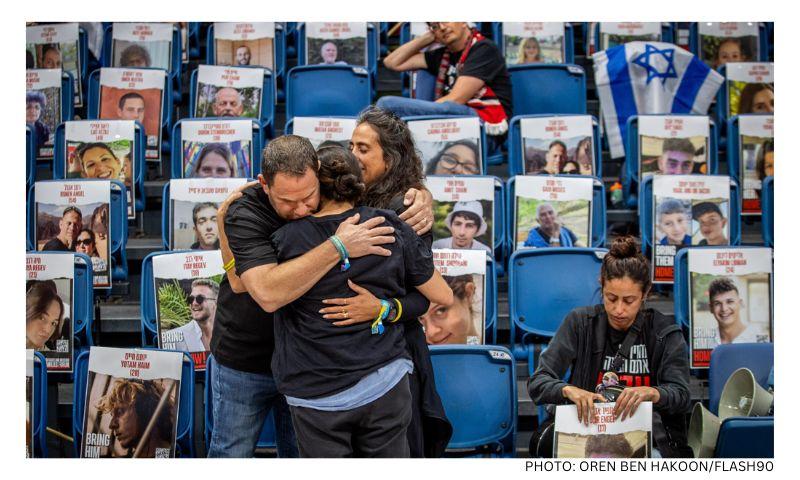
Trust in the government has evaporated. Everyone we MET said they felt the government and army had failed them.

Wherever I looked, there was a message of new unity on billboards and buses: “United to Victory”. This sentiment was cogent and widespread, reflecting Israelis’ near consensus support of the war. There is a strong sense that the immense division over the judicial crisis that preceded the war contributed to its outbreak and severity. 

Many English language commentators have declared that the country would shift rightward. I think this is true, but I also feel that the severity of the disunity which preceded it will prompt Israeli politics to be much more centrist and pragmatic going forward. 

There is a wartime solidarity across the country, but Israel is enveloped in active trauma. The pain of October 7 is yet to settle, and the unresolved hostage situation is a stark obstacle to closure. People everywhere are wearing dog-tags that say “Our hearts are hostage in Gaza”. 

The frustration of the hostage issue is compounded by the fact of the ongoing war, and the consistent anxiety felt by those who have loved ones in active service. People are not thinking about peace, or hope, or what Gaza will look like the day after. This is in part due to the fog of war and pain that is so dense across the country. It’s also because as yet they have been denied any opportunity to do so. 

Trust in the government has completely evaporated. Everyone we talked to about October 7 said they felt the government and army had failed them categorically. Extremist partisanship had sought to repress the Gaza issue in favour of securing settlements in the West Bank, and military hubris meant that a host of warnings signalling impending attack were ignored. In the end it took far too long for the military to respond, and Israelis are coldly aware of that fact and its consequences.  

Unsurprisingly, trust between Israelis and their neighbours has been devastatingly wounded. It will take a long time to recover, and the scale of pessimism is ominous. Before the war, 60,000 Gazans came in and out of Israel every day to work. That will not resume. Inter-communal relations in the country have become unsurprisingly strained. It broke my heart to hear a family friend shrug their shoulders, defeated, and describe the war as endless. 

Upon visiting Kibbutz Be’eri, I could not blame a single Israeli for their anger or their pessimism. We saw empty strollers on the porches of scorched houses; a football still wedged onto a portion of a roof where the rest had caved in. We also saw a house where IDF tanks, trying to eliminate the terrorists inside, had killed a dozen trapped hostages. 

We were awed by the resilience of our guide, Danny, who spoke the language of regrowth with a strength you could never expect of someone standing outside the house where their sister was murdered just months before. He spoke with anger too. The intermittent shelling just across the border punctuated everything he said, and it filled me with grief. 

It broke my heart to hear a friend shrug their shoulders, defeated, and describe the war as endless. 

At Re’im, much closer, we could feel the explosions in our chest. It pained me greatly to think that every impact had a target. I dread the kind of future that the innocents of Gaza have been handed by Hamas and by the IDF’s response. I doubt that the language of regrowth will be as persuasive in a city of rubble. 

We ended that day in Rahat. We were all exhausted, but the bleakness of the day was somewhat relieved by the person we met there: a Bedouin Israeli Arab Woman named Aisha. She ran a joint Jewish/Arab women’s empowerment organisation called Switch, and worked to coordinate support services and resources across the region’s communities. She spoke about her work and the many directions in which the war had pulled her. 

Her perspective was unique, as she described the turmoil of having both relatives that are suffering in Gaza and ones that are serving in the IDF. Aisha made us feel a sense of rejuvenated hope that we did not expect. Things are complicated, and we are all in pain. We are all just humans navigating this mess. If she could hope for a better future, then so could we. 

Upon visiting Kibbutz Be’eri, I could not blame a single Israeli for their anger or their pessimism.

It was an overwhelming week. Perhaps equally overwhelming was the knowledge all those we met had been living this experience for months. We felt it was a solemn honour to bear witness to the pain and violence that has unfolded since October 7. Travelling to Israel was a stinging reminder of how privileged we are in the diaspora that we can choose which battles we are ready and willing to fight. For Israelis, there is no such privilege. 

You might also like
  • The Israelis who flew home to vote
    Gideon Cohen
  • Flooding and illness increase urgency of humanitarian relief in Gaza
    Shahar Burla
  • Australia’s latest sanctions raise the stakes, but stay on track
    Deborah Stone
logomark.67a07ee3
We believe in the free flow of information

Republish our articles for free, online or in print, by using our Creative Commons licence

You might also like

    August Victoria Hospital
    PeacebuildingOpinionIsrael

    My vision for Palestinian cancer patients

    David Adler
    Joint list
    AnalysisIsrael

    Unlikely bedfellows: How Arab parties could deliver Israel’s next government

    Ben Lynfield 1
    Eisenkot Herzog
    Israel Votes 2026NewsIsrael

    Diaspora Jews urge Israel’s change bloc to form a Jewish–Arab coalition

    Sharon Offenberger 2

About the author

Ziggy Enoch

author