Aa
  • Read, Watch, Listen
  • TJI Series
  • Community Action
  • Events
  • Zedi
Follow us and continue the conversation
  • LinkedIn
  • Instagram
  • FaceBook
  • X
  • YouTube
Test yourself with the TJI Quiz!

Adjust size of text

Aa

Follow us and continue the conversation

  • LinkedIn
  • Instagram
  • FaceBook
  • X
  • YouTube

Your saved articles

You haven't saved any articles

What are you looking for?

Original reporting, insightful analysis and diverse views, delivered straight to your inbox

  • LinkedIn
  • Instagram
  • FaceBook
  • X
  • YouTube
Your support fuels our mission to inform, entertain and inspire.

The Jewish Independent is bound by the Standards of Practice of the Australian Press Council. If you believe the Standards may have been breached, you may approach The Jewish Independent or make a complaint to the Australian Press Council in writing at www.presscouncil.org.au. The Council may also be contacted on 1800 025 712.

  • Our Story
  • Contact us
  • Our Team
  • Support us
  • Guidelines
  • Pitch your idea
  • Republishing us
  • Community Action
  • Our Awards
  • LinkedIn
  • Instagram
  • FaceBook
  • X
  • YouTube
Aboriginal FlagTorres Strait Islanders Flag

The Jewish Independent acknowledges Aboriginal and Torres Strait Islander peoples as the Traditional Owners and Custodians of Country throughout Australia. We pay our respects to Elders past and present, and strive to honour their rich history of storytelling in our work and mission.

© The Jewish Independent 2026All Rights Reserved
Website design and development by Your Creative, MelbourneTerms & ConditionsPrivacy Policy
HomeRead, Watch, ListenIsrael
Israel Hamas WarOpinionIsrael

Israel’s media is betraying its duty on Gaza

Israel's public is not getting the full picture on Gaza because the media is intimidated and overreliant on the IDF.
Anat Saragusti
Print this
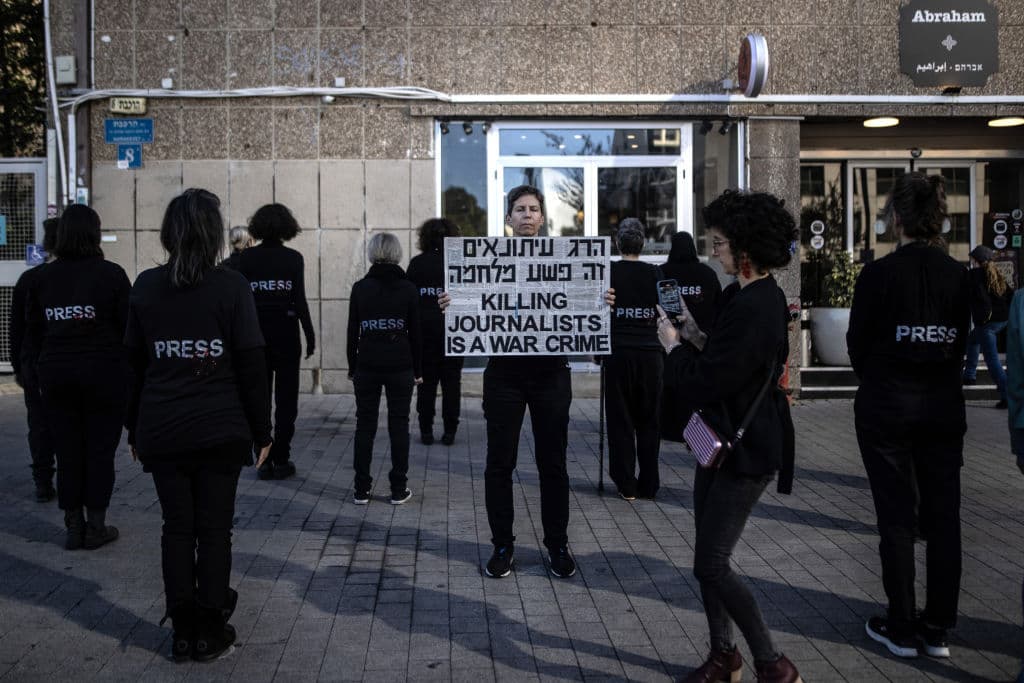
A woman in black holding a sign that reads 'Killing journalists is a war crime' in Hebrew and English, in front of several people in black with their backs to the camera and the word 'Press' printed on their shirts.

A protest in support of Palestinian journalists in Tel Aviv in January 2025 (Mostafa Alkharouf/Anadolu via Getty Images)

Published: 20 August 2025

Last updated: 20 August 2025

At the beginning of August 2025, the Israeli army targeted a well-known Al Jazeera journalist, Anas al-Sharif, in Gaza, killing him and four other journalists in an airstrike. Immediately afterward, a spokesperson for the Israel Defense Forces (IDF) issued a statement claiming that al-Sharif was not an innocent journalist, but a Hamas militant. The spokesperson attached evidence of al-Sharif being a registered member of Hamas's operational division, which served as a justification for the targeted killing of him and other Palestinian journalists in Gaza.  

Not long after, a few well-known Israeli journalists published reports on the killing, celebrating it on their social media accounts. Others simply repeated word-for-word the text dictated by the IDF spokesperson. None of these journalists questioned the information given by the IDF official, fact-checked it, or even asked why al-Sharif was killed and not put on trial if there was evidence against him. 
This incident encapsulates all the dilemmas, contradictions, and wrongdoings of Israel's mainstream media when covering the war in Gaza. Journalists report statements from the IDF spokesperson as if they were solid truth, fail to question the official narrative, ignore the other side, celebrate successes, and view the "other side" solely through the prism of an enemy, even when the victim is an uninvolved woman, a toddler, or a journalist.  

This approach does not reflect professional journalism.  

Glaring absence

It is no secret that Israel's mainstream media is not covering the war in Gaza from the Palestinian perspective and is not fulfilling its duty to serve the public's interests. By not providing the full picture, the Israeli media is betraying its duty.  
Covering the humanitarian crisis in Gaza does not mean identifying with or supporting Hamas. The gap between what the international community sees happening in Gaza and what the Israeli public sees has never been deeper.  

Since October 7, 2023, and until a few weeks ago, there have been only a handful of news stories in Israel's mainstream media depicting the reality of the war from the Palestinian perspective.  

These reports hardly covered the scale of the humanitarian crisis in Gaza, the immense number of casualties, and the countless homes that have been destroyed.  

A recent leak from a closed WhatsApp group of senior editors and reporters at Israel's Channel 12 News provided a behind-the-scenes look at the editorial decision-making process regarding war coverage in Gaza. This internal correspondence revealed a discussion about whether the country's most-watched news program should ignore the situation beyond the conflict lines or if it was their duty as journalists to report on the situation in Gaza, even if they dislike doing so or could not identify with the suffering of the Palestinians. Unfortunately, most senior editors in the group believed it was right not to cover the humanitarian situation in Gaza. 

However, it was not long before they could no longer ignore the Palestinians. Reports on severe famine in Gaza, including photos of emaciated children, made headlines all over the world. World leaders held Israel accountable, and protests calling on Israel to end the war spread to cities worldwide. Even journalists in the mainstream media could no longer ignore these reports; they had to reflect the reality in Gaza.  

The challenge of good journalism

Covering Gaza is challenging. Israel strictly prevents journalists from entering Gaza independently. Local and foreign journalists can only enter Gaza under the umbrella of the IDF spokesperson, who can shape and influence the coverage. Furthermore, military censorship is imposed on all media outlets and journalists working in and from Israel.  

To cover Gaza properly and professionally, one must make an extra effort. This includes collecting digital information remotely, finding reliable sources, fact-checking everything, investing time and resources, and questioning all official statements until they can be verified. Media outlets worldwide do this routinely. A New York Times team was awarded a Pulitzer Prize last year for this type of coverage.  

However, only the daily newspaper Ha'aretz provides this type of coverage in Israel. Other media outlets prefer not to dig too deep.  

Government intimidation

Most mainstream media outlets in Israel prefer not to show those images because journalists and local media outlets are intimidated. They lack the courage to face a backlash, fearing they might be accused of treason or of being Hamas supporters, that they might annoy their audience, and, most of all, that they might be targeted by a toxic smear campaign from the "poison machine" operated by Prime Minister Netanyahu's closest advisors, family members, and political allies.  

Haaretz was subject exactly to that. The government imposed economic sanctions on Haaretz, to weaken its sustainability because the editorial is too critical.  

So, even when they had no choice but to cover the developing famine and starvation in Gaza, the Israeli media preferred to echo the government's statements that there was no famine and that claims of starvation are the result of an orchestrated campaign by Hamas to pressure Israel.  

Israeli journalists are also adopting a form of self-censorship, which is impossible to quantify. 

Voices for better

It is important to note that recently, there have been strong voices within Israeli society, including key activists and academics, calling on the mainstream media to do its job. There are daily demonstrations in front of the main studios of the country's leading TV channels, urging them to stop ignoring Gaza. Many media outlets worldwide have already written about it, discussed it, and asked questions.  

In their turn, major media outlets are calling on the Israeli government to grant foreign press access to Gaza, to allow journalists to see if there is famine, to let them collect evidence and data, and to hear the voices of Palestinians independently.  

There is no neutrality here. By not covering what is going on in Gaza, the Israeli media prevents its audience from understanding the magnitude of the event and from forming their own informed opinions about the war.  

Moreover, and perhaps more importantly, lack of effective media coverage strengthens the government's stance that all protests and demonstrations against Israel, and the diplomatic pressure applied to it, are antisemitic and not legitimate criticism of Israeli government policy.

While there are some isolated cases of antisemitism, Israel is rapidly losing its status and the support of the democratic nations - and not because everyone is antisemitic. 

You might also like
  • The Altalena should be a warning, not a political weapon
    Shahar Burla
  • Turkey emerges as military threat to Israel
    Dror Doron
  • Because of my Zionist values, I’m joining an Arab party
    Yoav Segalovitz
logomark.67a07ee3
We believe in the free flow of information

Republish our articles for free, online or in print, by using our Creative Commons licence

You might also like

    Segalovitz Abbas
    Israel Votes 2026AnalysisIsrael

    Segalovitz decision to join Arab party is a paradigm change for Israel

    Eetta Prince-Gibson
    ISRAEL-TRANSPORT-AVIATION-STRIKE
    Israel Votes 2026AnalysisIsrael

    Bennett’s balancing act: can he win over the right without losing the centre?

    Shahar Burla 1
    Marwan Barghouti demonstration
    Israel Hamas WarAnalysisIsrael

    Palestinians disillusioned with Hamas and armed struggle: new survey

    Shahar Burla

About the author

Anat Saragusti

Anat Saragusti

Anat Saragusti is a Israeli journalist, commentator, a documentarian and editor. She was on journalistic assignment in Gaza, Beirut, Ramallah, Aman, and Cairo. She runs freedom of the press for the Journalists Union of Israel.

Comments2

  • Avatar of Jack

    Jack22 August at 05:05 am

    The reference to the New York Times having won media awards and being held up as an exemplar of good reporting on Gaza is questionable. NYT parroting of Hamas lies about the Al Ahli hospital and recent front page lead on a child without noting pre existing medical conditions and well fed sibling and parent, suggests it is no exemplar.

  • Avatar of Ian Light

    Ian Light21 August at 03:44 am

    Not only Haaretz but also the Times of Israel the Jerusalem Post i24 News and the Protests in Israel have expressed deep concern and the result is a just and humane reversal of the harsh policy from March 2025 of stopping the trucks Now reports of 300-400 Trucks a day are entering Gaza .
    Will the New York Times CNN ABC and SBS report on this far more Humane Policy ?