Aa
  • Read, Watch, Listen
  • TJI Series
  • Community Action
  • Events
  • Zedi
Follow us and continue the conversation
  • LinkedIn
  • Instagram
  • FaceBook
  • X
  • YouTube
Test yourself with the TJI Quiz!

Adjust size of text

Aa

Follow us and continue the conversation

  • LinkedIn
  • Instagram
  • FaceBook
  • X
  • YouTube

Your saved articles

You haven't saved any articles

What are you looking for?

Original reporting, insightful analysis and diverse views, delivered straight to your inbox

  • LinkedIn
  • Instagram
  • FaceBook
  • X
  • YouTube
Your support fuels our mission to inform, entertain and inspire.

The Jewish Independent is bound by the Standards of Practice of the Australian Press Council. If you believe the Standards may have been breached, you may approach The Jewish Independent or make a complaint to the Australian Press Council in writing at www.presscouncil.org.au. The Council may also be contacted on 1800 025 712.

  • Our Story
  • Contact us
  • Our Team
  • Support us
  • Guidelines
  • Pitch your idea
  • Republishing us
  • Community Action
  • Our Awards
  • LinkedIn
  • Instagram
  • FaceBook
  • X
  • YouTube
Aboriginal FlagTorres Strait Islanders Flag

The Jewish Independent acknowledges Aboriginal and Torres Strait Islander peoples as the Traditional Owners and Custodians of Country throughout Australia. We pay our respects to Elders past and present, and strive to honour their rich history of storytelling in our work and mission.

© The Jewish Independent 2026All Rights Reserved
Website design and development by Your Creative, MelbourneTerms & ConditionsPrivacy Policy
HomeRead, Watch, Listen

Kea’s confronting doco: giving a voice to Australian Jews who question Zionism

Dashiel Lawrence
Print this

Published: 4 June 2021

Last updated: 4 March 2024

DASH LAWRENCE asks Sydney woman Kea Cranko what drove her to make a documentary on this taboo subject, and what she learned about herself in doing so

IT TAKES A BRAVE PERSON to tackle the State of Israel or Zionism publicly in Australia – especially when you’re Jewish. What comes next is often unpleasant and painful: locked out of Jewish communal spaces; ostracised by family members; condemned privately as a traitor and self-hating Jew.

These dissenting Jewish voices soon learn a salient lesson: call yourself Jewish, critique Zionism and you will pay a price. It’s the lesson others – across time and diasporas, from philosopher Hannah Arendt to former Australian governor-general Sir Isaac Isaacs – have discovered.

This is the path Kea Cranko is now walking. The bright and curious 23-year-old from Sydney’s inner west has just released In Dialogue: Jews on the Borderlands - a self-funded, largely self-made documentary film about Australia’s non-Zionist Jewish Left.

Cranko, who went to the Emanuel School and has a degree in sociology, says she wanted to “give a voice and a platform form to a specific Jewish identity, that very much exists in the Australian Jewish community, but has gone by largely unnoticed.” 

The hour-long documentary opens with its most intriguing and compelling scene. Seated in the office of her father, Peter, Kea asks what he makes of her film project.

“It’s confronting to me, it makes me uncomfortable,” Peter tells his daughter.

Though sympathetic, he warns her of falling into a trap; of being reactive to something she doesn’t support.

The Cranko family, originally from Johannesburg in South Africa, arrived in Australia in the early 2000s. Peter was involved in anti-apartheid circles. He clearly understands both the need to and the cost of taking a principled stand.  

The scene, although constructed, is unvarnished. It symbolises the generational divide that often runs across Shabbat tables. Moreover, it cuts to the heart of something many viewers will be asking: why put opposition to Israel and Zionism at the centre of your Jewish identity?
I started off angry and reactive; as I met more people, and discovered how many different iterations of being Jewish there are out there, the more I softened my message.

It’s a question that Kea spends much of the next hour reckoning with.

She admits to starting off the project “angry and reactive; I wanted to expose the Jewish establishment.”

Over time, she tells The Jewish Independent, she understood she wanted to tell “a more nuanced story”.

“As I deep-dived into the topic, and I met more people, and discovered how many different iterations of being Jewish there are out there, the more I softened my message.

“It became about me wanting to platform an alternative way of being Jewish – less oppositional and more positive.” 

In Dialogue spotlights non-Zionist and anti-Zionist Jewish activists and their rejection of Australian Jewry’s defacto support for the State of Israel. The film captures their involvement in BDS protests at Max Brenner cafes, protesting Australia’s treatment of refugees and counter-rallying against far-right campaigners in the streets of Melbourne.

There’s Sydney woman Vivienne Porszolt; the child of Jewish refugees, who under the banner of Jews Against the Occupation, has spent years leading a small band of Jews at Palestinian solidarity rallies.

Melbourne man Max Kaiser, a historian who co-founded the collective Jews Against Fascism, shares his story of resuscitating Melbourne Jewry’s anti-fascist past. 

Younger voices like Chaya Kasif and Clare RM speak to an emerging generation that are unsettled by the Zionist focus of their Jewish education and communal spaces.

Each subject is searching for an authentic, principled way of being Jewish.  Most have developed a thick skin and were unambivalent about telling their stories.

“Generally, the people I spoke to were really very open about sharing their story,” Cranko explains.

“Many of them have been in the game for a while and have been called all the names before, so they weren't too worried.”

Others, particularly the younger ones, took some convincing. Several liberal Zionists, who believe in the need for a Jewish state but are greatly concerned with Israel’s current trajectory, were approached to be interviewed but declined.

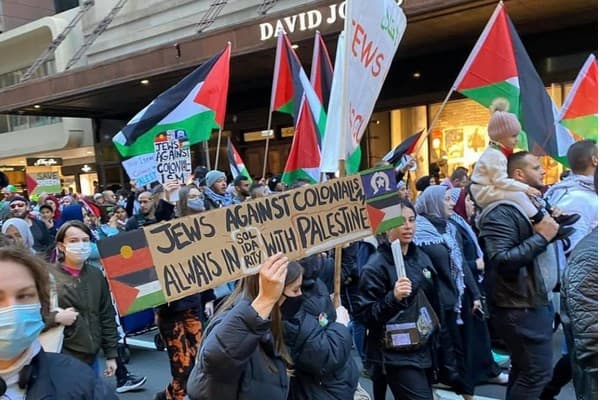
Jews march in solidarity with Palestinians in Melbourne after Israel's recent conflict with Hamas (screenshot)

Their voices would have addressed one of the self-admitted flaws of Cranko’s film: the way Zionism, a complex and historically divergent movement, is reduced to a monolith. It’s a criticism she has heard from many, and accepts as fair.

“They think, and this is a valid critique, that I treat Zionism as a homogenous entity. Perhaps my documentary doesn’t do justice to that plurality.”

In the film’s second half, the narrative takes an unexpected and important turn, albeit briefly, when it explores the problem of antisemitism on the Left.

Clare shares a disturbing story of a late-night assault in February 2017 at the hands of a group of Left-wing activists and anarchists in Sydney’s Marrickville.

The takeaway for Clare: “if Jewish people aren’t safe in the diaspora, Zionism will seem like the only alternative.”

It became about me wanting to platform an alternative way of being Jewish – less oppositional and more positive.

Although the film soon moves in a different direction, it stumbles on an enduring problem ­for Left-wing parties and groups in Australia and globally: an unwillingness to hear a Jewish narrative of suffering. Jews are perennially cast as aggressor. Zionism is seen as a violent settler project, akin to the worst form of European colonialism. The reality that Israel is both the answer to and the culmination of centuries of violence and dispossession, is dismissed.

It is this profound lack of empathy and deafness to the narrative of others, that leaves many anti-Zionist voices, Jewish or not, open to the charge of inconsistency at best, and at worse, bigotry.

One of the film’s main interviewees, the Melbourne-based historian and former member of the Australian Jewish Democratic Society, Jordy Silverstein, gets it:

“I totally understand why people are Zionist – I was a Zionist. My mum still is and most of my family still is. People want the idea of a place where they feel like they’re not going to get killed.

“That’s real,” Silverstein acknowledges.

Silverstein’s response, however, is to seek an end to the Zionist project.

“Our safety lies in decolonisation – the safety of all people lies in decolonisation. That has to be the starting point of a community politics.”

Such a confronting proposition will appeal to very few Australian Jews – a diaspora in which the connection with Israel and Zionism is deep and abiding. Most identify as Zionists and have visited Israel at least once in their lifetime.

It's a valid critique that I treat Zionism as a homogenous entity. Perhaps my documentary doesn’t do justice to that plurality.”

Only rarely, such as the botched mishandling of the Maccabiah Bridge collapse in 1997, has the bond between Israel and Australian Jews been seriously called into question.    

In the end though, In Dialogue is just that: a provocation to question the status quo.  Disagree with the film’s findings, by all means, but enter into a dialogue. That’s Cranko’s hope.

By the end of the film, we learn Cranko has reconnected with her Eastern European Jewish heritage. Like many non- and anti-Zionists before her, she’s excavated the rich non-Zionist past of the International Labour Bund and Yiddishkeit.  She is learning Yiddish, much to the delight of her ageing Litvak grandmother. She is also exploring Jewish rituals that align with her idea of God.

Peter Cranko is pleased – if relieved – that the documentary has been the catalyst for a deeper engagement with Jewishness.  

In a few months, Cranko will pack her bags and move to Melbourne to begin a Masters degree in Jewish Cultural Practice at the Australian Centre for Jewish Civilisation, Monash University.

A new project and a new community await.  

In Dialogue: Jews on the Borderlands is now available to watch online

More information can be found at the film’s Facebook page.

READ MORE

Why I disagree with my Jewish family about Israel's politics (VICE Belgium)

Four young Jewish people describe reconciling their own beliefs with their families' views on the Israel-Palestine conflict

Main photo: Kea Cranko

You might also like
  • Freedom Rides: Allyship for dark times
    Eliezer Rubenstein Sturgess
  • Israel now faces 138 sanctions across 63 countries
    Shahar Burla
  • Brazilian Jews treated as pawns in presidential election
    Karina Stange Calandrin
logomark.67a07ee3
We believe in the free flow of information

Republish our articles for free, online or in print, by using our Creative Commons licence

You might also like

    Australia’s Prime Minister Albanese Speaks After Bondi Shootings
    News

    What PM, Premier, Police say about Bondi antisemitic attack

    The Jewish Independent 1
    tame kostakidis west
    AnalysisAustralia

    How not to apologise

    Zac Klugman
    Jewish-diversity copy
    Feature

    The three questions that will define the Jewish future

    Shahar Burla 1

About the author

Dashiel Lawrence

Dashiel Lawrence

Dr Dashiel Lawrence is the Executive Director of The Jewish Independent. A graduate of the Jewish Studies program at the University of Melbourne, he has been writing about Australia's Jewish diaspora for nearly two decades. His books include Australia and Israel: A Diasporic, Political and Cultural Relationship (2015) and People of the Boot: The Triumphs and Tragedy of Australian Jews in Sport (2018).

More from the author

FeatureLifestyle

Discovering my secret scandalous Jewish family history

FeatureArts & Culture

Team Jewish Roller Derby laces up their skates

FeatureAustralia

Understanding the back story of Australian Jews’ attitudes to Israel

Australia

Building a roof without the walls for women entrepreneurs