Published: 21 May 2016
Last updated: 4 March 2024
A few days ago, Netta’s son Daniel drove up winding Kalman Ya’akov Man Street, past planted pines, to the Hadassah Medical Center. In his vehicle was precious cargo and he was doing his duty. Daniel feels the same sense of duty putting on an Israeli military uniform as he does now driving a three-year-old Palestinian girl to Prof. Weintraub, the head of Hadassah’s Department of Pediatric Hematology, Oncology and Bone Marrow Transplantation, so she can be treated for cancer.
Daniel had picked Reema up from ‘The Tunnels”, the last checkpoint into Israel from the West Bank. Reema’s father had no choice but to put his daughter into the arms of strangers. All that matters is survival. Fadi doesn’t speak Hebrew, doesn’t have money for petrol, and would never have been able to find his way from the West Bank to Hadassah, even if he’d been allowed to travel, which as a Palestinian would be difficult.
The checkpoint separates two worlds divided on issues of politics, history, territory, and the future. The material differences between Daniel’s and Fadi’s worlds, separated by only 10 kilometres, are enormous. If Reema had been born in Jerusalem her chance of surviving a retinoblastoma diagnosis would be around 92%. Without the help of volunteers like Daniel and Prof. Weintraub, her chances of surviving eye cancer in the West Bank are virtually nil.
This month some Australians were fortunate enough to meet Prof. Weintraub. He has been visiting Sydney and Melbourne on an 8-day ‘reverse pilgrimage’ to spread the word about a heart-warming transformation between Israelis and Palestinians that is taking place quietly, calmly, and effectively.
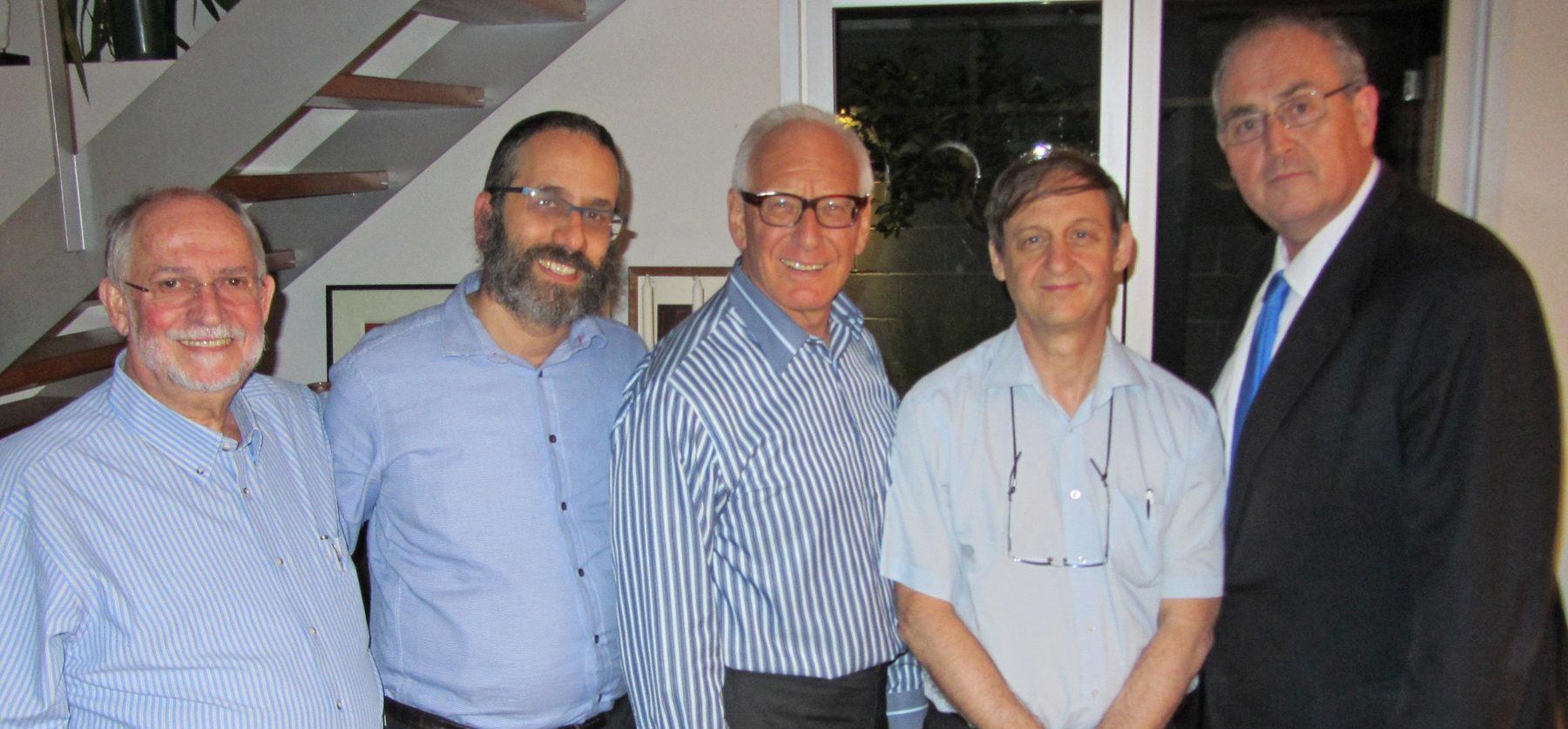
 L to R: Uri Windt, Rabbi Zalman Kastel, Ron Finkel, Prof. Michael Weintraub, the Hon. Walt Secord, Shadow Minister for Health
Prof. Michael Weintraub and his colleagues are heroes, plain and simple. But they do not seek publicity, nor do they want any. In fact Michael states emphatically, ”Making publicity out of this work could harm it.”
The comment captures the delicate balance required when communicating across the Green Line to do the right thing under conflicting and difficult circumstances.
Michael and a group of dedicated Israelis provide sophisticated cancer treatment to Palestinian children. Their patients are assisted by volunteers like Netta’s son, who participate in programs like ‘The Road to Recovery’, ferrying the sick from checkpoints to Hadassah and other hospitals throughout Israel at no cost. Michael’s clinic at Hadassah takes about a third of all Palestinian children diagnosed with cancer each year. But simply treating Palestinians on the Israeli side isn’t a long-term solution. Prof. Weintraub says, ”That simply perpetuates the problem”.
Michael and the founders of Project Rozana are holistic thinkers and the parallel aim has been from the outset to help Palestinians build their own medical and palliative care capacities so they are able to treat patients and to provide care in or closer to their homes. They partnered some years ago with a hospital in East Jerusalem, where their Palestinian colleagues are now able to provide sophisticated oncological diagnosis and care. Michael is also behind a new initiative, which will train Palestinian palliative care providers to support Palestinian patients and families in their own homes. Project Rozana will assist in funding this initiative.
When asked whether the Israeli government takes issue with its citizens pursuing such partnerships with Palestinians, Prof. Weintraub said: ”We are not political. Nobody interferes in what we do.”
When it comes to cancer and other life-threatening illnesses affecting children, the Palestinian-Israeli conflict evaporates. “We have a common enemy, it’s the disease.”
Project Rozana shows that Israelis and Palestinians can work together as equals through mutual respect. It’s an important lesson for the Israeli government and the Palestinian Authority; all people of goodwill can influence the way things need to be done.
More important than anything else, Project Rozana shows that, despite political deadlocks and obstacles, people on both sides are laying foundations and building pathways to peace. It’s hard. It’s slow. Few things worth having are ever easy. But individuals who want peace need to work for it in whatever ways they can, independently of their leaders if necessary.
 Some of the Sydney-siders who came to hear about the work of Prof. Weintraub and his colleagues
Hadassah, Prof. Weintraub, Project Rozana, and Netta’s son Daniel show that things can change, despite the rhetoric, the politics, the fear mongering and the ideologies
Speaking after Prof Weintraub’s visit to Sydney, Uri Windt, a Panel member of The Jewish Independent and a director of the Shalom Institute, said: ”Reality gets changed on the ground. Grassroots partnerships between Israelis and Palestinians are necessary to prepare the way for peace.”
To learn more and support the efforts of Prof. Michael Weintraub and Project Rozana, follow this link: http://www.projectrozana.org/
This The Jewish Independent article may be republished if acknowledged thus: ‘This article first appeared on www.thejewishindependent.com.au and is reprinted with permission.’
And see: Saving Lives, Making Peace May 10, 2016