Published: 8 July 2022
Last updated: 5 March 2024
Tedeschi’s Jewish heritage is central to his new book which combines family memoir with prose and poetry, ficton and fact
Having a child prodigy sounds like a parent’s dream, but being one is a different story, if pianist Simon Tedeschi’s first book is anything to go on.
At eight, Tedeschi was up there, in the Sydney Opera House, winning against a 23-year-old in an open-age-competition. He’s not complaining - not at all - but, as he tells The Jewish Independent, a prodigy is “an adult construct, foisted onto a developing psyche … a person acts in some ways like an adult, but is a child.”
It’s since been a stellar career for the classical pianist, and now he can add to his repertoire a genre-defying book, Fugitive. Part family memoir, part philosophy, part poetry, part fiction, part speculation, even part love story, it is with some satisfaction that Tedeschi says that booksellers don’t know where to shelve it. “What is it about genres? We need them like comparisons, to get through every day.
“The books I love the most, and the music I love the most, certainly defies genre-markers. I kind of look at a book in the same way as I look at human identity, it’s much too complex for labels.”
In Fugitive, Tedeschi writes of learning very early on what it is to change clothes rapidly, and to read the mood of the room in a heartbeat. He was younger, smaller, “weighed down by a kit bag of griefs, old enough to know, when threatened, how to flash colours as madly as a chameleon.”
Playing in a big hall, even now, he says, one can feel like a gladiator in an amphitheatre. “Especially if the audience is above you. That's, you know, the Albert Hall or something.”
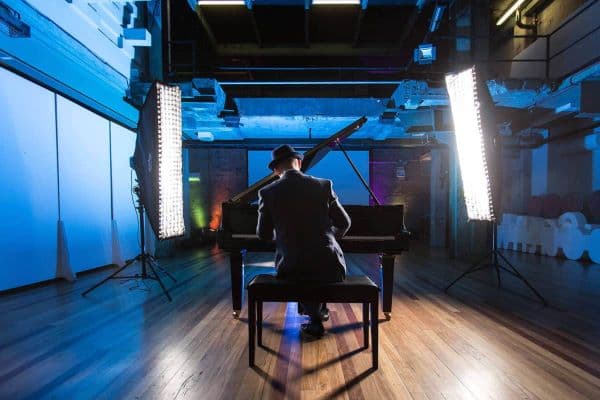
The book’s title comes from Prokofiev’s Visions Fugitives, a suite of 20 piano miniatures written in Petrograd (today Saint Petersburg) during WW1. The book has “possibly hundreds of bits” and its form is that of a musical fugue, which consists of many voices.