Published: 2 October 2017
Last updated: 4 March 2024
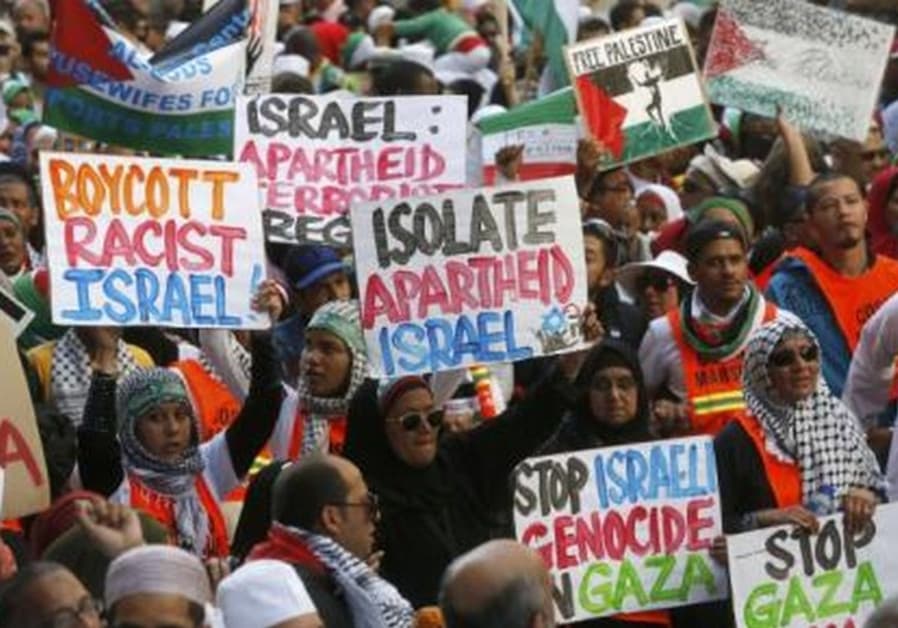
Africa’s top university, the University of Cape Town, is debating a proposed academic and cultural boycott of Israel. The proposal was put forward by the Palestine Solidarity Forum, which has called on the university to implement an academic boycott of Israeli universities
AND READ:
BDS – A NON-VIOLENT CONTINUATION OF THE PALESTINIAN WAR AGAINST ISRAEL
By Philip Mendes
The BDS movement emerged as a by-product of the outbreak of the second Palestinian Intifada in September 2000 and the associated collapse of the Oslo Peace Accord based on the concept of peaceful negotiations and mutual compromise. It represents a return to the earlier pre-1993 Palestinian viewpoint that Israel is not a legitimate state, that Palestinian aspirations can only be advanced via zero-sum conflict at the expense of Israel, and that all possible forms of pressure should be used to coerce Israel into surrendering to Palestinian demands. It also reflects an understanding that the violent strategies such as suicide bombings and rocket attacks that characterised the Second Intifada have failed (at least in Western eyes). However, it is effectively a continuation of the Palestinian war against Israel by non-violent means.
The three key aims of the BDS movement, espoused in 2004-05 by the Palestinian Campaign for the Academic and Cultural Boycott of Israel (PACBI), are:
To end the Israeli occupation of lands occupied in the 1967 War including East Jerusalem, and dismantle the security barrier;
To achieve full equality for the Arab-Palestinian citizens of Israel;
To support the rights of Palestinian refugees including their demand for a Right of Return to Israel as implied by UN Resolution 194.
I will consider each of these aims in turn, and particularly whether or not they are compatible with a two-state solution.
FIRSTLY, THE CALL FOR AN END to the Israeli military occupation of the West Bank including East Jerusalem, Gaza Strip and the Syrian Golan Heights seems on the surface to be a reasonable demand, and potentially compatible with a two-state perspective. However, the language used in the PCACBI documents is open to some ambiguous interpretations.
For example, the 2005 statement demands that Israel ‘end its occupation and colonization of all Arab lands’. Given that the Palestinian national movement prior to 1993 defined even Israel within the Green Line borders as Occupied Palestine, this could mean a rejection of Israel’s very existence.
In fact, key BDS leaders suggest that the meaning of occupied territory is intended to denote Green Line Israel. ‘If the Occupation ends, would that end our call for BDS’, Omar Barghouti, the Qatari-born spiritual leader of the BDS campaign, asked in 2010. ‘No, it wouldn’t’.
Another concern is that the statement ignores any genuine Israeli concerns about potential military threats following an Israeli withdrawal from the West Bank. Following the removal of troops and settlers from the Gaza Strip in 2005, Israel was inundated with rockets fired from the evacuated territory. Israel is not likely to allow a similar situation to occur in the West Bank given that the firing of rockets or missiles from the geographically high territory onto the heavily populated Israeli coastal plains below could suffocate the life of the country. Related to this aim is the demand to dismantle the West Bank security barrier.
Undeniably, the barrier has stopped the suicide bombings and terror attacks launched against Israel. In the absence of a negotiated final status agreement, dismantling of the barrier is simply not going to transpire. In short, any arrangement to end the occupation will need to respect the security needs of Israel as well as the right of the Palestinians to national independence. Otherwise, an Israeli withdrawal may only lead to greater violence as happened in the case of Gaza.
[gallery columns="1" size="large" ids="9438"]
SECONDLY, THE CALL FOR EQUALITY for Arabs living in Israel also seems potentially in accord with a two-state solution. This is also laudable if taken to mean simply those Palestinian Arabs living within the Green Line. But the ambiguous language used in the BDS statements suggests that the true agenda may not be civil equality for all citizens of Israel, but rather collective national rights for Arabs requiring the transformation of Israeli into a bi-national state, or worse. As such, BDS supporters are prone to suggest that Jews are not a bona fide nation deserving of national rights of their own. Rather, they are a religious minority to be tolerated by the Arab world.
Arab Israelis constitute about 20 per cent of the population or 1.7 million people. In principle, Arab citizens enjoy formal equality including freedom of speech, assembly and movement, the right to vote, and equal access to health care, education and employment. There are 17 Arab Members of the Israeli Knesset (out of 120) who vocally critique Israeli policies. Arabs have served as members of Cabinet, in prominent positions in the civil service and hospitals, as judges and diplomats, and in senior positions in the police and army. Arabic is officially recognised as Israel’s second language.
Even supporters of Israel acknowledge that Arabs experience systemic disadvantage including disproportionate poverty, under-funding of housing and infrastructure, low representation in professional employment, higher death rates from preventable diseases, much lower participation rates in higher education, and limited resources allocated to Arab schools. But they argue that Israel is actively working to reduce inequalities experienced by the Arab minority citing initiatives to promote Arab employment and economic development, increase recruitment to the civil service, equalize access to welfare payments, and facilitate greater access to higher education.
Critics of Israel, in contrast, argue that Israel’s self-definition as a Jewish state creates inherent discrimination towards its non-Jewish citizens. They refer, for example, to the Law of Return which privileges citizenship rights for Jews from all over the globe. Associated concerns relate to the Jewishness of the national flag, anthem and associated national symbols, land laws which privilege Jewish ownership, and the state’s refusal to recognise or provide services to many Arab villages.
THE THIRD AND MOST CONTROVERSIAL DEMAND is for a Palestinian ‘right of return’. This aim is highlighted in the 2004 PACBI statement and emphasises that the first and foremost priority of BDS is to reverse the events of 1948 (i.e. the foundation of Israel) that led to the Palestinian refugee tragedy, and secondly, to demand the unconditional return of the 1948 Palestinian refugees and their millions of descendants to their former homes inside Green Line Israel.
The inclusion of the right of return is no aberration. Indeed, many key BDS activists call for the establishment of a ‘secular democratic state’ of Palestine. This is the so-called one-state solution, which would see a single, non-Jewish state magically created between the Jordan River and the Mediterranean Sea, ushering in the end of the state of Israel after 66 years in existence. The mass return of potentially six million Palestinians living in refugee camps and the diaspora would massively change the demographic composition of Israel and almost certainly turn the Jewish population into a disempowered minority. It is inherently inconsistent with a two-state solution.
The concept of a Palestinian right of return is based on the United Nations General Assembly Resolution 194 of December 1948. The Resolution stated that ‘the refugees wishing to return to their homes and live at peace with their neighbours should be permitted to do so at the earliest practicable date, and that compensation should be paid for the property of those choosing not to return and for loss of or damage to property which, under principles of international law or equity, should be made good by the governments or authorities responsible’.
[gallery columns="1" size="large" ids="2379"]
The meaning of this resolution was clearly conditional, and its implementation dependent on conflict resolution and Israeli-Palestinian reconciliation. It was formally linked to acceptance of the earlier UN partition resolution creating both Jewish and Arab states in Palestine, and a negotiated peace. In practice, both the Palestinian leaders and the Arab governments initially rejected the resolution precisely because it implied recognition of Israel’s legitimacy.
Prior to the 1967 Six Day War, Palestinian right of return rhetoric was used to deny the legitimacy of the State of Israel, and so provide a rationale for the Arab refusal to recognize the State of Israel. However, following the 1967 war, the international debate shifted from questions about the legitimacy of Israel within the Green Line borders to questions about the legitimacy of a Palestinian State in the West Bank or Gaza Strip.
The subsequent political contest for or against a two-state solution explicitly assumed that any resolution of the Palestinian refugee tragedy would be addressed within the territories occupied by Israel in 1967. There could be two states or there could be a Palestinian right of return, but there could not be both. It was instructive that the Oslo Peace Accord signed by Israel and the PLO in 1993 did not mention Resolution 194.
Today, Israel as a sovereign state has a right to determine its own immigration policies, and is hardly likely to permit the entry of millions of people potentially hostile to its very existence. Of course, a Palestinian State created in the future in the West Bank and Gaza Strip will have the same right as any other new nation to determine whether or not to admit large numbers of new citizens to its borders. This is right and proper.
It should be evident from this discussion of BDS aims that the movement does not favour a two-state solution to the Israeli-Palestinian conflict, and in fact actively vilifies supporters of two states, including leading Israeli peace activists such as Amos Oz and Uri Avnery, The key leaders of the BDS movement such as Omar Barghouti and Ali Abunimah openly state their preference for the so-called one-state solution. Barghouti proposes an Arab dominated Greater Palestine populated by millions of returning Palestinian refugees in which Jews would be permitted to remain as a tolerated religious minority. He also concedes that a Palestinian Right of Return cannot possibly be reconciled with a two-state solution.
The movement does not favour a two-state solution to the Israeli-Palestinian conflict, and in fact actively vilifies supporters of two states.
BDS IN AUSTRALIA
Not surprisingly the Australian BDS movement’s agenda has not changed since the initial call for an academic boycott of Israel in 2002. The major local manifestations include:
- The Max Brenner chocolate shop protests led by the Socialist Alternative group who urge the restoration of Palestine from the Jordan River to the Mediterranean Sea;
- The Centre for Peace and Conflict Studies at the University of Sydney whose Director Jake Lynch, boycotted the visiting Israeli peace academic Dan Avnon. Lynch has publicly argued that Jewish financial pressure was responsible for the ALP switching leaders from Kevin Rudd to Julia Gillard in 2010.
- The NSW Branch of the Australian Greens, which voted in 2010 “to boycott Israeli goods, trading and military arrangements, and sporting, cultural and academic events as a contribution to the struggle to end Israel’s occupation and colonization of Palestinian territory, the siege of Gaza and imprisonment of 1.5 million people and Israel’s institution of a system of apartheid”. This later resultedin the embarrassing Marrickville Council BDS saga during the 2011 state election.
- The Victorian Trades Hall Council, which hosted a BDS Conference in October 2010 with the American BDS activist Anna Baltzer, who favours the abolition of the State of Israel, as the key note speaker.
- The Sydney University Staff for a BDS, who construct Israelis as monolithically evil oppressors
- Most recently, the Department of Peace and Conflict Studies at the University of Sydney hosted a two-day conference on July 28-29 Among the speakers were Melbourne Professor Ghassan Hage, a co-coordinator of the 2002 academic boycott petition,; Vacy Vlazna who has previously accused University of NSW academic administrators such as David Gonski and Fred Hilmer, who happen to be of Jewish background, of being responsible for the establishment of the Max Brenner chocolate shop on campus; University of Sydney English lecturer Nick Riemer, who argued in an accompanying opinion piece in the Australian’s Higher Education section that the BDS movement never boycotts individual Israeli academics (tell that to Dan Avnon).
- Other speakers included former Peace Studies Centre head Stuart Rees, who in an accompanying opinion piece in New Matilda argued that an all-powerful Zionist lobby had intimidated most politicians and academics into silence; the current Director of the Department of Peace Studies, Jake Lynch, who spoke about the enormous power of pro-Israel influence in Australia; and writer Jeff Sparrow, who spent over 12 minutes personally attacking myself and Nick Dyrenfurth, my co-author of Boycotting Israel is Wrong.
- Sparrow finished his talk by asserting that all those who attack the BDS movement are “on the far Right”. Well given that both Nick and I sit clearly on the social democratic Left, and I have supported a Palestinian State alongside Israel for 35 years, Sparrow is best off sticking with fiction.
Talks at government level between the current hawkish Israeli Government and the PA will go nowhere because neither side is interested in listening to the other side’s narrative.
Progressive alternatives to BDS
The first thing progressives need to do is the exact opposite to the BDS movement: actively engage in dialogue to identify common ground, and promote a space for discussion of strategies that will promote mutual compromise leading to two states for two peoples. The second point is that there is no simple linear road or magic wand to a negotiated two-state solution as envisaged by the Oslo Peace Accord or the Camp David negotiations.
Talks at government level between the current hawkish Israeli Government and the Palestinian Authority have gone and will go nowhere because neither side are interested in listening to the other side’s narrative.
What is needed instead is dialogue at the grass-roots level. Recently I came across the activities of the SULHA (which means Reconciliation in Arabic) Peace Project which creates opportunities for Palestinians and Israelis to meet regularly to get to know each other. Their view is that “making peace requires cooperation, and cooperation is only possible between people who know and honour each other’s essential humanity”. Exactly what is needed.
At a more political level, there is the Geneva Initiative, an ongoing campaign to promote a negotiated two-state solution based on the key principles of mutual recognition and compromise. That initiative builds on the earlier Geneva Peace Accord negotiated by a team of prominent Israeli and Palestinian negotiators in 2003 which remains the benchmark for Israeli-Palestinian conflict resolution.
The Accord, which proposed the establishment of a demilitarised Palestinian State in the West Bank and Gaza Strip alongside Israel accompanied by minor land swaps, was rejected by hardliners on both sides, but attracted significant support from ordinary Israelis and Palestinians. It is stridently opposed by the BDS movement.
Some people get very excited about proposals for boycotting West Bank settlement products instead of a blanket BDS. My personal views are sympathetic, but would also suggest that advocates take a cold shower and reflect on the following points:
1. Boycotting settlements is a completely separate debate to the BDS debate, which is centred around eliminating Israel per se.
2. Boycotting settlements (even if it impacts on Israeli trade and economic relations) will not convince Israelis to withdraw from the West Bank unless strategies are also developed that influence and modify Palestinian views and actions. The Palestinians have been criticised, fairly or otherwise for not having a Mandela, but perhaps its more relevant to note they don’t have a Xanana Gusmao or Gerry Adams either.
This is an edited version of a talk given by Philip Mendes on September 3 to the Northern Jewish Education Centre in Melbourne titled Israelis and Palestinians need to talk more not less
Associate Professor Philip Mendes is Acting Head of Social Work Department at Monash University, and co-author with Nick Dyrenfurth, of Boycotting Israel is Wrong (NewSouth Books,. 2015)
Photo: Demonstrators march through the streets of Cape Town against the Israeli-Palestinian conflict in August 2014. (Reuters)


Comments
No comments on this article yet. Be the first to add your thoughts.