Aa
  • Read, Watch, Listen
  • TJI Series
  • Community Action
  • Events
  • Zedi
Follow us and continue the conversation
  • LinkedIn
  • Instagram
  • FaceBook
  • X
  • YouTube
Test yourself with the TJI Quiz!

Adjust size of text

Aa

Follow us and continue the conversation

  • LinkedIn
  • Instagram
  • FaceBook
  • X
  • YouTube

Your saved articles

You haven't saved any articles

What are you looking for?

Original reporting, insightful analysis and diverse views, delivered straight to your inbox

  • LinkedIn
  • Instagram
  • FaceBook
  • X
  • YouTube
Your support fuels our mission to inform, entertain and inspire.

The Jewish Independent is bound by the Standards of Practice of the Australian Press Council. If you believe the Standards may have been breached, you may approach The Jewish Independent or make a complaint to the Australian Press Council in writing at www.presscouncil.org.au. The Council may also be contacted on 1800 025 712.

  • Our Story
  • Contact us
  • Our Team
  • Support us
  • Guidelines
  • Pitch your idea
  • Republishing us
  • Community Action
  • Our Awards
  • LinkedIn
  • Instagram
  • FaceBook
  • X
  • YouTube
Aboriginal FlagTorres Strait Islanders Flag

The Jewish Independent acknowledges Aboriginal and Torres Strait Islander peoples as the Traditional Owners and Custodians of Country throughout Australia. We pay our respects to Elders past and present, and strive to honour their rich history of storytelling in our work and mission.

© The Jewish Independent 2026All Rights Reserved
Website design and development by Your Creative, MelbourneTerms & ConditionsPrivacy Policy
HomeRead, Watch, ListenArts & Culture
OpinionArts & Culture

Taylor Swift and the power of words that heal

The Swiftie enthusiasm captures a need for song that dates back to the Bible.
Ralph Genende
Print this
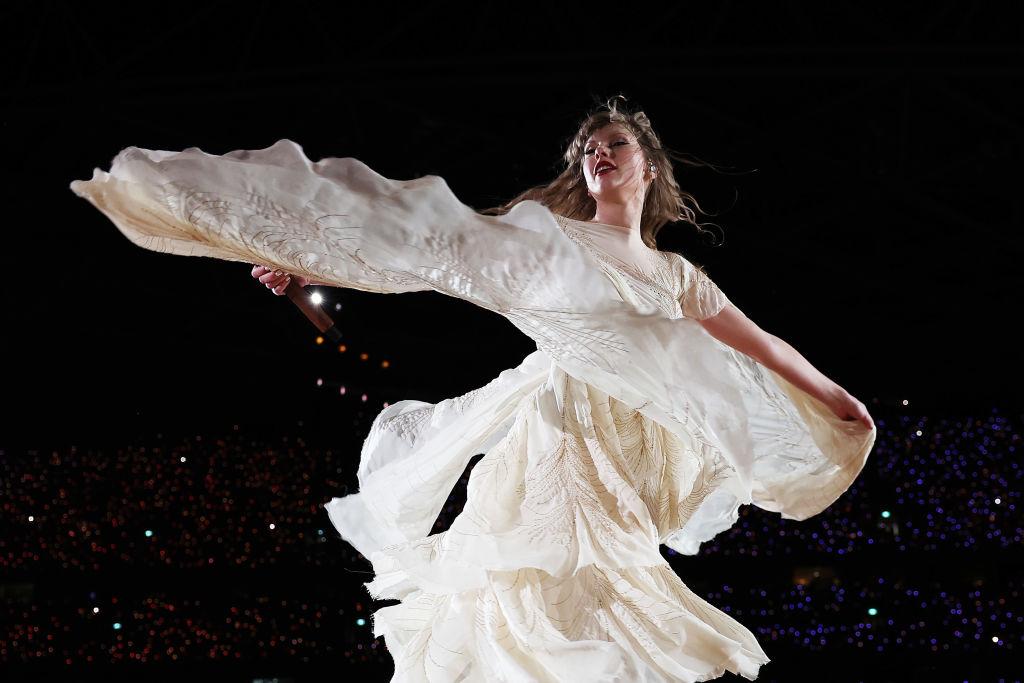
Woman dancing in white dress

Taylor Swift performs in Sydney on February 23 ( Don Arnold/TAS24/Getty Images)

Published: 28 February 2024

Last updated: 21 March 2024

The Swiftie enthusiasm captures a need for song in difficult times that dates back to the Bible.

Shabbat Shira, the Shabbat of Song, usually falls in the height of the Australian summer. It is named for the week’s reading: the Song of the Sea. Probably the most famous song of Jewish history, it is the song sung by Moses to celebrate the crossing of the Red Sea and the Jewish people’s victory over an enemy in pursuit.

Australians have been celebrating Saturdays of Song too this summer – Swiftie Sabbaths when Taylor Swift performed for hundreds of thousands in Melbourne and Sydney.

The arrival of Taylor Swift has generated enormous interest and excitement. She is an icon for countless teenagers and many older fans too. Her life story of hardship, resilience and success, referenced in her lyrics, is inspirational.

In these hard times, it is refreshing to move from warfare to wonder, from words that wound to words that heal.

“Long story short it was a bad time; long story short I survived,” she sings. And elsewhere, "These things will change; can you feel it now? These walls that they put up to hold us back will fall down."

As a community in distress, we can take comfort from these words. These are bad times for Jews worldwide and for Jewish Australians it’s achingly hard as we encounter unimaginable levels of antisemitism.

In recent weeks our antagonists put up other walls in an attempt to separate, if not excise, us from Australian society. The disgraceful doxing of Jewish groups and the offensive language of Green’s MP Jenny Leong are two examples.
Israel and the Jewish people are the target for weaponised words and wild unfounded accusations. The lax language of hatred and exclusion, the old surly stereotypes of colonialism, control, and bloodsucking Jews is creating a new blood libel. We are facing new forms of old canards: what we might call the protocols of the elders of radical Islam.

Toxic lies accuse us of occupation and apartheid. How exactly do you occupy and colonialise the land that has been part of your tradition and heritage for thousands of years, including centuries preceding Islam?

The apartheid accusation is particularly wounding for me, raised in South Africa. Israel where Arabs and Muslims vote and participate fully in civil life is nothing like the separation and demonisation that I lived through in my youth in apartheid South Africa.

This is not to deny the serious ethical lapses in the West Bank areas that Israel occupies, nor to minimise the outrageous extremism of the religious right wing settlers.  

Extremism and fanaticism in any form and in any religion are a danger for any society.

The extremism that poses the most serious threat for the West is the menacing militancy of radical Islam — be it Isis or Hamas, Hezbollah or the Iranian Ayatollahs.

In the face of these threats, we Australian Jews need to be strong and confident in our own strength. Melbourne and Sydney are not Berlin or Frankfurt of 1936. We are a resilient community with many friends and allies. We have agency and moral courage.

We are overwhelmingly a Zionist community, albeit with a wide range of opinions about Israel and its government policies. Israel is an integral part of Jewish religious and cultural identity.

Taylor Swift’s inspirational lyrics capture the resilience we need at this time, "People throw rocks at things that shine but they can't take what's ours," she sings.

Israel is ours and a shining, if imperfect, example of democracy and free speech in a hostile neighbourhood where both these elements are in short supply.

And Australia is ours too. We Jews have been here since the first ships sailed into Botany Bay and we have made important contributions to Australian society, particularly to Aboriginal advancement.

On the Shabbat of Song we read that after Moses led the Hebrews in the Song of the Sea, Miriam topped it off with a song of her own. Taking a tambourine in her hand she leads the women of Israel in a rapturous song of deliverance.

Miriam was a Biblical Swift, bringing inspirational words to her generation. She was a model of visionary leadership and stewardship for the new nation.

Her astonishing foresight in bringing musical instruments with her from Egypt displayed a faith in the future and a belief that her people would move from slavery to salvation, desolation to celebration, despair to repair.

Songs from Miriam to Taylor give us hope for the future.

You might also like
  • ‘As an Israeli Jew, I don’t want to be resilient anymore’
    Eetta Prince-Gibson
  • Jewish joy is the best form of resilience 
    Ellie Schwarz
  • Resilience: hope in unexpected places
    Ittay Flescher
logomark.67a07ee3
We believe in the free flow of information

Republish our articles for free, online or in print, by using our Creative Commons licence

You might also like

    Adelaide Hermann magicianHarvard_Theatre_Collection_-_Hermann_TCS_28
    FeatureArts & Culture

    Legendary magicians who made their Jewish identities disappear

    Nina Siegal
    Picture 1
    FeatureArts & Culture

    Eight Jewish and Israeli video games you should check out 

    Jarod Rhine-Davis
    Yitzhak Yedid
    InterviewArts & Culture

    Finding hope in the Valley of the Dry Bones

    Jarod Rhine-Davis

About the author

Ralph Genende

Ralph Genende

Rabbi Ralph Genende is the Interfaith and Community Liaison at the Australia Israel and Jewish Affairs Council. He is also Senior Rabbi to the Australian Defence Force and Rabbi of Kehilat Kesher Community.

More from the author

ReflectionWorld

A celebration of chutzpah, from Moses to modern times

AnalysisAustralia

Interfaith relations after Bondi 

DebateAustralia

Stopping the sacrifice of children on a new altar 

OpinionLifestyle

Forgiving our parents: a Yom Kippur challenge