Aa
  • Read, Watch, Listen
  • TJI Series
  • Community Action
  • Events
  • Zedi
Follow us and continue the conversation
  • LinkedIn
  • Instagram
  • FaceBook
  • X
  • YouTube
Test yourself with the TJI Quiz!

Adjust size of text

Aa

Follow us and continue the conversation

  • LinkedIn
  • Instagram
  • FaceBook
  • X
  • YouTube

Your saved articles

You haven't saved any articles

What are you looking for?

Original reporting, insightful analysis and diverse views, delivered straight to your inbox

  • LinkedIn
  • Instagram
  • FaceBook
  • X
  • YouTube
Your support fuels our mission to inform, entertain and inspire.

The Jewish Independent is bound by the Standards of Practice of the Australian Press Council. If you believe the Standards may have been breached, you may approach The Jewish Independent or make a complaint to the Australian Press Council in writing at www.presscouncil.org.au. The Council may also be contacted on 1800 025 712.

  • Our Story
  • Contact us
  • Our Team
  • Support us
  • Guidelines
  • Pitch your idea
  • Republishing us
  • Community Action
  • Our Awards
  • LinkedIn
  • Instagram
  • FaceBook
  • X
  • YouTube
Aboriginal FlagTorres Strait Islanders Flag

The Jewish Independent acknowledges Aboriginal and Torres Strait Islander peoples as the Traditional Owners and Custodians of Country throughout Australia. We pay our respects to Elders past and present, and strive to honour their rich history of storytelling in our work and mission.

© The Jewish Independent 2026All Rights Reserved
Website design and development by Your Creative, MelbourneTerms & ConditionsPrivacy Policy
HomeRead, Watch, ListenAustralia
Australia Votes 2025OpinionAustralia

The main parties are so uninspiring but I can’t risk the alternatives

There are compelling policies coming from the fringes, but they are wrapped in ideologies of the far-left that alienate me and many Jewish voters.
Nomi Kaltmann
Print this
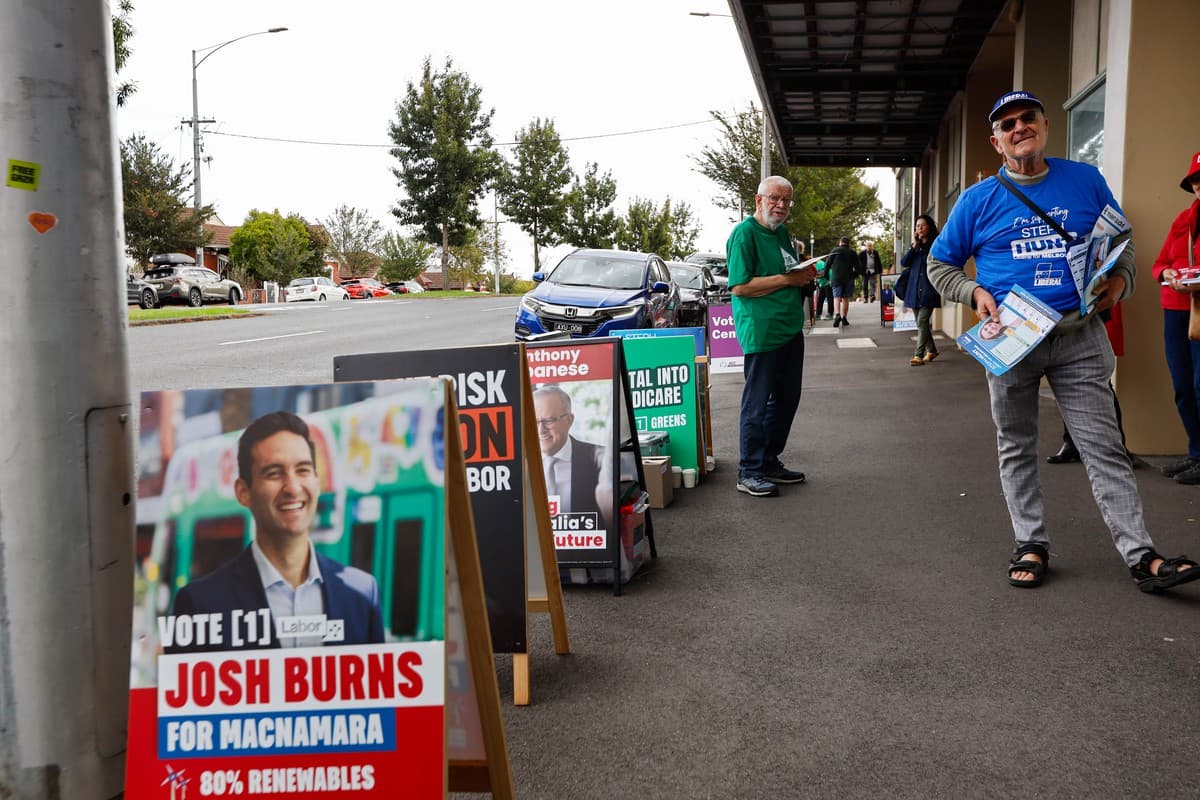
election corflutes for Josh Burns along the pavement

Early voting centre in Macnamara (Ye Myo Khant/SOPA/Sipa USA)

Published: 28 April 2025

Last updated: 5 May 2025

If I’m being honest, I’m not feeling particularly excited about the upcoming election.  Like so many Australians, I look at the major parties and struggle to see much substantive difference between them. In my humble opinion, neither is offering anything groundbreaking or visionary. That’s frustrating, because there’s so much low-hanging fruit that could genuinely improve life for ordinary working people.

It shouldn't be this hard

My husband and I are middle-class professionals, and parents of several young children. Most of our friends are a similar stage of life. And yet, almost everyone I know in their early thirties feels under financial pressure. The cost of living is crushing. Our weekly grocery shop has blown out by hundreds of dollars, and I’ve watched the price of a simple latte creep up again and again. This past Passover, we skipped the chocolate altogether. I couldn’t believe it was $8.40 a block at Coles!

My husband and I, we’re lucky, apparently. Without intergenerational wealth and up to our eyeballs in debt, we’ve managed to buy a home in Caulfield. However, since inflation began, our mortgage repayments have more than tripled due to interest. Since the last election, it’s been an exhausting few years just trying to keep up. I can’t imagine how hard it must be for people further down the economic ladder. If professionals are struggling, how is everyone else supposed to cope?

It’s pretty clear to any Gen Z and millennial that this country desperately needs tax reform.

There’s no denying that earlier generations, particularly the baby boomers, benefited from a very different Australia, one where university was free, housing was affordable, and jobs were plentiful. That’s not a criticism, it’s just the reality of the time.

But for younger Australians today, that kind of stability feels increasingly out of reach. The housing market is cooked, education is expensive, and secure work is harder to find. We need meaningful reform to ensure that future generations can thrive too, not just scrape by in a system that no longer works for them.

It shouldn’t be this hard for two working people to buy their first home, or to raise a family without drowning in debt. It’s no wonder so many people are delaying having kids. If life just doesn’t feel sustainable or affordable before kids, why would it be easier after?

And yet, I find myself deeply conflicted about who to vote for this election.

The fringe isn't all wrong

There are some genuinely compelling policy ideas emerging from the fringes of politics, from candidates like Jordan van den Lamb (known online as Purple Pingers), to parts of the Greens platform. I’ve followed the housing debates closely, and I think van den Lamb’s focus on vacancy taxes, public housing, and reining in investor speculation is bold and overdue.

He’s a Victorian Senate candidate who’s gained attention for exposing vacant Aussie properties, some left empty for decades, during a national housing crisis. His approach is provocative, and while he doesn’t openly call for squatting, that’s clearly the implication.

While I don’t particularly like his methods, he has rightly identified a broken housing system that neither major party has been able to tackle properly. His activism has shown the dismal state of many rentals and the unchecked power of landlords. As a millennial, I think that these are conversations we should be having.

Similarly, the Greens are offering serious proposals on paid parental leave, climate action, and tax reform, areas where the major parties have repeatedly failed to be imaginative or courageous.

All or nothing politics

But here’s where it gets complicated, because I think that these ideas often come wrapped in the broader, radical ideologies of the far-left that I, and many other Jewish voters, don’t subscribe to. It’s not just about Israel, although that’s part of it.

Some progressive spaces have embraced an all-or-nothing politics that can be alienating, even for those who deeply want change.

It’s about how some progressive spaces have embraced a kind of all-or-nothing politics that can be alienating, even for those of us who deeply want change. There’s a risk that good, practical policy gets entangled with more extreme rhetoric, leaving voters like me, who are hungry for reform but wary of dogma, with nowhere to go.

Van den Lamb has accused Australia of participating in genocide for supporting Israel’s actions in Gaza. On a webpage from the Victorian Socialists announcing his candidacy, he says, “Labor’s red doesn’t represent social-democratic values anymore. It represents the blood of Palestinians killed in Gaza while Labor has signed deals with weapons companies that are arming Israel.”

That kind of language doesn’t just lack nuance, it flattens an incredibly complex conflict into a dangerous and divisive narrative.

I wish I didn’t have to choose between uninspired centrism and activist platforms that feel like political ultimatums.

Likewise, the Greens were the only party to refuse to condemn Hamas for the October 7 attacks. I won’t support a party that refuses to endorse the IHRA definition of antisemitism or has MPs that flirt with conspiracy theories about Jewish influence in politics.

I wish the major parties had taken up the mantle of bold reform themselves. I wish I didn’t have to choose between uninspired centrism and activist platforms that sometimes feel like political ultimatums. But that’s the choice we’re left with, and for voters like me, it’s exhausting.

When I ran for Parliament as a Teal independent in the 2022 Victorian election in the seat of Caulfield, I did so because I wanted to make the place, I live in better for all people here. I care about climate, housing, education, and equity.

But I also care about being safe in my own country, about my kids growing up in a place where they don’t feel like outsiders. When the major parties fail to offer bold or meaningful solutions to long-standing policy issues, it leaves frustrated voters, who want to see meaningful policy reform, with few options.

Politically homeless

Sometimes it can mean that people become so fed up with the status quo that they can end up voting for fringe candidates, not because they support the radical ideology, but because they’re desperate for change. That kind of political drift can have dangerous consequences.

I want to vote for someone who wants to fix the system. But I worry that these choices would offset my safety.

My grandfather was a Holocaust survivor, who came here because it was a safe refuge, and it terrifies me that some of the most progressive voices in our politics have forgotten how to talk about Jews and Israel without suspicion, cynicism, or hostility.

So where does that leave me?

Politically homeless. Bored and uninspired by the candidates from the major parties.

I live in Macnamara, one of the most Jewish electorates in the country, and I want to vote for someone edgy and bold, someone who can see the system is broken and wants to fix it. But I worry that these choices would offset my safety in this country. Instead, I feel boxed in by the safest, most conventional choices, not because they excite me, but because I can’t risk the alternatives.

As a proud Jewish Australian, I don’t think voting for radical social reform should mean that I gamble with my place in society or minimising the very real threat of antisemitism.

And yet, here we are. For many Jewish Australians, especially progressive ones, this election feels like a slow walk through a minefield. We want to change the world. But not if it comes at the cost of being erased from it.

You might also like
  • ‘The Great Dismissal’: how our echo chambers fool us
    Isabelle Oderberg
  • Firebombing attack on Americans demonstrating for hostage release
    Philissa Cramer
  • Make your vote meaningful
    The Jewish Independent
logomark.67a07ee3
We believe in the free flow of information

Republish our articles for free, online or in print, by using our Creative Commons licence

You might also like

    neo-nazis white supremacists corowaTEST
    Royal CommissionOpinionAustralia

    Antisemitism, homophobia and a radical response to both

    Dennis Altman
    Tame
    Australia

    Tame apologises – but with little grace

    Deborah Stone 1
    Royal Commission final
    Royal CommissionNewsAustralia

    Strategies for cohesion final focus of Royal Commission hearings

    Peter Kohn 1

About the author

Nomi Kaltmann

Nomi Kaltmann

Nomi Kaltmann is an Australian lawyer and journalist. Her writing has appeared in major Australian and international publications including Crikey, Griffith Review, Mamamia, Tablet Magazine, The Australian Financial Review, The Daily Beast, The Forward, The Guardian, The Jewish Telegraphic Agency and The Spectator. She regularly appears on radio and podcasts to discuss Australia’s Jewish community, including NPR (USA), CBC (Canada), LBC (London), Call Me Back, Unholy: Two Jews on the News, SBS and The Times of Israel. An influential Orthodox feminist leader and founding president of the Jewish Orthodox Feminist Alliance (JOFA Australia), she is a sought-after speaker on religion, interfaith and contemporary Jewish life.

More from the author

OpinionAustralia

Cancellation backfires but we are at it again

OpinionWorld

From NY to Melbourne, local politicians are whipping up hate 

ReflectionAustralia

I have lost faith in our multicultural institutions 

InterviewIsrael

Dreams, nightmares and realities from a bereaved mother 

Comments1

  • Avatar of DaveM

    DaveM1 May at 10:42 am

    I am right with you in the disappointing lack of vision from the two major parties and the frank anti-Semitism of seemingly everyone left of centre (and some to the right).
    It’s a poor time to be an Australian voter.