Aa
  • Read, Watch, Listen
  • TJI Series
  • Community Action
  • Events
  • Zedi
Follow us and continue the conversation
  • LinkedIn
  • Instagram
  • FaceBook
  • X
  • YouTube
Test yourself with the TJI Quiz!

Adjust size of text

Aa

Follow us and continue the conversation

  • LinkedIn
  • Instagram
  • FaceBook
  • X
  • YouTube

Your saved articles

You haven't saved any articles

What are you looking for?

Original reporting, insightful analysis and diverse views, delivered straight to your inbox

  • LinkedIn
  • Instagram
  • FaceBook
  • X
  • YouTube
Your support fuels our mission to inform, entertain and inspire.

The Jewish Independent is bound by the Standards of Practice of the Australian Press Council. If you believe the Standards may have been breached, you may approach The Jewish Independent or make a complaint to the Australian Press Council in writing at www.presscouncil.org.au. The Council may also be contacted on 1800 025 712.

  • Our Story
  • Contact us
  • Our Team
  • Support us
  • Guidelines
  • Pitch your idea
  • Republishing us
  • Community Action
  • Our Awards
  • LinkedIn
  • Instagram
  • FaceBook
  • X
  • YouTube
Aboriginal FlagTorres Strait Islanders Flag

The Jewish Independent acknowledges Aboriginal and Torres Strait Islander peoples as the Traditional Owners and Custodians of Country throughout Australia. We pay our respects to Elders past and present, and strive to honour their rich history of storytelling in our work and mission.

© The Jewish Independent 2026All Rights Reserved
Website design and development by Your Creative, MelbourneTerms & ConditionsPrivacy Policy
HomeRead, Watch, ListenAustralia
Australia

‘They don’t see their survival as an achievement’: Telling Holocaust stories

Michael Visontay
Print this

Published: 27 January 2023

Last updated: 5 March 2024

JACQUI WASILEWSKY has spent nearly 20 years publishing Holocaust memoirs for the Sydney Jewish Museum. MICHAEL VISONTAY asks her about the sensitivities and surprises behind survivor stories.

“For the next generation, it's so inspiring to meet a Holocaust survivor, particularly if you weren't in the family of one. When we learn about their past, it’s like they suddenly become a ‘superstar’. That is how we perceive them,” Jacqui Wasilewsky says.

“And yes, there are some Holocaust survivors for whom surviving was the focus of their life. But for the majority of people, they tell their stories because their family urged them over many years.

“They don't see their survival as an achievement. It's just something that happened. Whereas their experience has meaning and gravity to the people (their family) who want that story told,” she explains.

Over the past 18 years, as manager of the Sydney Jewish Museum’s Community Stories program, Wasilewsky has published more than 100 books, the vast majority of them Holocaust memoirs, wearing multiple hats of publisher, historian, confidant and therapist – and not always in that order.

The one constant in her role is the power of stories to affect her. Sometimes the impact comes not from the detail of the story itself but in its telling, she explains.

“We had one which was beautifully written by a woman who later became a writer in America, who ended up taking her own life. She was so traumatised by her experience. Her husband published the book. It was so difficult.”

This recollection highlights something that is often taken for granted. Many survivors are not endowed with the resilience that we somehow assume they have because they are still alive.

"We are looking at these people as they are now. Here’s somebody’s granny or grandfather. But they look in the mirror and see their young spunky self - it took me a long time to figure this out."
“We published a book by a man who was the most broken Holocaust survivor I've ever, ever, ever met. His book is not quite random thoughts but a kind of stream of consciousness. We left it like it was because you got a sense of who he was, of how broken he was. And I thought that was important.”

Wasilwesky says this realisation – to leave the author’s voice intact - was the biggest lesson she has learned from the job. “That means their stories are not literary masterpieces. But they're never going to be because for 99.9% of these people, English is not even a first language. But it’s important that if their family is reading it, they get a sense of who that person was.

“Their expression may not be perfect English, but they all have their way of talking - particularly the Hungarians,” she laughs.

This has led to another consideration about her obligation to the author. “It took me a long time to figure this one out. We are looking at these people as they are now. Here’s somebody’s granny or grandfather. But they look in the mirror and see their young spunky self. Don't take that self away from them, because you're doing them a disservice.

“The best example I can give is a book by a survivor about his successful life in Australia but it was also a chronology of his sexual exploits from when he was 15.

“This man’s family phoned me and asked me to rewrite the book. So I re-read it, saw that it was confronting in parts, and thought ‘we can edit it out’.

Wasilwesky says leaving the author’s voice intact is the biggest lesson she has learned from the job.

“The editor said, ‘We can't take all of this sexual material out because if we do, we're going to take him out of it. This is who he was.' We took some out but not all, and I think the family is probably still sad about that book. But if you knew him, that is who he was. And that’s ok.”

It wasn’t just men who exhibited this trait. Wasilewsky recalls a Polish woman, “a remarkable person,” who passed away last year. “The only way I can describe her is as a little Babushka doll. But her memoir read like Fatal Attraction.”

At the other end of the spectrum, some anecdotes are so poignant, so singular that they have stayed with her for life. “There's one I did years and years ago, but I still can't get it out of my head.”

She pauses, visibly affected even now, many years later. “It was a young boy who was alone after his entire family had perished in front of him, shot in the fields in Poland. As he wandered, he took shelter in a cave and realised it was time for his bar mitzvah. He'd come from a religious family and he gave himself a bar mitzvah, by himself, in a cave.”

Another incredible story of “happenstance” as she puts it, was reading about a woman who gave birth to her child in a toilet in Auschwitz. “What did that feel like for her, and what did it mean for her from that point onwards? That has stuck with me for life.”

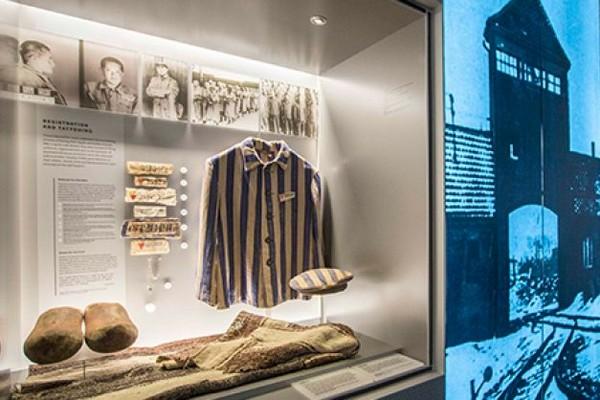
Exhibit at the Sydney Jewish museum (courtesy SJM)

Not all books, however, have come from Jewish families. Wasilewsky published a book by a non-Jewish man who had a Jewish grandmother and a grandfather who was a Nazi sympathiser and wanted to track down his family’s roots. She has also been approached by non-Jewish neighbours and carers of Holocaust survivors who believe their stories need to be told.

But the Community Stories program also publishes other non-Holocaust books such as social and military histories. They include the fall of Singapore during World War II, Jewish Olympians and another simply titled True Blue Jews.

Among all the inspiring and straightforward stories, there are awkward ones. Some have historical or chronological inaccuracies. Konrad Kwiet, the museum’s world-renowned Holocaust historian, looks over every manuscript. If he finds something that puts a significant hole in someone’s story, Wasilewsky has developed a protocol.

“One has to decide that this is a memoir, and it's someone's memory. And usually in those cases, I get Konrad to write a preface which talks in a general sense about memory and fallibility.

"The second generation just doesn’t realise that their experience is an authentically new story."

“That’s how I get around the problem; I’ve done that a few times. It is very important not to give ammunition to Holocaust denial. You can’t let these things just go through.”

She has refused a couple of manuscripts, one because of defamation concerns and another when a survivor “was very vindictive against her family and felt that they had cheated her and done her wrong. The story was a vicious attack on her family, which is fine from her side.

“But she had no one else in her family. Her ex-husband was caring for her and her daughter. And I felt that if she published this book, she would be completely alone in the world. The psychologist in me said to her, ‘I can't publish this. You can go and do it somewhere else. But if you really do want your family to read it, put it somewhere they'll find it after you're gone.’

The emotional intensity in Wasilewsky’s job raises the question of Holocaust fatigue. “It’s not an easy subject to talk about but I’d be remiss if I didn't acknowledge it. I think everyone in the museum has that to an extent,” she says. “Sometimes we joke about it.”

So how does she retain her enthusiasm? “There are some stories that just either break your heart or are so different or so poignant that they stick up and make you want to keep going.”

And now, she explains, there’s a whole new project emerging: the second generation. She’s about to launch a round of interviews with the children of survivors, starting with the museum’s volunteers. She already has 28 signed up. “I want to ask them what it was like growing up in the home of a Holocaust survivor.

“Did they know? Did they even talk to you about it? Did it seem like there was a great elephant in the room? Were there things about your parents that were different from other people who you went to school with? It can range from attitudes to food, to household habits, to parents working so hard that they couldn’t look after them, or they didn’t have grandparents.

“I don’t need to know their parents’ survivor stories. Just give me a potted version; five minutes max. But then after that I want to hear from them, stories specifically about them. This is an initiative of the museum. Its education department is keen to use these stories in guiding.

“My focus is on their experience. It could be traumatic or not. But I can’t believe that it had no impact at all. It may have taken a long time for children to see it. But now they are at an age where they can reflect on that.

“They've learned what they know from listening to their parents telling the Spielberg story. But they just don’t realise that their experience is an authentically new story.”

Photo: Jacqui Wasilewsky with some of her books at the Sydney Jewish Museum (courtesy Jacqui Wasilewsky)

You might also like
  • The first step in antisemitism education: teaching the teachers
    Michael Visontay
  • From mourning to memory: preserving the Bondi massacre tributes
    Shannon Biederman & Rebecca Kummerfeld
  • Expanded Sydney Jewish Museum aims to challenge prejudice with pride
    Paula Towers
logomark.67a07ee3
We believe in the free flow of information

Republish our articles for free, online or in print, by using our Creative Commons licence

You might also like

    Yitzhak Yedid
    InterviewArts & Culture

    Finding hope in the Valley of the Dry Bones

    Jarod Rhine-Davis
    Eva Geller
    Australia

    Bondi victim dies after almost 11 months fighting

    The Jewish Independent
    Josh Frydenberg
    FeatureAustralia

    Josh Frydenberg weighs political return as he releases his new memoir

    Gideon Cohen

About the author

Michael Visontay

More from the author

NewsAustralia

Matt Chun’s hate speech prompts change in arts funding policy

AnalysisAustralia

Mishandled antisemitism education is not just ineffective, it’s dangerous

FeatureLifestyle

Where Shtisel meets The Jetsons

ReviewIsrael

Beinart’s utopian vision ignores awkward truths