Aa
  • Read, Watch, Listen
  • TJI Series
  • Community Action
  • Events
  • Zedi
Follow us and continue the conversation
  • LinkedIn
  • Instagram
  • FaceBook
  • X
  • YouTube
Test yourself with the TJI Quiz!

Adjust size of text

Aa

Follow us and continue the conversation

  • LinkedIn
  • Instagram
  • FaceBook
  • X
  • YouTube

Your saved articles

You haven't saved any articles

What are you looking for?

Original reporting, insightful analysis and diverse views, delivered straight to your inbox

  • LinkedIn
  • Instagram
  • FaceBook
  • X
  • YouTube
Your support fuels our mission to inform, entertain and inspire.

The Jewish Independent is bound by the Standards of Practice of the Australian Press Council. If you believe the Standards may have been breached, you may approach The Jewish Independent or make a complaint to the Australian Press Council in writing at www.presscouncil.org.au. The Council may also be contacted on 1800 025 712.

  • Our Story
  • Contact us
  • Our Team
  • Support us
  • Guidelines
  • Pitch your idea
  • Republishing us
  • Community Action
  • Our Awards
  • LinkedIn
  • Instagram
  • FaceBook
  • X
  • YouTube
Aboriginal FlagTorres Strait Islanders Flag

The Jewish Independent acknowledges Aboriginal and Torres Strait Islander peoples as the Traditional Owners and Custodians of Country throughout Australia. We pay our respects to Elders past and present, and strive to honour their rich history of storytelling in our work and mission.

© The Jewish Independent 2026All Rights Reserved
Website design and development by Your Creative, MelbourneTerms & ConditionsPrivacy Policy
HomeRead, Watch, ListenAustralia
Australia

Tikkun Olam, Muslim style

Vic Alhadeff
Print this

Published: 14 July 2023

Last updated: 5 March 2024

VIC ALHADEFF visits the annual convention of the Ahmadiyya Muslim community and learns about the important work of Australian Muslim doctors for the global poor.

Sixty percent of the population of the Ivory Coast, on the southern tip of West Africa, live in slums, health care is sub-standard and malaria is endemic throughout the year. But the impoverished country will soon acquire a world-class hospital which will include surgical wards, operating theatres, a gynaecology wing and all manner of quality medical care. 

It has taken five years to build the hospital, which is due to open next April. The seed funding for its establishment came from 10 Australian doctors, each of whom donated $25,000.

There is only one cardiac ultrasound machine in the entire Solomon Islands, servicing a population of 700,000, while Thailand and Malaysia have 67 cardiac and non-cardiac surgeries between them, also funded by Australian doctors. Teleconference clinics are conducted regularly by the Australian team.

These and other statistics were proffered in a riveting presentation last weekend by Dr Ata Rehman, president of the Ahmadiyya Muslim Medical Association of Australia. His platform: a keynote address at the annual convention of Australia’s Ahmadiyya Muslim Community, which attracted about 3000 participants to Rosehill Gardens.

The Ahmadiyya Muslim Medical Association of Australia comprises a mere 110 doctors – male and female – yet they spread their expertise to such needy nations as Vanuatu, Gambia, Senegal, Thailand, Malaysia, Pakistan, the Solomon Islands and the Ivory Coast, as well as several other struggling centres. And they all do so on a voluntary basis, at no charge to patients.

One of the doctors is Dr Rehman, a Sydney-based echocardiologist who takes his specialist skills to one of those countries every two or three months. Two months ago, he was operating in Malaysia, while 120 cardiac and other patients are booked in to consult with him on his forthcoming trip to Thailand.

“All Ahmadi doctors should sacrifice their time and their skills for the sake of the wider community,” Dr Rehman tells The Jewish Independent. “This is the message from the Caliph (who is based in London and is the current supreme head of the worldwide Ahmadiyya movement). During Covid, for example, we provided thousands of testing kits free of charge across Australia to anyone in need. I am proud to represent Australia in this way all over the world and to belong to a community which is so small, yet voluntarily does so much humanitarian work and at our own cost.”
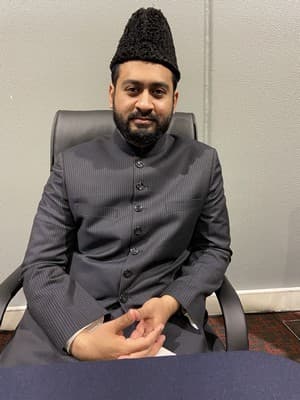
Two months ago, Dr Rehman was operating in Malaysia, while 120 cardiac and other patients are booked in to consult with him on his forthcoming trip to Thailand.

Founded in 1889 by Indian-born Mirza Ghulam Ahmad, the Ahmadiyya Muslim movement adheres to Sunni Islam and follows the Koran and Muhammad, “the difference being that we believe that our founder was the Messiah, which means that we suffer persecution in some countries”, says Mohammad Atae Rabbi Hadi, spiritual leader of the Ahmadi community in Queensland.

“Our belief is that the Messiah will bring about gradual change in the world and that mankind therefore has a chance, an opportunity, to rectify himself through personal, professional and religious development. It’s a work in progress.”

Mohammad Atae Rabbi Hadi, spiritual leader of the community in Qld

Subscribing to the worldwide Ahmadi movement’s ethos of “Love For All, Hatred For None”, the Australian Ahmadi community numbers a mere 7000. It is part of a global network which exists in about 200 countries - including in Haifa, where its adherents are Arab Muslim - with the largest concentrations of members located in Ghana and Indonesia. The global membership numbers about 25 million, its infrastructure including 16,000 mosques, 600 schools and 30 hospitals.

It has translated the Koran into more than 70 languages and operates a 24-hour satellite television channel. And through its affiliate organisation HumanityFirst.org, which is active in 52 countries - mainly in Africa and South-East Asia - it is extensively engaged in disaster relief, assisting in the aftermath of earthquakes, building schools and hospitals and helping the underprivileged.

Last weekend’s convention drew participants to Sydney from around the country - women in hijabs, children resplendent in specially bought outfits, and political and civic leaders turning up to pay their respects.

Waqas Ahmed and his wife Asma Choudhary with their children Adil, 9, Faiza, 7, Arsla, 5, and Ayesha, 2.

The parallels between Ahmadi values and priorities and various aspects of Jewish tradition and practice were immediately evident, from the physical separation of men and women at the conference – each group assigned to halls 50 metres apart and each venue with its own program of poems, prayers, Koran readings, speeches and dinner - to the premium placed on the value of education, the importance of family, the imperative accorded to philanthropy, the open-hearted outreach to other faiths including the Jewish community, and the striking similarity with the Jewish ethos of “Tikkun Olam – Healing the World”.

"The conference is about spiritual replenishment and guidance. It’s about our moral and ethical responsibilities."

Waqas Ahmed

“We came to the conference to increase our spiritual knowledge,” says Waqas Ahmed, an accountant who works in the construction business and was accompanied by his wife and four children, their daughters’ hands ornately decorated with henna. Originally from Pakistan and immigrating to Australia seven years ago, the family drove from Melbourne for the occasion. “The conference is about spiritual replenishment and guidance,” he said. “It’s about our moral and ethical responsibilities.”

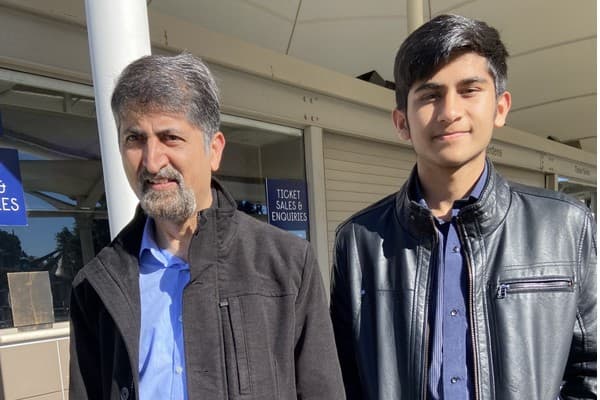
Muhammad Ashraf and his son Arham

Muhammad Ashraf also drove to Sydney from Victoria, from the city of Shepparton, with his son Arham Abdullah. It’s the third time that Arham, who is 13, has attended the conference. “I enjoy coming because I get to meet a lot of friends here,” the Year 8 student says. “I get to learn when I’m here – about my religion, about what other people think of my religion, as well as about other religions.

“It’s important to know what humanity means and to understand the impact of religion on humanity. And it’s very important to focus on the need to be kind to each other. That is more important than anything else.”

Photo: Dr Ata Rehman, president of the Ahmadiyya Muslim Medical Association Australia (Vic Alhadeff)

You might also like
  • Sanctioning settlements is a defence of Israel, not an attack
    Elisheva Madar
  • Sanctions must influence, not just perform disapproval
    Adam Slonim
  • Mind the mentality: not every rejection is antisemitism
    Nomi Kaltmann
logomark.67a07ee3
We believe in the free flow of information

Republish our articles for free, online or in print, by using our Creative Commons licence

You might also like

    Generation change Template
    Generation ChangeInterviewAustralia

    Ash Densham: Building community through Humanistic Judaism

    Gideon Cohen
    jiff26-cancelled.jpg
    ReflectionArts & Culture

    On despair: A reflection after watching ‘Cancelled’

    Deborah Stone
    Lobby
    OpinionAustralia

    Confronting Richard Flanagan and the myth of the Israel lobby

    Mary Garden 9

About the author

Vic Alhadeff

Vic Alhadeff

Vic Alhadeff OAM is former CEO of the NSW Jewish Board of Deputies and former editor of the Australian Jewish News.

More from the author

InterviewArts & Culture

‘The battle for the future of Jews will be fought in the cultural arena’

InterviewWorld

IHRA head: discrediting definition means ‘turning a blind eye’ to anti-Zionism

OpinionArts & Culture

40 years since Lanzmann’s Shoah, his central question remains: When is it too late?

OpinionAustralia

A shocking moment at Sydney Writers’ Festival