Aa
  • Read, Watch, Listen
  • TJI Series
  • Community Action
  • Events
  • Zedi
Follow us and continue the conversation
  • LinkedIn
  • Instagram
  • FaceBook
  • X
  • YouTube
Test yourself with the TJI Quiz!

Adjust size of text

Aa

Follow us and continue the conversation

  • LinkedIn
  • Instagram
  • FaceBook
  • X
  • YouTube

Your saved articles

You haven't saved any articles

What are you looking for?

Original reporting, insightful analysis and diverse views, delivered straight to your inbox

  • LinkedIn
  • Instagram
  • FaceBook
  • X
  • YouTube
Your support fuels our mission to inform, entertain and inspire.

The Jewish Independent is bound by the Standards of Practice of the Australian Press Council. If you believe the Standards may have been breached, you may approach The Jewish Independent or make a complaint to the Australian Press Council in writing at www.presscouncil.org.au. The Council may also be contacted on 1800 025 712.

  • Our Story
  • Contact us
  • Our Team
  • Support us
  • Guidelines
  • Pitch your idea
  • Republishing us
  • Community Action
  • Our Awards
  • LinkedIn
  • Instagram
  • FaceBook
  • X
  • YouTube
Aboriginal FlagTorres Strait Islanders Flag

The Jewish Independent acknowledges Aboriginal and Torres Strait Islander peoples as the Traditional Owners and Custodians of Country throughout Australia. We pay our respects to Elders past and present, and strive to honour their rich history of storytelling in our work and mission.

© The Jewish Independent 2026All Rights Reserved
Website design and development by Your Creative, MelbourneTerms & ConditionsPrivacy Policy
HomeRead, Watch, ListenIsrael
AnalysisIsrael

One in three Israelis does not have shelter from missiles

Poor, elderly, disabled and minority Israelis are less likely to have access to safe rooms or bomb shelters.
Hannah Moshinsky
Print this
bomb shelter  missile iran train station

A family with a two-month-old child takes shelter in a train station during an ongoing rocket attack from Iran in Tel Aviv, Israel on March 1, 2026. (Maya Levin / AFP via Getty Images)

Published: 10 March 2026

Last updated: 11 March 2026

The low number of casualties in Israel relative to Iran or Gaza means Israel is perceived from the outside as almost bullet proof, protected by the iron dome and a network of shelters and safe rooms.

But many Israelis are in fact unprotected and even those who are have no guarantees: two of the nine people killed in the direct hit in Beit Shemesh last week were in a public shelter at the time.  

One in three Israelis does not have access to adequate shelter, according to Israel’s State Comptroller and Ombudsman.

Those on the geographical and social periphery are least likely to have suitable shelter: 50% of non-Jewish Israelis do not have access to a shelter. 

In the past year the government funded 1500 new shelters, but The Association for Civil Rights in Israel(ACRI) found these were primarily placed in the central Gush Dan area, which are the nearly exclusively Jewish cities of Tel Aviv, Ramat Gan, Petah Tikva, Herzliya, Givatyim and Bat Yam. 

Not all shelters are equal

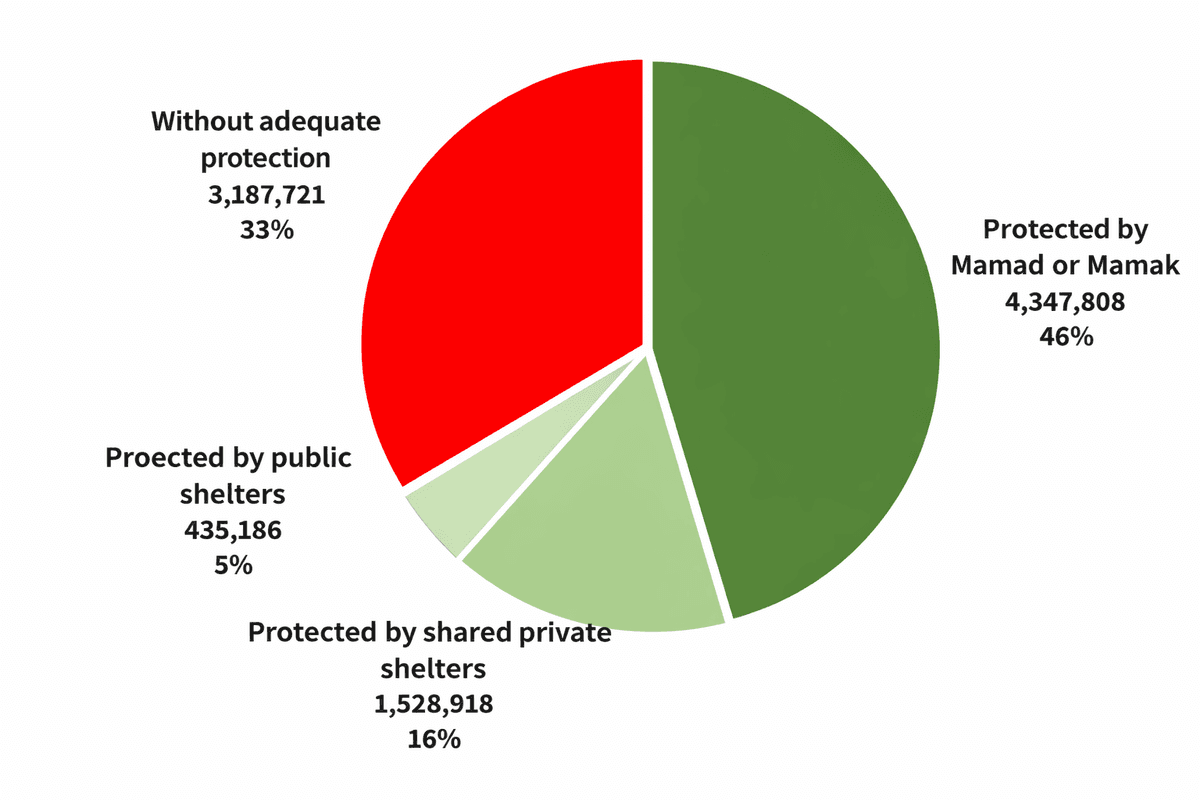
As of data from January 2025 by the Home Front Command, the protection of Israeli residents in a war is the following:

  • 46% - Mamad (Private safe room) or Mamak (internal protected space in a multi-story building 
  • 16% - Miklat (communal shelter) on the ground floor or in the basement of a building 
  • 5% - Public shelter built in a residential area 
  • 33% - No protected space 
Translation by author:&nbsp;<a href="https://fs.knesset.gov.il/globaldocs/MMM/94b51a81-2f16-f111-a13e-005056aa7c52/2_94b51a81-2f16-f111-a13e-005056aa7c52_11_21456.pdf">Protection of Israeli residents in January 2025</a>&nbsp;from data Home Front Command data processed by the Comptroller of the Interior.&nbsp;
Translation by author: Protection of Israeli residents in January 2025 from data Home Front Command data processed by the Comptroller of the Interior. 

Buildings built after 1969 are required by law to have a communal shelter at the base, and taller buildings are required to have an internal shelter. Since 1993, following the 1991 Gulf War, all new apartment buildings and homes are required to have safe rooms.

The best option is a private safe room inside the home, but installing one into an existing home can cost up to NIS 200,000 ($59,300), which most Israelis cannot afford. 

Bedouin and Arab communities

According to the ACRI, more than 150,000 Bedouin citizens living in the Negev live in temporary structures without shelters and have no local authority to build them. Many of these small villages are not recognised by the Israeli government.

Some shelters have been donated in recent years to Bedouin communities, but they do not adequately cover the geographical expanse of all their communities. Many Bedouins rely on shelter under bridges and in makeshift caves in the ground. 

Arab communities also struggle to build shelters, often lacking both financial means and facing legal blocking when seeking permits. Out of 71 Arab local authorities, public shelters were found in only 11 of them.

In a recent appeal by ACRI, which called on the relent defence and ministerial apparatuses to provide adequate safety for non-Jewish citizens of Israel, Attorney Abir Joubran states that "this situation is not only immoral but also unconstitutional and grossly violates the right to equality, and the state's obligations to protect the right to life, protection, and security." 

Elderly people

Filipina carer Mary Anne Velasquez de Vera, 32, was the first casualty from this latest war. She was killed when she chose to stay by the side of Doris Gurin, 89, the woman she cared for in Tel Aviv. Gurin survived and was rescued from the rubble. 

Many older people, often living in older apartments, do not have the physical ability to race flights of stairs to get to a basement or public shelter, especially not repeatedly as is required in the current war.

Mary Anne Velasquez De Vera's (source: Facebook)&nbsp;
Mary Anne Velasquez De Vera's (source: Facebook) 

Disabled people

The Ministry of Welfare and Social Affairs has relocated nearly all of its elderly and disabled residents into fortified facilities or hotels.

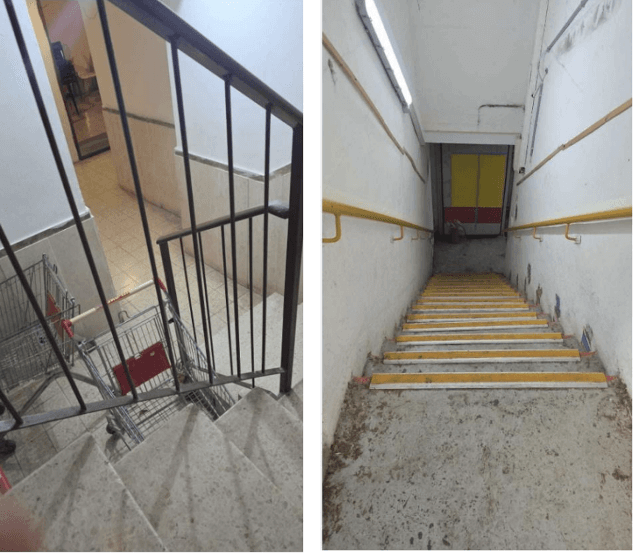
But many disabled citizens who live by themselves or with carers are unable to get to a shelter on time. Many shelters have steps making them inaccessible to those in wheelchairs, as disability advocate Be-Shvil Gisha recently observed. 

Image from a<a href="https://fs.knesset.gov.il/globaldocs/MMM/94b51a81-2f16-f111-a13e-005056aa7c52/2_94b51a81-2f16-f111-a13e-005056aa7c52_11_21456.pdf">&nbsp;recent report by the Knesset</a>.&nbsp;
Image from a recent report by the Knesset. 

Young families

For families, it can be impossible to get small children to a public shelter in time. 

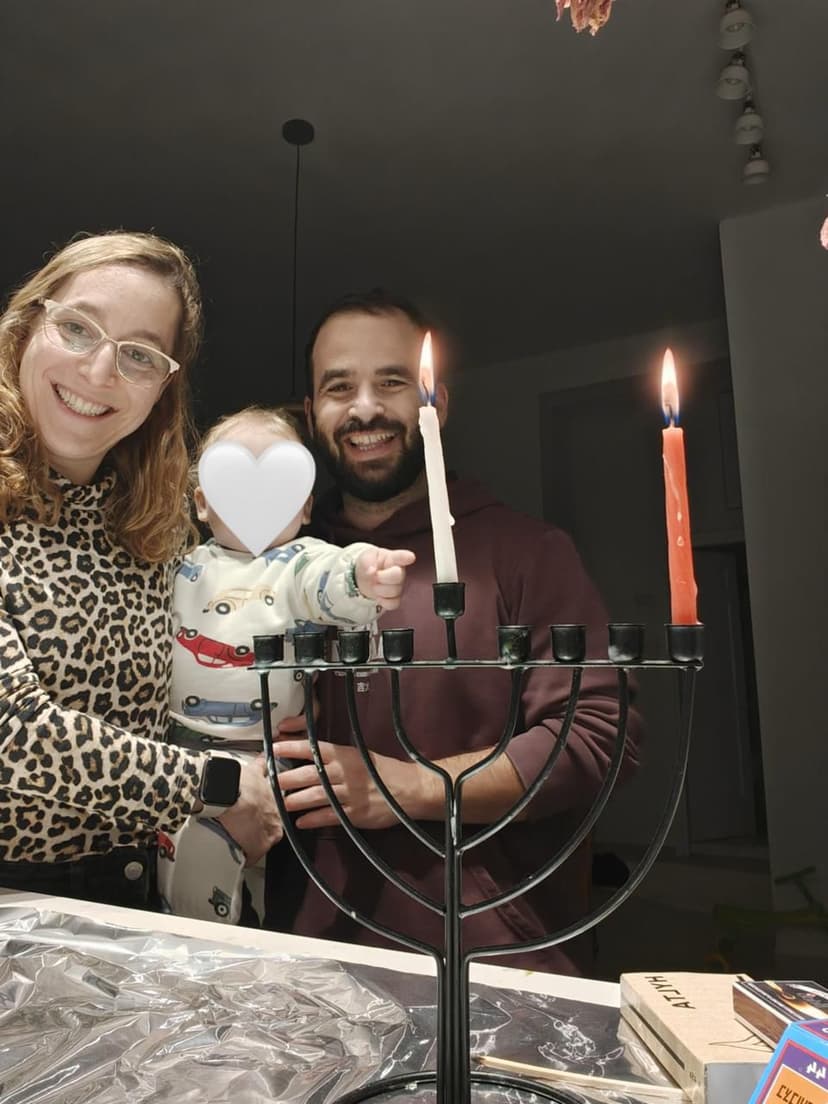
Oren Perl and her husband Nadav Uzan have had to evacuate from their shelterless apartment because they could not get from their third-floor apartment to a shelter carrying their 20-month baby. 

Oren Perl, their 20-month baby and her husband Nadav Uzan have had to evacuate from their home in Tel Aviv.

Perl said the couple had previously taken shelter in the basement of a building across the street, but it was not sufficiently secure against Iranian missiles.

“A place like that doesn’t provide enough protection or safety, so it’s not really secure… and since we have a small baby, we can’t and don’t want to take that risk. So, we decided that we can’t stay in our home right now.”

They are staying with relatives in another city who have a safe room.

Perl says it’s hard not being in her own home and she worries for her neighbours in Tel Aviv. “We have an elderly neighbor across from us, and every time there’s a siren, we check on her and make sure she makes it to the shelter on time.”

Not everyone has relatives to go to. Many Israelis are staying in underground train stations or other safe areas because their own homes are not safe. 

Essential Workers

Many essential workers risk their life because their physical labour is essential under the emergency economy conditions, such as facilities that provide water, electricity, fuel, gas, emergency medical services, and, of course, the army.

Some essential workers operate in open areas and thus do not always have access to a shelter and rely on personal protective equipment, lying on the ground, and protecting their head with their hands.

As Velasquez De Vera's death indicates, many carers also put their life on the line to stay with patients unable to get to a shelter.

Domestic violence increase

It must also be noted that safety from missiles does not condition safety in totality. Sadly, there is an increase in domestic violence in times of war, reported by both the Israeli Ministry of Social Affairs and other international studies. 

The Israeli domestic report found that reports of domestic violence more than doubled following October 7, with 4565 cases from October 2023-2024 compared to 2760 cases from October 2022-20223. While there are many factors at play, the main component in Israel’s current context of war is the heightened stress and the safety risks of leaving one's home.

You might also like
  • ‘Israel is systemically eliminating Palestinian collective life’:  B’Tselem
    Deborah Stone
  • Tame apologises – but with little grace
    Deborah Stone
  • Confronting Richard Flanagan and the myth of the Israel lobby
    Mary Garden
logomark.67a07ee3
We believe in the free flow of information

Republish our articles for free, online or in print, by using our Creative Commons licence

You might also like

    Netanyahu
    Israel Hamas WarFeatureIsrael

    New evidence Netanyahu was warned about October 7

    Shahar Burla 2
    Woman with land and houses behind her
    NewsAustralia

    Australia to increase sanctions against West Bank settlements

    Deborah Stone 2
    Yoav Segalovitz Mansour Abbas
    Israel Votes 2026OpinionIsrael

    Because of my Zionist values, I’m joining an Arab party

    Yoav Segalovitz 1

About the author

Hannah Moshinsky

Hannah Moshinsky

author

Hannah Moshinsky completed a Bachelor of Arts in History and Politics at the University of Melbourne and was involved in various Melbourne-based community organisations, including Kehilat Kolenu and Habonim Dror. Hannah made aliyah at the start of 2024 and is currently the madricha (youth leader) of Habonim Dror Shnat.

More from the author

FeatureIsrael

Meet some young Aussies weathering war during their gap year

FeatureIsrael

When the party moves to the bomb shelter

OpinionAustralia

A Palestinian Solidarity Sukkot needs to invite Israelis

Comments1

  • Avatar of Mark Ian

    Mark Ian15 March at 01:56 am

    It is a disgrace and over the next Decade Deep Underground Shelters like in Eastern Europe and Switzerland are needed .
    This is though passive type Defense and Deterrence with Ballistic Missiles and hundreds of thousands of Drones are for the Party of War .
    The Party of Peace would offer an International Interim Palestine Trusteeship backed by Armed Troops in the majority of the West Bank but all Jihadi would have to be crushed as well as the hilltop settler psychopaths .