Aa
  • Read, Watch, Listen
  • TJI Series
  • Community Action
  • Events
  • Zedi
Follow us and continue the conversation
  • LinkedIn
  • Instagram
  • FaceBook
  • X
  • YouTube
Test yourself with the TJI Quiz!

Adjust size of text

Aa

Follow us and continue the conversation

  • LinkedIn
  • Instagram
  • FaceBook
  • X
  • YouTube

Your saved articles

You haven't saved any articles

What are you looking for?

Original reporting, insightful analysis and diverse views, delivered straight to your inbox

  • LinkedIn
  • Instagram
  • FaceBook
  • X
  • YouTube
Your support fuels our mission to inform, entertain and inspire.

The Jewish Independent is bound by the Standards of Practice of the Australian Press Council. If you believe the Standards may have been breached, you may approach The Jewish Independent or make a complaint to the Australian Press Council in writing at www.presscouncil.org.au. The Council may also be contacted on 1800 025 712.

  • Our Story
  • Contact us
  • Our Team
  • Support us
  • Guidelines
  • Pitch your idea
  • Republishing us
  • Community Action
  • Our Awards
  • LinkedIn
  • Instagram
  • FaceBook
  • X
  • YouTube
Aboriginal FlagTorres Strait Islanders Flag

The Jewish Independent acknowledges Aboriginal and Torres Strait Islander peoples as the Traditional Owners and Custodians of Country throughout Australia. We pay our respects to Elders past and present, and strive to honour their rich history of storytelling in our work and mission.

© The Jewish Independent 2026All Rights Reserved
Website design and development by Your Creative, MelbourneTerms & ConditionsPrivacy Policy
HomeRead, Watch, ListenIsrael
OpinionIsrael

God weeps on Jerusalem Day

The way we treat others is the way we are relating to God. Anything less is heretical
Bryan Conyer
Print this
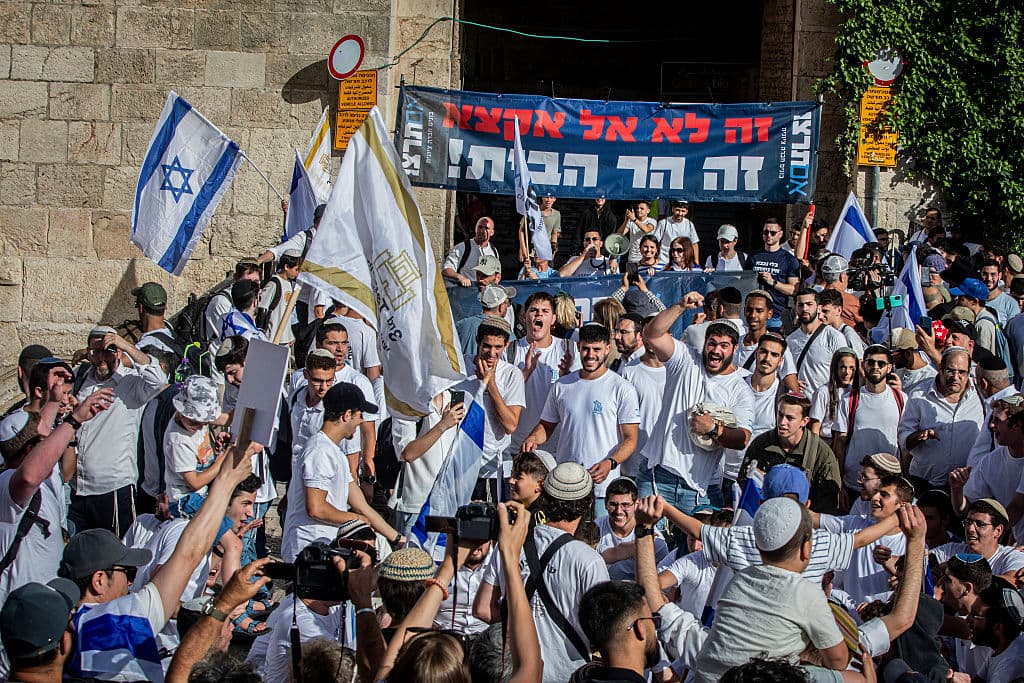
Israeli right wing youths wave their national flags outside

Right wing youths wave flags and display a banner reading ‘This is not Al Aqsa, this is Temple Mount’ outside Damascus gate on Jerusalem Day 2026 (Eyal Warshavsky/SOPA Images/LightRocket via Getty Images)

Published: 20 May 2026

Last updated: 21 May 2026

According to the Talmud, God cries only in God’s most inner chambers. Yet, when God’s children are suffering, our sages explain, God openly releases two tears into the ocean, which reverberate like an earthquake throughout the world.

The Talmud continues to identify three moments that cause God to cry: when one can study Torah but does not; when one struggles to engage with Torah and still does; and when a leader abuses authority. I believe that God wept again on Yom Yerushalayim (Jerusalem Day).

My wife and I chose to get married on Yom Yerushalayim. The thought of us uniting on this day, on the anniversary of the Jewish people once again being returned as our whole eternal capital city, gifted our marriage the promise to live in tandem with the Jewish story.

For our engagement, she bought me a new pair of tefillin, as the line said while putting on tefillin, mostly by Jewish men throughout the ages: “And I will espouse you forever: I will espouse you with righteousness and justice, and with goodness and mercy,” resonated with our personal vision, and compelled us to emulate God’s values.

It was not lost on us that we face Jerusalem while saying our prayers. Our sages go further and teach us that even God wears tefillin. “Rav Ḥiyya bar Avin: What is written in the tefillin of the ruler of the world? Rav Ḥiyya bar Avin replied: It is written: “Who is like your people, Israel, one nation in the land?”

Yom Yerushalayim, 1967, created the promise of a divided city once again unified. Jerusalem’s name: Ir Shalom: City of peace/ wholeness, could become this new reality. Our prayers to be reunited with it were answered. Without Jerusalem, we were incomplete.

Yet, this year, like so many before it, Yerushalayim was trampled by mobs of hate-mongers who turned what should be a day of joy and celebration into one of sinat chinam (baseless hatred). As self-proclaimed Torah devotees they marched through the old city of Jerusalem, deliberately targeting the residents of the Muslim Quarter, with cries of “death to the Arabs”, upturning furniture both in and outside of their shops and antagonising anyone that they identified as an “other”.

Acting on a right is not always the holy choice

The police, it has been reported, apparently mostly to protect these marchers, threw out journalists, and gut punched and removed other devout Jews there to embrace all of Jerusalem’s residents in a united city under Jewish rule. Itamar Ben Gvir, Israel’s offensive Minister of National Security, provocatively promotes this police positioning, and began the day praying on the Temple Mount.

While praying on one of our most holy of spaces should be a Jewish right under a sovereign Israel, acting on a right is not always the holy choice. The devoutly religious Israeli philosopher, Yeshayahu Leibowitz, warned us that: “The idea that a specific country or location has an intrinsic ‘holiness’ is an indubitably idolatrous idea. Kal v’Chomer (all the more so), when applied to its capital city."

Rav Kook, Israel’s first Chief Rabbi said it best: “The holiness of the land is revealed only through the holiness of life lived upon it.” Bereishit Rabbah 24:7 goes further: “One who shames another person is as though they have shed blood …because they have diminished the image of God.” How could these “religious marchers” claim that they are living in any way close to Judaism’s most cherished values?

Part of Judaism’s genius is that Jews only enter God’s creation in the 20th generation of human existence. Before this, we are told that all humans are made “B’tzelem” – in God’s image. At times, it is argued that mitzvot can be swept aside for the sake of upholding human dignity: “Great is human dignity (kavod habriyot), for it overrides a negative commandment of the Torah.” Human dignity is the essence of how we live Jewish values. The way we treat others is the way we are relating to God. Anything less is heretical.

Only a few days after Yom Yerushalayim, we revisit the anniversary of us receiving the torah at Mount Sinai with Shavuot. While tradition tells us that Sinai was covered in flowers, some Jew tried to reduce the harm of these “marchers” by handing a conciliatory flower to the victims. Is this enough?

Rashi (the medieval French rabbi) says that on our first Shavuot we stood at Mount Sinai as an Am Echad b’lev Echad: as one people with one heart. Shavuot itself is about union. God’s fundamental quality is oneness. Yet, we begin Shavuot with a Tikkun Leil Shavuot. Tikkun is an act of repair. We are told that rather than zealously awaiting God’s revelation, our ancestors slept through it. So, we, their inheritors, stay up all night as an act of teshuva (repentance).

For Jews, we know we live in a broken world. Our imperative is to repair it. Rabbi Nachman of Breslov said: "If you believe that it is possible to damage, believe that it is possible to repair." What type of tikkun is now demanded by us as we look non-Jewish Israeli citizens and residents in their eyes and walk past them? What do we say to God when we are deaf to God’s words while celebrating the unity of God’s united city of peace? Till we answer that, God cries.

Bryan Conyer wrote this article in a personal capacity. References for this article can be found here.

You might also like
  • Israel is cementing its control over the West Bank and East Jerusalem while the world is distracted
    Martin Kear
  • Abuse by IDF soldiers humiliates Muslim Palestinians
    Ben Lynfield
  • Beinart takes a wrecking ball to Israel
    Michael Visontay
logomark.67a07ee3
We believe in the free flow of information

Republish our articles for free, online or in print, by using our Creative Commons licence

You might also like

    ISRAEL-TRANSPORT-AVIATION-STRIKE
    Israel Votes 2026AnalysisIsrael

    Bennett’s balancing act: can he win over the right without losing the centre?

    Shahar Burla 1
    Activists attempt to deliver supplies to Palestinian families near Nablus
    OpinionIsrael

    Qusra siege exposes shared agenda of IDF and settler extremists

    Ben Lynfield
    Marwan Barghouti demonstration
    Israel Hamas WarAnalysisIsrael

    Palestinians disillusioned with Hamas and armed struggle: new survey

    Shahar Burla

About the author

Bryan Conyer

Bryan Conyer

Bryan Conyer is a Jewish educator and Head of Jewish Studies at Bialik College. He writes in a personal capacity.

Comments1

  • Avatar of Ian Grinblat

    Ian Grinblat24 May at 12:36 am

    I am profoundly disappointed by this article. Here was an opportunity to explore some meaty issues but the writer has fallen back on feelings.
    I don’t want to rain on his parade but it seems that he and his partner, in the flush of young love, forgot that Jerusalem was reunited through war, albeit a defensive war.
    It is true that asserting a right does not necessarily lead to peace, but in the current situation, where the right of the entire Jewish people to land and life is challenged in deed as well as hate speech, I see no harm in asserting sovereignty legitimately acquired in a defensive war. I only wish that in 1967, the then-leaders of Israel had been so assertive.