Aa
  • Read, Watch, Listen
  • TJI Series
  • Community Action
  • Events
  • Zedi
Follow us and continue the conversation
  • LinkedIn
  • Instagram
  • FaceBook
  • X
  • YouTube
Test yourself with the TJI Quiz!

Adjust size of text

Aa

Follow us and continue the conversation

  • LinkedIn
  • Instagram
  • FaceBook
  • X
  • YouTube

Your saved articles

You haven't saved any articles

What are you looking for?

Original reporting, insightful analysis and diverse views, delivered straight to your inbox

  • LinkedIn
  • Instagram
  • FaceBook
  • X
  • YouTube
Your support fuels our mission to inform, entertain and inspire.

The Jewish Independent is bound by the Standards of Practice of the Australian Press Council. If you believe the Standards may have been breached, you may approach The Jewish Independent or make a complaint to the Australian Press Council in writing at www.presscouncil.org.au. The Council may also be contacted on 1800 025 712.

  • Our Story
  • Contact us
  • Our Team
  • Support us
  • Guidelines
  • Pitch your idea
  • Republishing us
  • Community Action
  • Our Awards
  • LinkedIn
  • Instagram
  • FaceBook
  • X
  • YouTube
Aboriginal FlagTorres Strait Islanders Flag

The Jewish Independent acknowledges Aboriginal and Torres Strait Islander peoples as the Traditional Owners and Custodians of Country throughout Australia. We pay our respects to Elders past and present, and strive to honour their rich history of storytelling in our work and mission.

© The Jewish Independent 2026All Rights Reserved
Website design and development by Your Creative, MelbourneTerms & ConditionsPrivacy Policy
HomeRead, Watch, ListenAustralia
Australia

101 and still going strong, Berysz’s memory of the ghetto is forensic

Nomi Kaltmann
Print this

Published: 13 August 2021

Last updated: 4 March 2024

NOMI KALTMANN sits down to talk to her Caulfield neighbour, Berysz Aurbach, about the dramatic life’s journey he has led, from Warsaw to Melbourne

THIS PAST DECEMBER, a clip did the rounds on social media showing 100-year-old Holocaust survivor Berysz Aurbach standing at the lectern of Melbourne’s Caulfield Bet Hamedrash Synagogue reciting Kaddish for his late mother, Rivka, on the 100th anniversary of her death.

This moment was especially poignant as it almost did not happen. Synagogues in Melbourne had only reopened a few weeks prior following extensive Covid lockdowns which had shuttered all places of worship for many months during 2020.

I found the video particularly moving because Berysz Aurbach is my neighbour. When my husband and I moved to Caulfield a few years ago, every Saturday morning at 9.30am we would see our new neighbour in his wheelchair, being pushed to synagogue by his son Moshe.

This month is a cause for big celebration in our street: next Tuesday, on August 17, Berysz will be celebrating his 101st birthday.

To this day he can recite the prayers and Torah that he learnt as a youth in his local Polish Talmud Torah school.

His good health, despite his age, demonstrate the massive changes in healthcare and technology that have taken place since his mother died of typhus when he was a small baby, more than 100 years ago.

Born in 1920, Berysz comes from a long line of Hasidic rabbis. His family had lived in the Polish town of Biala Podlaska for hundreds of years, which is known for its connection to the Ger Hasidic sect.
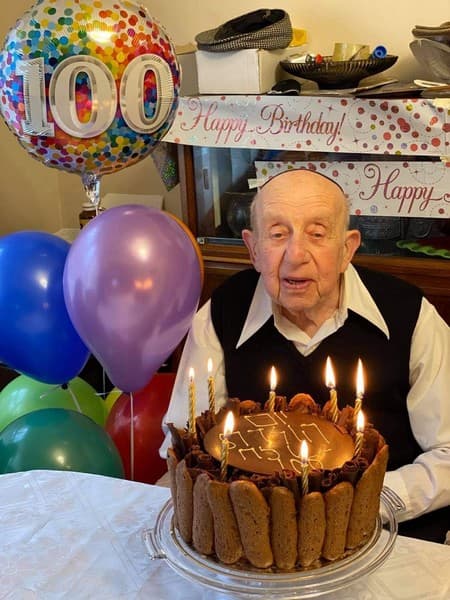
Berysz celebrates his 100th birthday last year

He had three elder brothers and a sister, as well as a half-brother from his father’s second marriage. His family life was comfortable, and to this day he can recite the prayers and Torah that he learnt as a youth in his local Polish Talmud Torah school.

Despite his age, Berysz has full movement and precise mental recall. He provided me with a copy of his two-and-a-half-hour Holocaust survivor testimony he recorded in 1996 for the Jewish Holocaust Museum in Elsternwick. 

When I sat to interview him, he spoke for over two hours with unrelenting clarity, with every detail identical to the original testimony he recorded 25 years prior.

His story of survival is captivating. “My life is very rich; I have experienced many things,” he says.

Berysz was one of the last survivors to be smuggled out of the Warsaw Ghetto on the eve of the uprising, just prior to Passover 1943. In his words, “the ghetto was already burning and on fire” as he was taken to a safe house on the Polish side.

His family history is intertwined with the heroes of the Warsaw Ghetto uprising. Berysz’s brother, Mordecai Aurbach, was the head of the right-wing Zionist youth group, Hanoar Hazioni, which alongside other youth movements in the ghetto (including Hashomer Hatzair, led by Mordechai Anielewicz) formed the Jewish Fighting Organisation.

According to Berysz, his elder brother played an integral role in smuggling weapons and obtaining finance to pay for the arms that were used by Anielewicz and the other Jews to fight the Germans during the uprising.

“My elder brother Mordechai, together with other ghetto leaders, went to rich people in Warsaw to obtain money for arms,” he says. “Rich people gave him and other leaders money after my brother convinced them to fund resistance in the ghetto.”

It was through his brother that Berysz was provided safe passage from the ghetto.

However, Berysz’s safety came with a terrible caveat: while he would be hidden on the Polish side, hiding places for other immediate family members in the ghetto, including his father and brothers, could not be secured.

“My brother Mordechai didn’t have the full say on who went into hiding. It was a committee of members from the Hanoar Hazioni youth movement in the ghetto who made decisions about who was given a place in hiding” he says.

Berysz's brother, Mordechai Aurbach, as a young man

“After a lot of arguments with the committee, Mordechai managed to find a place for me,” notes Berysz. But this decision was not without controversy, “Some people on the committee said he did too much for me, his brother.”

Mordechai Aurbach was also able to smuggle himself out to safety from the ghetto. “My brother had also arranged for himself a hiding place, along with his girlfriend,” says Bersyz. “But while in hiding, Mordechai was betrayed to the Gestapo, who shot and killed him.”

Their father and brothers left behind in the ghetto were also killed. “I do not know the exact date, so I mark their Yahrzeit on Passover, when the ghetto was set on fire by the Nazis,” he says. 

My dad, he is really something special, I promise you: he will be putting us all in a nursing home before he goes into one!

Tragically, aside from his sister Esther who moved to Palestine prior to the outbreak of the Second World War, all his immediate family perished during the Holocaust.

After realising that he had no one left in Poland, Berysz contacted an elderly uncle who had moved to Australia in 1936, Noah Blass. “He sponsored my visa and allowed me to immigrate to Australia,” he says. 

Before immigrating to Melbourne, he returned to his town of birth, Biala Podlaska. There, he found that the Jewish Cemetery had been destroyed and the tombstones had been used for making roads.

The remaining Polish people in the town let the returning Jews know that during the war the Nazis had executed many Jews but had not afforded them proper burials. Instead they were buried in people’s yards scattered across the town.

Berysz and a committee of other returned Holocaust survivors decided to bury these murdered Jews properly. “I, and the Committee, gave up our time and worked to dig out these people from every yard and street and place the corpses into a communal grave.”

After completing this task, in 1947 Berysz arrived in Melbourne, where he owned and operated a knitting mill on Lygon Street in Carlton. However, after a few years, he had not yet found a wife, so he moved to Israel in search of a partner.

“I wanted to get married, and meet a wife, so in 1956 I went to Israel.”  While in Jerusalem, he met Tova. They got married and moved back to Australia and had three children.

Since arriving in Melbourne, Berysz has lived a rich and happy life. However, as I sit with him and his son Moshe, it is clear that remembering the past weighs heavily on them both.

The mantlepieces in their home display the pictures of those who were killed in the Holocaust, as well as pictures of happier times in Berysz’s life.

Speaking to a living legend in walking distance of my home had been a huge pleasure and learning experience.

As Moshe led me to the door, he quipped: “My dad, he is really something special, I promise you: he will be putting us all in a nursing home before he goes into one!”

Photo: Berysz with his son Moshe (supplied)

You might also like
  • Jimmy Carter at 100: his Jewish legacy
    Dan Coleman
  • Caulfield and Coogee: a chilling new phase in physical hostility towards Jews
    Michael Visontay
  • ARNOLD ZABLE: Remembering the Warsaw Ghetto uprising in an age of growing hate
    Arnold Zable
logomark.67a07ee3
We believe in the free flow of information

Republish our articles for free, online or in print, by using our Creative Commons licence

You might also like

    chai necklace copy
    ReflectionAustralia

    Facing my mortality, the Book of Life is no metaphor

    Talia Slonim 4
    antisemitism online
    NewsAustralia

    Proposed digital care law to offer protection against online antisemitism

    Deborah Stone
    jiff26-cancelled.jpg
    ReflectionArts & Culture

    On despair: A reflection after watching ‘Cancelled’

    Deborah Stone

About the author

Nomi Kaltmann

Nomi Kaltmann

Nomi Kaltmann is an Australian lawyer and journalist. Her writing has appeared in major Australian and international publications including Crikey, Griffith Review, Mamamia, Tablet Magazine, The Australian Financial Review, The Daily Beast, The Forward, The Guardian, The Jewish Telegraphic Agency and The Spectator. She regularly appears on radio and podcasts to discuss Australia’s Jewish community, including NPR (USA), CBC (Canada), LBC (London), Call Me Back, Unholy: Two Jews on the News, SBS and The Times of Israel. An influential Orthodox feminist leader and founding president of the Jewish Orthodox Feminist Alliance (JOFA Australia), she is a sought-after speaker on religion, interfaith and contemporary Jewish life.

More from the author

OpinionAustralia

Mind the mentality: not every rejection is antisemitism

OpinionAustralia

Cancellation backfires but we are at it again

OpinionWorld

From NY to Melbourne, local politicians are whipping up hate 

ReflectionAustralia

I have lost faith in our multicultural institutions