Aa
  • Read, Watch, Listen
  • TJI Series
  • Community Action
  • Events
  • Zedi
Follow us and continue the conversation
  • LinkedIn
  • Instagram
  • FaceBook
  • X
  • YouTube
Test yourself with the TJI Quiz!

Adjust size of text

Aa

Follow us and continue the conversation

  • LinkedIn
  • Instagram
  • FaceBook
  • X
  • YouTube

Your saved articles

You haven't saved any articles

What are you looking for?

Original reporting, insightful analysis and diverse views, delivered straight to your inbox

  • LinkedIn
  • Instagram
  • FaceBook
  • X
  • YouTube
Your support fuels our mission to inform, entertain and inspire.

The Jewish Independent is bound by the Standards of Practice of the Australian Press Council. If you believe the Standards may have been breached, you may approach The Jewish Independent or make a complaint to the Australian Press Council in writing at www.presscouncil.org.au. The Council may also be contacted on 1800 025 712.

  • Our Story
  • Contact us
  • Our Team
  • Support us
  • Guidelines
  • Pitch your idea
  • Republishing us
  • Community Action
  • Our Awards
  • LinkedIn
  • Instagram
  • FaceBook
  • X
  • YouTube
Aboriginal FlagTorres Strait Islanders Flag

The Jewish Independent acknowledges Aboriginal and Torres Strait Islander peoples as the Traditional Owners and Custodians of Country throughout Australia. We pay our respects to Elders past and present, and strive to honour their rich history of storytelling in our work and mission.

© The Jewish Independent 2026All Rights Reserved
Website design and development by Your Creative, MelbourneTerms & ConditionsPrivacy Policy
HomeRead, Watch, ListenAustralia
ReflectionAustralia

Arnold Zable remembers Abram Goldberg’s epic life

Abram Goldberg spent his life bearing witness. He spoke for the millions whose voices were silenced. But he turned pain into wisdom, and suffering into compassion.
Arnold Zable
Print this
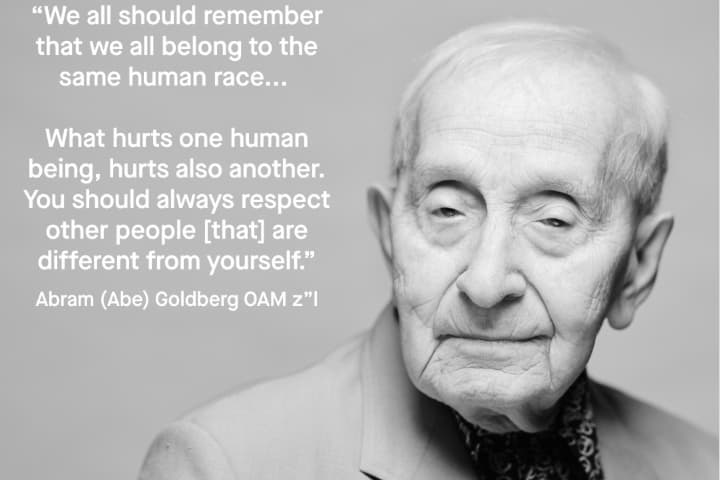
Image of old man with a quote "One shold always remember we all belong to the human race"

Abram Goldberg, as remembered by the Melbourne Holocaust Museum (MHM)

Published: 10 November 2025

Last updated: 10 November 2025

Abram Goldberg died in Cabrini hospital on September 21. He was approaching his 101st birthday.  I write my tribute on his shloshim, 30 days after his passing, marking an end to an intense period of mourning. In the secular adaptation, it is a time to look back and reflect on a life. And what an epic life Abram lived.

Born in Lodz, the youngest of four siblings, Abram’s life pivoted on a promise he made to his mother, on 29 August 1944, the day he arrived with her in Auschwitz-Birkenau. Do everything humanly possible to survive, she insisted,  before they were separated. Wherever you find yourself, tell the world happened to your family and to your people.

Abram fulfilled the promise. He spent his life bearing witness. He seized every chance he had to tell his story. He spoke at countless forums. He was a founding member of the Melbourne Holocaust Museum where he guided many thousands of school children and adults. Just weeks before his passing he was at the museum, still sharing his life’s journey. He spoke of his murdered father, mother, siblings, extended family. He spoke for the millions whose voices were silenced.

A lifelong member of the Jewish Labour Bund, Abram embodied its social democratic and egalitarian principles, and its emphasis on friendship and community. The Bund was family. I first met Abram when I was seven years old at a Bund gathering. I saw him for the final time 70 years later, two weeks before his passing. He lay in state at Cabrini hospital surrounded by his loved ones and a constant stream of visitors. He knew the end was near, but he cherished each remaining day, regardless.
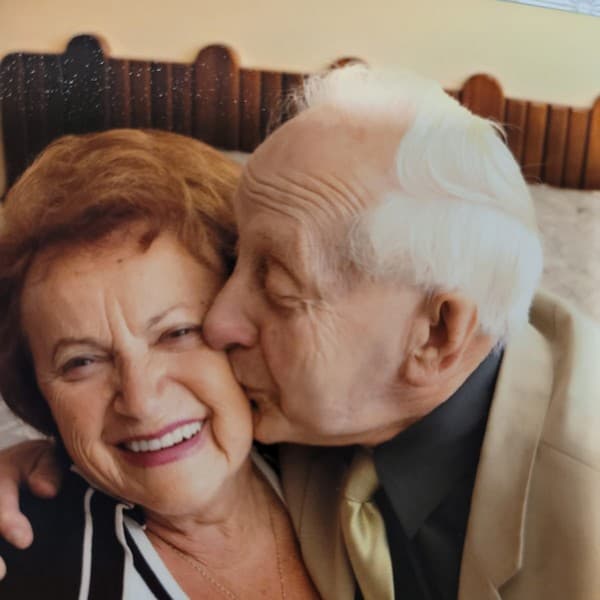
Abram and Cesia - a 70-year- romance

I sat bedside and leant in close so that I could hear his fading voice. We spoke in Yiddish, the beloved mother tongue, a language that evolved out of centuries of wandering, a language that knows no borders. We chatted for a while, and I then asked him three leading questions. His answers were sharp and immediate. He did not hesitate. He knew what he wanted to say  and he did so with spontaneous certainty. 

The first question: Abram, what was the most beautiful moment in your long life? “Reuniting with Bono Wiener in Lodz in 1945,” he answered. Bono Wiener was a co-founder of the Melbourne Holocaust Museum, a builder of institutions, a Bund legend. He was a fierce and much loved mentor to many. As a young man, he became a leader of the resistance in the Lodz ghetto.

Secret radio

For a number of years Bono and the teenage Abram shared a secret radio between them. The radio was divided in two parts and hidden in  aluminium billies. It was reassembled in the attic at home, or in the metal factory where both Abram and Bono worked. During the day, Abram carried one half, Bono the other. To be caught with a radio meant certain torture and execution. Seventeen radio operators were arrested and shot at various times in the ghetto.

They would have made an odd couple, the six-foot Bono alongside the five-foot Abram. When the coast was clear they would join the parts together. As a foreman at the factory, Abram covered for Bono while he listened to the radio. Bono tuned in to the BBC, the Polish radio station, ‘Swit’, and to the Polish underground and government-in-exile. Ghetto inmates were informed of the extermination camps and stripped of their illusions. They were made aware of the progress of the war and the rising number of allied victories. The radio reports lifted morale, and helped the resistance plan the way forward. 

In July and August 1944, as the liquidation of the ghetto was imminent, Bono and Abram buried the radio as part of an archive which was stored in two metal boxes. They buried them in two separate places — a stinking latrine in the courtyard of a ghetto tenement, and beneath a tree near the Lodz cemetery, and vowed that whoever survived would return to recover the boxes. They included documents, posters, diaries, eyewitness accounts, photos, minutes of resistance meetings, and that secret radio.

Abram was liberated on May 2, 1945, from the Wöbbelin concentration camp in Germany. It took him three weeks to hitch hike back to Lodz through a war-torn landscape. It was rumoured that Bono had not survived. Abram located one of the boxes. He kept several personal items and handed the rest to the Jewish Labour Bund which had regrouped in Lodz.

Regretfully, the radio was not recovered. Abram left Poland to search for survivors in the Displaced Persons camps in Germany, and when he returned in October 1945, he was reunited with Bono, who had been liberated from the Gusen labour camp. Bono and Abram were elated. Yes, it was a beautiful moment.

The second question: Abram. What is der iker, the essence, the most important thing in life? “To be a mensch,” Abram answered. A good person. No further explanation needed. Abram practiced what he advocated. He was small in stature but a giant in his fierce advocacy for a better world, and in his glorious capacity for friendship. And he did it alongside his partner of seventy years, his beloved Cesia, who was liberated a near skeleton from the Bergen-Belsen concentration camp.

Abram and Cesia in Brussels, 1947

Cesia a pocket dynamo

Cesia was a pocket-sized dynamo. She too served the community in many guises. For many years Abram and Cesia ran the popular city café, Goldy’s, located at 212 Little Collins Street. The couple knew how to both feed and entertain their many loyal customers, among them theatre goers and actors, eager for company after a night performance.  Abram and Cesia loved to party, and to have people around them. And despite what they had endured, perhaps because of it, they exuded great joy.

Hence my third and final question: Abram. What was the funniest moment of your one hundred years on the planet? “When I saw Australian Rules football played for the first time,” he replied. He chuckled as he answered. Abram and Cesia arrived in Melbourne in 1951.  Abram’s sister-in-law, Hela, had migrated a year earlier. Her family lived in a two-storey terrace house, opposite the Brunswick Street Oval, the Fitzroy football ground.

Abram could see the players in action from the second-floor balcony. “It was hilarious,” he said. “I saw grown men running in circles, pushing each other, bumping each other, hitting each other, twisting this way and that. Chasing a strange oval ball that bounced this way and that.”

I was one of the many who loved Abram and rejoiced in his company. This was the great paradox: Abram and Cesia, who died just six months earlier, experienced the darkest of times. They witnessed the worst in human behaviour and endured many horrors. Yet they lived a life of joy and inspired joy in others.  They were light in spirit, so easily hugged.

When Abram shared his story, he had in mind both the specific tales and their universal significance. As his daughter Helen and son Charlie said at his funeral, their father “survived not to be a prisoner of the past, but to be a guardian of the future... Abram turned pain into wisdom, and suffering into compassion.”

Abram understood that beyond our tribal affinities lay a deeper truth, a common humanity. We need that vision so dearly in these divided and warring times. And we need his democratic and egalitarian spirit when all too many nations are turning to authoritarian rule. As Abram’s children pointed out in their joint eulogy, their father taught everyone he encountered that we all belong to the same human race. What hurts one human being, hurts also another.

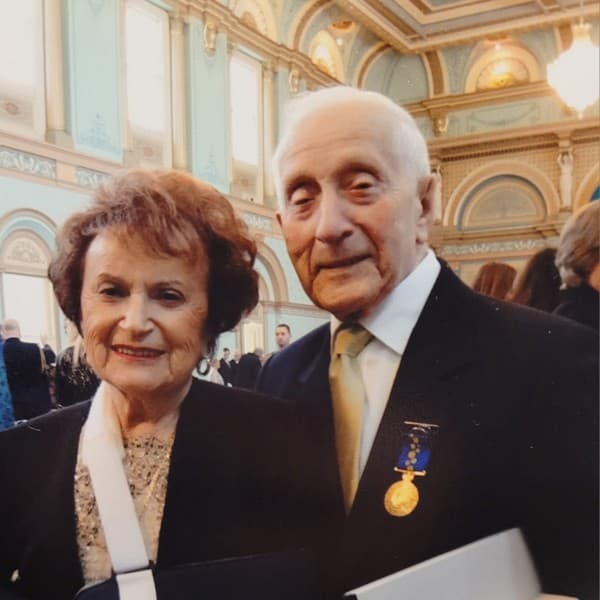
Abram receiving his OAM in 2013

As his 100th birthday approached, Abram joked that it would take the MCG to accommodate his many friends. He had to settle for the Glen Eira townhall. Almost 500 attended. Abram sat on stage, and his great granddaughter, seven-year-old Sienna, leant on his regal armchair throughout the many speeches. Abram was adored by his children, grandchildren, great grandchildren, extended family, and all who knew him. He loved people. He loved to dance. He loved good food. He loved a good joke. On his shloshim I raise a vodka, his favourite spirit, and drink a toast to a true mensch. To Abram. L’chaim.

This article was first published in Eureka Street

You might also like
  • Antisemitism, homophobia and a radical response to both
    Dennis Altman
  • Tame apologises – but with little grace
    Deborah Stone
  • Confronting Richard Flanagan and the myth of the Israel lobby
    Mary Garden
logomark.67a07ee3
We believe in the free flow of information

Republish our articles for free, online or in print, by using our Creative Commons licence

You might also like

    Generation Change: Rachel Moshel
    Generation ChangeInterviewArts & Culture

    Rachel Moshel: Creating a space for Jewish art and joy

    Gideon Cohen
    funding handouts
    NewsAustralia

    Who will get the money from the Cranbourne windfall?

    Gideon Cohen
    Royal Commission final
    Royal CommissionNewsAustralia

    Strategies for cohesion final focus of Royal Commission hearings

    Peter Kohn 1

About the author

Arnold Zable

Arnold Zable

Arnold Zable is a writer and novelist and the recipient of the 2021 Australia Council Award for Lifetime Achievement in Literature. His account of his first journey to Poland, "Jewels and Ashes," was published in 1991.

More from the author

FeatureArts & Culture

Yentl’s masterstroke takes Yiddish theatre from fiasco to Opera House

ReflectionArts & Culture

To a Caulfield boy from a Carlton boy

World

ARNOLD ZABLE: Remembering the Warsaw Ghetto uprising in an age of growing hate

Comments

No comments on this article yet. Be the first to add your thoughts.