Aa
  • Read, Watch, Listen
  • TJI Series
  • Community Action
  • Events
  • Zedi
Follow us and continue the conversation
  • LinkedIn
  • Instagram
  • FaceBook
  • X
  • YouTube
Test yourself with the TJI Quiz!

Adjust size of text

Aa

Follow us and continue the conversation

  • LinkedIn
  • Instagram
  • FaceBook
  • X
  • YouTube

Your saved articles

You haven't saved any articles

What are you looking for?

Original reporting, insightful analysis and diverse views, delivered straight to your inbox

  • LinkedIn
  • Instagram
  • FaceBook
  • X
  • YouTube
Your support fuels our mission to inform, entertain and inspire.

The Jewish Independent is bound by the Standards of Practice of the Australian Press Council. If you believe the Standards may have been breached, you may approach The Jewish Independent or make a complaint to the Australian Press Council in writing at www.presscouncil.org.au. The Council may also be contacted on 1800 025 712.

  • Our Story
  • Contact us
  • Our Team
  • Support us
  • Guidelines
  • Pitch your idea
  • Republishing us
  • Community Action
  • Our Awards
  • LinkedIn
  • Instagram
  • FaceBook
  • X
  • YouTube
Aboriginal FlagTorres Strait Islanders Flag

The Jewish Independent acknowledges Aboriginal and Torres Strait Islander peoples as the Traditional Owners and Custodians of Country throughout Australia. We pay our respects to Elders past and present, and strive to honour their rich history of storytelling in our work and mission.

© The Jewish Independent 2026All Rights Reserved
Website design and development by Your Creative, MelbourneTerms & ConditionsPrivacy Policy
HomeRead, Watch, ListenArts & Culture
FeatureArts & Culture

Yentl’s masterstroke takes Yiddish theatre from fiasco to Opera House

The edgy new character that lights up the latest production continues a rich tradition of provocative Yiddish theatre in Australia.
Arnold Zable
Print this
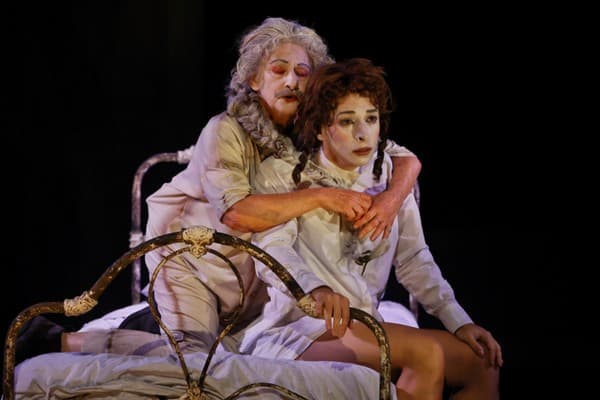
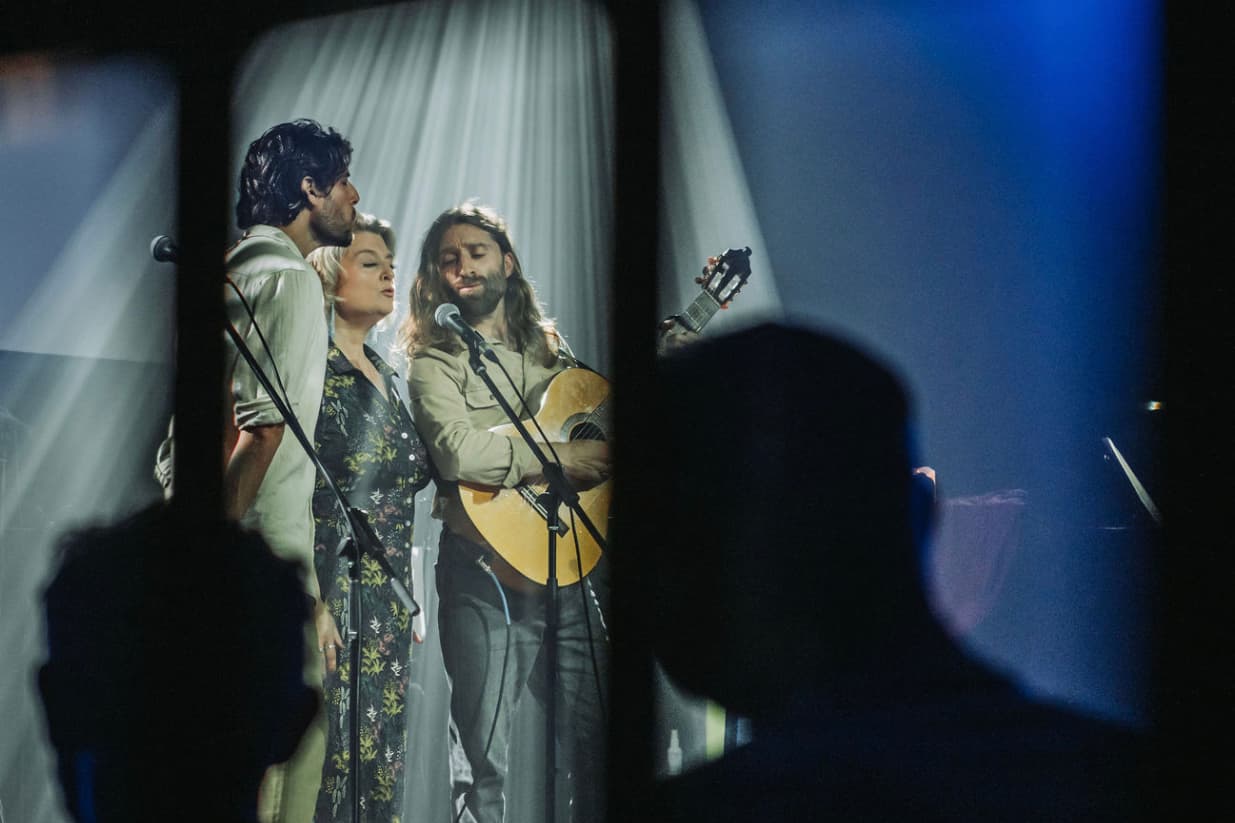
Yentl at the Sydney Opera House

Scene from the producton of Yentl at the Sydney Opera House

Published: 28 October 2024

Last updated: 29 October 2024

The Kadimah Yiddish Theatre’s production of Yentl marks a new chapter in the storied history of Yiddish theatre in Australia. After two acclaimed seasons in Melbourne, it is apt that the play has made it to the Sydney Opera House, a short stroll from Circular Quay, one of the ports that received Jewish immigrants on our shores. 

Indeed, the first Yiddish play performed in Australia was staged in Sydney in 1905, when Warsaw-born actor, Chaim Reinholz, produced the biblical operetta Shulamis, written by the so-called “father” of Yiddish theatre, Avram Goldfaden. Reinholz directed the play with a cast of non-Jewish actors. It is said the opening night was a fiasco. The actors either forgot their lines or spoke a pidgin Yiddish best described as Yinglish. 

In November 1908, the Yiddish actor Samuel Weissberg stepped ashore in Port Melbourne from the steamship Vulcania. That afternoon he made his way to a boarding house in Carlton, where Jewish immigrants would gather after a day’s work.

By the following afternoon — Melbourne Cup day Hag Ha’susim, the Holy Day of the Horses, as a Yiddish poet has called it — a committee was formed and plans were laid for the creation of the first of many Yiddish theatre ensembles in Melbourne. This initiative can be seen as marking the beginnings of Yiddish theatre in Australia.

By the 1920s, there were at least three companies performing to Yiddish-speaking audiences in Melbourne, among them the Kadimah Drama Circle. Founded in 1911 as a library and Jewish cultural centre, the Kadimah marked the grand opening of its new premises in Lygon Street, in 1933, with a production of a classic Yiddish play, Green Fields.

By the 1920s, there were at least three companies performing to Yiddish-speaking audiences in Melbourne,
Located in the heart of immigrant Carlton, the two-storey building, with its arched windows, stone steps and portico, resembled a secular synagogue. Set designer Mordechai Shechter transformed the purpose-built Kadimah stage into a pastoral setting, transporting its audiences back to the rural landscapes and hamlets of Belorussia.

In the late 1930s, renowned Polish-Yiddish actors Yankev Waislitz and Rokhl Holzer got stuck in Melbourne while on separate world tours, due to the outbreak of war. In 1940, they united the various local Yiddish troupes into the David Herman Theatre at the Kadimah. Waislitz had performed in the 1920 premiere of The Dybbuk.

Staged by the legendary Vilna Troupe in Warsaw, and directed by David Herman, the premiere marked a turning point in the history of Yiddish theatre. The Troupe toured their acclaimed production throughout Europe, playing to critical and popular acclaim, to audiences of Jews and non-Jews alike.

In 1938 Waislitz directed The Dybbuk to a capacity audience of 1500 in Melbourne’s Princes Theatre. The reaction to the performance parallels the responses of audiences and critics to the Kadimah Yiddish Theatre production of Yentl. As one mainstream reviewer wrote: “Waislitz’s production was performed with a solemnity never far from mysticism.

:The declamation of the players gave it an emotional… feeling, so that early in the piece the spectator felt that he was present at an unearthly rite… This feeling was prompted by Waislitz’s majestic stage settings, the awe-inspiring chanting of the beggars, and the pictorial arrangements of the ensemble.”

In another parallel, Waislitz took the play to Sydney. In its postwar heyday, the David Herman Troupe would board the overnight train to Sydney, perform, and get back in time for the new working week. So it was with the 1957 production of The Dybbuk, directed again by Waislitz. The cast, most of whom performed for the love of it, could not afford to fly.

The Jewish Independent

They made their way to Spencer Street Station after work on Friday evening, arrived in Sydney on Saturday morning, assembled the sets during the day, performed in the evening, and again the following day. Then they dismantled the sets and by nightfall they were back on the train, singing Yiddish songs to keep their spirits high as they journeyed back to Melbourne. They had a ball.

The Kadimah Yiddish Theatre adaptation of Yentl can be situated within the Yiddish art theatre movement whose revered ensembles included the Vilna Troupe, the Yiddish Art Theatre in New York, and the Moscow State Yiddish Theatre, formed in the wake of the Russian revolution. The Yiddish art theatres combined Jewish folklore and contemporary themes with the innovations of avant-garde European theatre in the early decades of the twentieth century.

There is  one striking innovation — the introduction of a new character, the yeytser ho’re, the evil inclination. It is a masterstroke.

Yiddish language plays a critical role in this new adaptation of Isaac Bashevis Singer’s story, Yentl the Yeshivah Boy. It is a trans-national language, rich with black humour, curses and blessings, enforced wanderings and the salt of the earth.  Gary Abrahams, Galit Klas and Elise Hearst’s script is strikingly true to the original Singer story, drawing on its feminist undertones and queer sub-text, and on its explorations of identity, sexuality, gender inequality and love. There is one striking innovation — the introduction of a new character, the yeytser ho’re, the evil inclination.

It is a masterstroke. The yeytser ho’re is part trickster, part narrator, part tempter, a whirlwind of frenetic energy sowing doubt, chaos and confusion, and daring Yentl to transgress. Yet the yeytser ho’re also drives Yentl to find herself, and break free, despite the perilous risks she must take.

Singer would have delighted in the antics of the yeytser ho’re. After all, he was a mischievous imp of a man, both son of a rabbi and child of modernity, steeped in Jewish folklore, theology and mysticism, and nurtured in the cauldrons of Yiddish-speaking Warsaw and immigrant New York. He understood that the yeytser ho’re resides in us all. Indeed, Singer too was a kind of yetzer ho’re, tempting his readers to enter forbidden worlds. 

For many years Yiddish theatre in Australia served as a bridge between the old world and the new,  allowing immigrant audiences to feel at home as they rebuilt their lives. In the 1940s, as their old world burned, The David Herman Theatre, with Waislitz and Holzer at the helm, produced seasons of up to eight plays a year on the Kadimah stage, providing a sense of comfort and continuity for the Yiddish-speaking immigrant communities of the time. And in the postwar years, the David Herman Theatre provided a sense of belonging for a new wave of Jewish immigrants, among them many Holocaust survivors.

A Saturday night at the Yiddish theatre at the Kadimah was a celebratory occasion. The Kadimah invited Yiddish theatre greats who, prewar, had spearheaded the Yiddish art theatres of Europe, for stints as guest directors. It also called on the talents of a new generation of immigrant actors, directors and theatre workers, some of whom had performed clandestinely in the ghettos and concentration camps of Eastern Europe and German.

And at a time of resurgence in secular Yiddish culture, productions such as Yentl are forging a bridge between the riches of the past, and re-imagining what it is to be human in our challenging times. In this, as in all great art, Yentl is universal.

Arnold Zable recounts the story of Yiddish theatre in Australia, in Wanderers and Dreamers: Tales of the David Herman Theatre (Hyland Press, 1997). An abridged version of this article appears in the program of the Sydney production of Yentl.

You might also like
  • Was the barmi a shemozzle? How Australians use Jewish words 
    Caroline Hendy & Emma Breslow
  • When the state faltered, civil society and Diaspora Jewry stepped up
    Shahar Burla
  • The case for leaving graffiti up for a while
    Adam Slonim
logomark.67a07ee3
We believe in the free flow of information

Republish our articles for free, online or in print, by using our Creative Commons licence

You might also like

    why main 4th
    PodcastArts & Culture

    Why we need to find our why now: new TJI podcast

    Ittay Flescher and Courtney Winter-Peters 1
    haredi street guitar
    Photo EssayArts & Culture

    Jerusalemites through the lens

    Sharon Gabay
    Copy of Website books template (2)
    FeatureArts & Culture

    The winning Jewish books by Australians in the past year

    Gideon Cohen

About the author

Arnold Zable

Arnold Zable

Arnold Zable is a writer and novelist and the recipient of the 2021 Australia Council Award for Lifetime Achievement in Literature. His account of his first journey to Poland, "Jewels and Ashes," was published in 1991.

More from the author

ReflectionAustralia

Arnold Zable remembers Abram Goldberg’s epic life

ReflectionArts & Culture

To a Caulfield boy from a Carlton boy

World

ARNOLD ZABLE: Remembering the Warsaw Ghetto uprising in an age of growing hate

Comments2

  • Avatar of Robert richter

    Robert richter29 October at 10:22 pm

    Zable is a fine repository and expositor of a tradition which must be preserved – and of which many in Israel are ignorant – because whatever happens in Israel itself, Jewish tradition and critical diaspora ethics must survive and hold a mirror to transient and disastrous Israeli political culture.. Robert Richter

  • Avatar of Martin Munz

    Martin Munz29 October at 06:35 am

    Terrific account of Yiddish theatre in Australia.