Aa
  • Read, Watch, Listen
  • TJI Series
  • Community Action
  • Events
  • Zedi
Follow us and continue the conversation
  • LinkedIn
  • Instagram
  • FaceBook
  • X
  • YouTube
Test yourself with the TJI Quiz!

Adjust size of text

Aa

Follow us and continue the conversation

  • LinkedIn
  • Instagram
  • FaceBook
  • X
  • YouTube

Your saved articles

You haven't saved any articles

What are you looking for?

Original reporting, insightful analysis and diverse views, delivered straight to your inbox

  • LinkedIn
  • Instagram
  • FaceBook
  • X
  • YouTube
Your support fuels our mission to inform, entertain and inspire.

The Jewish Independent is bound by the Standards of Practice of the Australian Press Council. If you believe the Standards may have been breached, you may approach The Jewish Independent or make a complaint to the Australian Press Council in writing at www.presscouncil.org.au. The Council may also be contacted on 1800 025 712.

  • Our Story
  • Contact us
  • Our Team
  • Support us
  • Guidelines
  • Pitch your idea
  • Republishing us
  • Community Action
  • Our Awards
  • LinkedIn
  • Instagram
  • FaceBook
  • X
  • YouTube
Aboriginal FlagTorres Strait Islanders Flag

The Jewish Independent acknowledges Aboriginal and Torres Strait Islander peoples as the Traditional Owners and Custodians of Country throughout Australia. We pay our respects to Elders past and present, and strive to honour their rich history of storytelling in our work and mission.

© The Jewish Independent 2026All Rights Reserved
Website design and development by Your Creative, MelbourneTerms & ConditionsPrivacy Policy
HomeRead, Watch, ListenAustralia
Generation ChangeInterviewAustralia

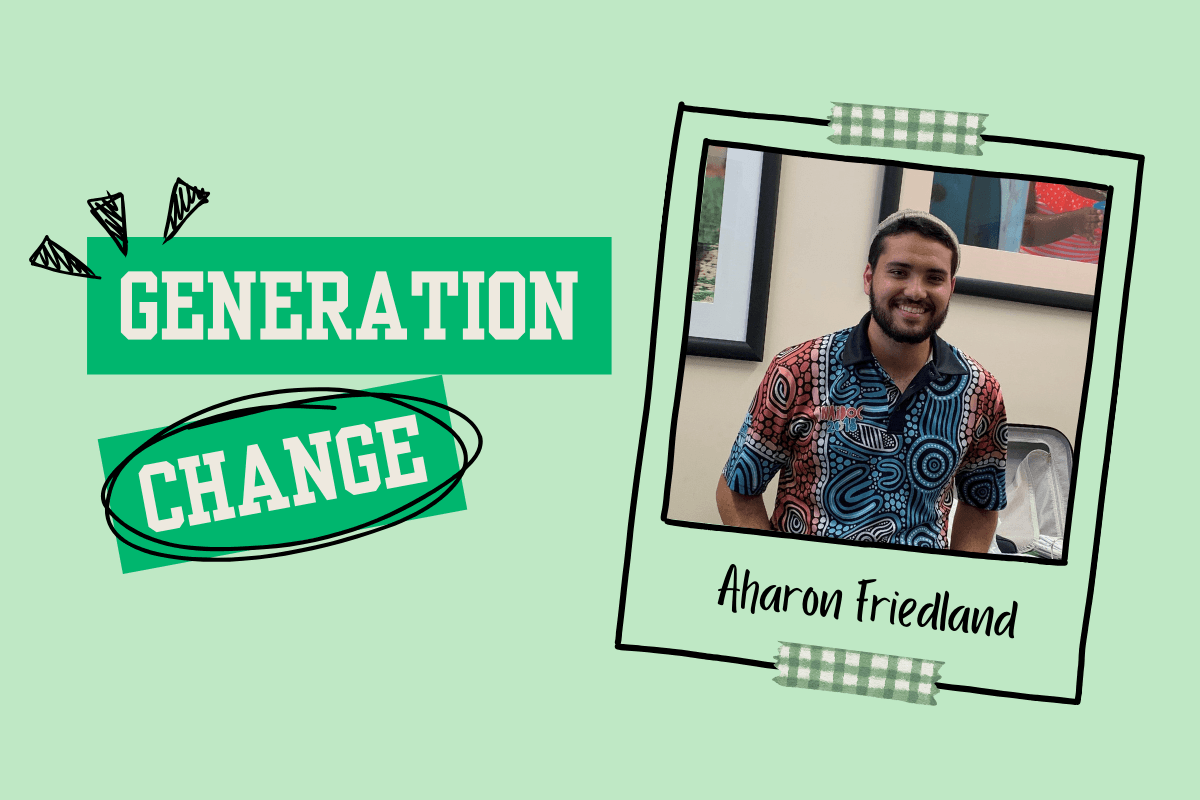
Aharon Friedland: a fighter for First Nations health

For 27-year-old Aharon Friedland, practicing medicine as a Jew in Australia comes with a responsibility to improve Indigenous health outcomes and advocate for justice.
Ruby Kraner-Tucci
Print this
Aharon Friedland

Aharon Friedland is passionate about First Nations health (Image: TJI).

Published: 3 May 2024

Last updated: 15 September 2025

What sparked your interest in Aboriginal health?

I have felt very strongly about Aboriginal health for a long time. It has always been an area that I have been passionate about.

Growing up in South Africa was a formative experience for me. The values instilled within me and the exposure of South Africa – the desperation and devastation, the discrimination and huge amount of disadvantaged people and communities – taught me a responsibility to give myself to others who have been wronged or who are vulnerable.

Moving to Australia when I was 12 years old and benefitting from all the advantage of being a white person, while knowing that First Nations communities are among the most disadvantaged in this country, created an obligation to contribute to and serve Aboriginal people.

In my biomedical science degree, I undertook a couple of elective units in Broome on Aboriginal history, culture and spirituality. It was the highlight of my undergraduate degree – possibly even my entire university experience. Hearing from Yawuru and Karrajari elders, rangers and community members; going out on Country; learning so much about the way Aboriginal people connect to each other and to the land was a very motivating and inspiring experience. It solidified my commitment to and interest in Aboriginal health.

Friedland participating in an on-Country cultural immersion with Yawuru and Karrajari rangers and elders <em>(Image supplied)</em>.&nbsp;
Friedland participating in an on-Country cultural immersion with Yawuru and Karrajari rangers and elders (Image supplied). 

Tell me about your practice in this field.
During my medical degree, I spent a clinical year up north in Karratha, which is a small town in the Pilbara. That brought me experience in rural medicine, and there I was exposed to remote Aboriginal communities and their health issues.

I had a placement in Roebourne where I worked in a medical service with GPs. I also volunteered with a mobile clinic that screens Aboriginal children's ears for middle ear infection – a huge health issue that disproportionately impacts Indigenous kids and can cause long-term hearing loss as well as a range of other health concerns.

"My commitment to Indigenous health and justice is born directly out of my Jewish beliefs and values."

Aharon Friedland

Coming back to the city, I wanted to better understand Aboriginal health within a metropolitan context and applied to the Royal Perth Hospital, an inner-city tertiary hospital with a high proportion of Indigenous patients, as well as those from low socioeconomic backgrounds who may be struggling with homelessness or drug and alcohol issues, for example. I started my internship at Royal Perth Hospital last year and I am now doing my second year of practice there.

How do you reflect on being a white person practicing Indigenous medicine?

For me, it is always a question of how I can contribute as a ‘wadjela’ or ‘whitefella’ in Australia without being paternalistic, or doing things for Aboriginal people, or thinking only through a Western model of medicine.

It is something that I am trying to understand and grapple with, but having humility and learning how to practice medicine in a way that is most beneficial, useful and appropriate for Aboriginal people is an important guide. It is about looking at Aboriginal health from a strengths-based perspective, and learning from Indigenous communities themselves and their incredible resources.

I have also had excellent mentors, Indigenous and non-Indigenous, who have provided me with so much advice in such a warm and welcoming way.

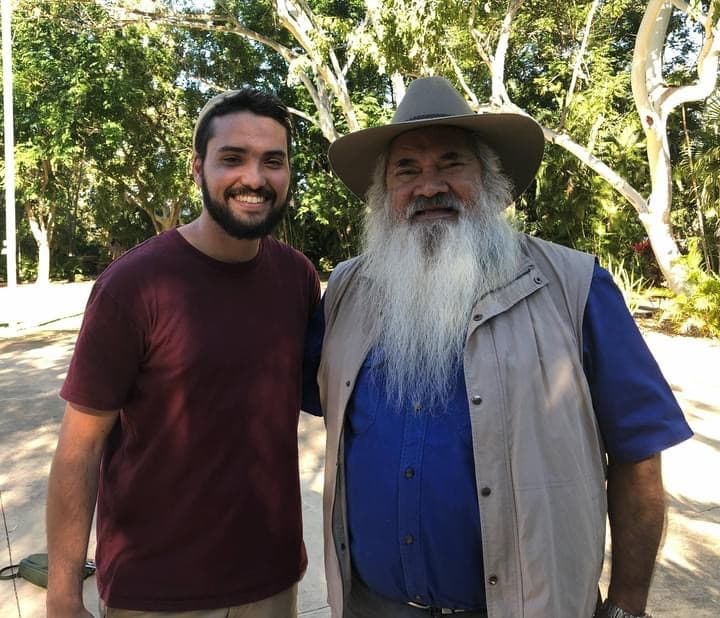
Friedland with former Senator Pat Dodson in Broome, Yawuru Country <em>(Image supplied)</em>.
Friedland with former Senator Pat Dodson in Broome, Yawuru Country (Image supplied).

Are we getting it right when it comes to Indigenous health care?

Being involved in the care and healing of patients that are in their most vulnerable moments has been a real privilege, but on the other hand, you get exposed to the disheartening moments where people are not treated appropriately.

I have heard of and seen several examples of racism within healthcare. There is a lot of despair – from disparaging comments and attitudes to actual borderline negligent treatments, just because a person is Aboriginal, homeless or drug affected.

I met with an executive who is at the top of the hospital chain, and even they told me that, as an Aboriginal person, they were not taken seriously when they went to the emergency department, or doctors have assumed their family members were drunk when they were coming in with real problems. There are lots of examples of that kind of behaviour.

It is not all the time and everyone, but being exposed to some of that racism reinforces the belief that more needs to happen, that the culture needs to change and that there is still a long way to go.

"There is a shared understanding that both of our peoples have a history of persecution, struggle and discrimination. That puts Jews in a very important place in Australia to advocate for Indigenous rights and freedoms."

Aharon Friedland

Do you think part of the problem is how Aboriginal culture is taught at school?

It is a big shame generally in Australian education that people do not get exposed to Aboriginal culture and teachings. It is very limited, and even more so when it comes to taking a positive, strength-based lens.

Until I got to university, all I learned about was the Rabbit-Proof Fence story. I think most people going through school, tertiary education and even work, do not keep learning about Indigenous education. I have been very lucky to have that focus throughout my life.

How do Aboriginal and Jewish cultures intersect?

There are some very profound similarities between Aboriginal culture and Judaism, but there are also quite a lot of differences.

The Aboriginal concept of kinship and interrelatedness is something I find quite bewildering. That everything is connected and one – from the land and sea to the spirits and each other – there is a value of reciprocity and community where everyone looks after each other. It is something that we feel in the Jewish community too.

I have always thought about the comparison that people make between the Jewish connection to Israel and Aboriginal people’s connection to land. It is not a perfect comparison but there is a shared understanding that both of our peoples have a history of persecution, struggle and discrimination. That puts Jews in a very important place in Australia to advocate for Indigenous rights and freedoms.

During the campaign for the Voice to Parliament, I wrote something brief to appeal to the Jewish community, expressing what I believed was one of the reasons why we should really appreciate and value Aboriginal recognition – that is the concept of Jewish memory. It is such a central value in Judaism, which is not very well understood but is about always remembering where we come from, who we are, and what our values are. History in Australia is often forgotten or actively disremembered, and as Jews, we can understand that even better given our own history.

Jewish-Indigenous collaboration has spanned throughout time. From the early Freedom Ride with Jim Spigelman, Mabo and native title with Ron Castan and today with the Voice Referendum and Mark Leibler. There has always been a Jewish sensibility to contribute to Aboriginal rights and advancements in Australia, which is important to reflect on.

One concept that motivates me constantly is a dictum from Pirkei Avot: "It is not up to you to complete the work, but neither are you free to desist from it". 

My commitment to Indigenous health and justice is born directly out of my Jewish beliefs and values. It is one in the same. I feel as if pursuing a career in Indigenous health is the realisation and culmination of my religious Jewish upbringing, values and ideals.

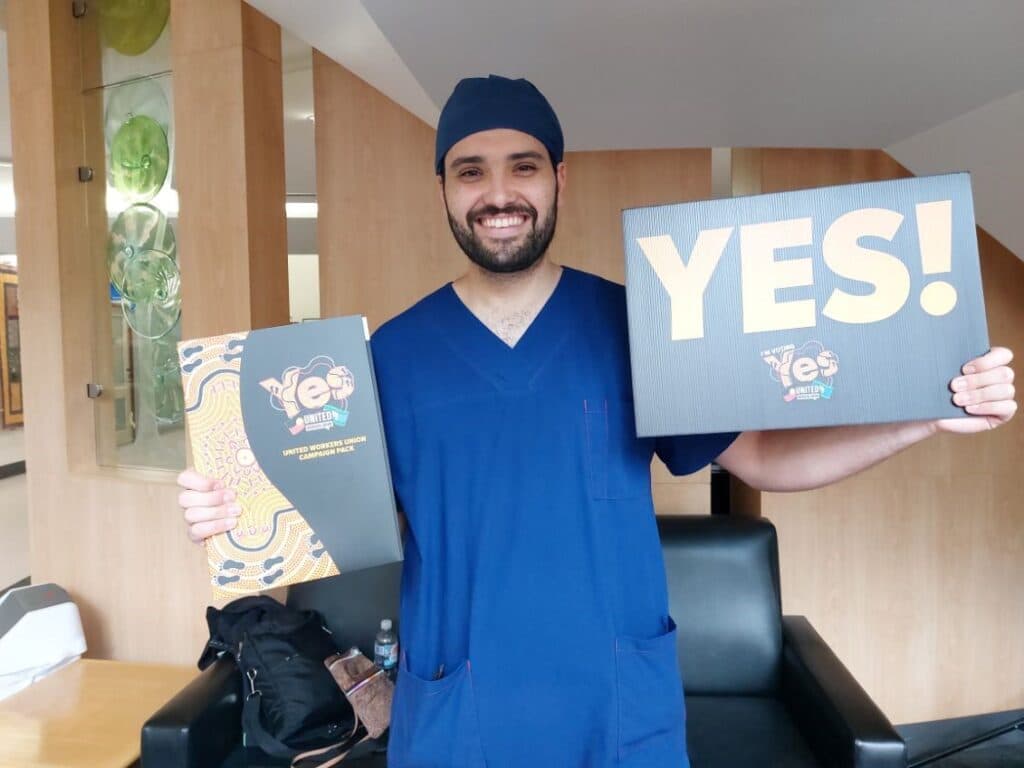
Friedland campaigning for the Yes vote during the 2023&nbsp;Referendum <em>(Image supplied)</em>.
Friedland campaigning for the Yes vote during the 2023 Referendum (Image supplied).

What's in store for your future medical practice?

I am still trying to figure out what I want to specialise in. One interest I currently have is paediatrics.

There is such a huge way to go with Aboriginal children and young people’s health. Especially ear disease, rheumatic heart disease and infectious diseases that do not occur in any other Western country. When it comes to the increased rates of diseases in Indigenous children compared to non-Indigenous kids, there is a whole list, and it is never ending. Added to that is the fact that one of the leading causes of death in young Aboriginal people is suicide, which is just incomprehensible and appalling to consider. It is something that should not even be acceptable.

I hope to get involved in the local Aboriginal medical service with their child health program and at the Perth Children’s Hospital. Committing to the health and wellbeing of young Indigenous people is something I am very passionate about.

You might also like
  • David Zwier: delivering comfort with a conscience
    Ruby Kraner-Tucci
  • Josh Kirsh: planning a NSW political first
    Tami Sussman
  • Leah Freudenberger: from insular roots to inclusive care
    Ruby Kraner-Tucci
logomark.67a07ee3
We believe in the free flow of information

Republish our articles for free, online or in print, by using our Creative Commons licence

You might also like

    Woman with land and houses behind her
    NewsAustralia

    Australia to increase sanctions against West Bank settlements

    Deborah Stone 2
    ANNIKA WELLS PRESSER
    Israel Hamas WarNewsAustralia

    No action to stop Hezbollah ally beaming antisemitic and anti-Israel content into Australia

    Michael Visontay
    Lobby
    OpinionAustralia

    Confronting Richard Flanagan and the myth of the Israel lobby

    Mary Garden 8

About the author

Ruby Kraner-Tucci

Ruby Kraner-Tucci

Assistant Editor

Ruby Kraner-Tucci is a journalist and TJI's assistant editor. Her writing has appeared in The Age, Australian Jewish News, Time Out and Broadsheet, among others. Ruby was awarded Multicultural NSW’s Best Report in Multicultural Media 2025 and has been named a Top 36 Under 36 Jewish Changemaker by B'nai B'rith.

More from the author

FeatureAustralia

‘True essence of being an ally’: The non-Jews choosing to work in the Jewish community

InterviewAustralia

Elliot Szafran: food that feels like a hug from Zaide

NewsAustralia

Antisemitic incidents down from peak but still triple pre-Gaza war

FeatureArts & Culture

Bringing Terezin music to life 

Comments

No comments on this article yet. Be the first to add your thoughts.