Aa
  • Read, Watch, Listen
  • TJI Series
  • Community Action
  • Events
  • Zedi
Follow us and continue the conversation
  • LinkedIn
  • Instagram
  • FaceBook
  • X
  • YouTube
Test yourself with the TJI Quiz!

Adjust size of text

Aa

Follow us and continue the conversation

  • LinkedIn
  • Instagram
  • FaceBook
  • X
  • YouTube

Your saved articles

You haven't saved any articles

What are you looking for?

Original reporting, insightful analysis and diverse views, delivered straight to your inbox

  • LinkedIn
  • Instagram
  • FaceBook
  • X
  • YouTube
Your support fuels our mission to inform, entertain and inspire.

The Jewish Independent is bound by the Standards of Practice of the Australian Press Council. If you believe the Standards may have been breached, you may approach The Jewish Independent or make a complaint to the Australian Press Council in writing at www.presscouncil.org.au. The Council may also be contacted on 1800 025 712.

  • Our Story
  • Contact us
  • Our Team
  • Support us
  • Guidelines
  • Pitch your idea
  • Republishing us
  • Community Action
  • Our Awards
  • LinkedIn
  • Instagram
  • FaceBook
  • X
  • YouTube
Aboriginal FlagTorres Strait Islanders Flag

The Jewish Independent acknowledges Aboriginal and Torres Strait Islander peoples as the Traditional Owners and Custodians of Country throughout Australia. We pay our respects to Elders past and present, and strive to honour their rich history of storytelling in our work and mission.

© The Jewish Independent 2026All Rights Reserved
Website design and development by Your Creative, MelbourneTerms & ConditionsPrivacy Policy
HomeRead, Watch, ListenAustralia
AnalysisAustralia

Australia’s last antisemitism crisis was different

In 1960, Australia had a spike in antisemitism similar to that experienced over the past year, but the response from the left was much more supportive.
Philip Mendes
Print this
Copy of Website article template (1)

Illustration: TJI

Published: 7 April 2025

Last updated: 7 April 2025

In the early months of 1960, the Australian Jewry experienced a sudden outbreak of anti-Jewish graffiti and vandalism not dissimilar to the current antisemitism crisis.

What has been called the ‘Swastika Epidemic’ began with the desecration of a synagogue in Cologne, West Germany on 26 December 1959, and then spread globally across the western world until it hit Australia.

During January and February 1960, there were approximately 20 to 30 anti-Jewish incidents in both cities and rural areas, including smashed at Temple Beth Israel, threatening slogans painted on the Zionist Federation building in Melbourne, and bomb threats targeting the Great Synagogue in Sydney. Anti-Jewish graffiti also appeared in small towns with few, if any Jewish, residents such as Whyalla in South Australia and Maryborough in Queensland.

Widespread condemnation

Australian governments of varied party persuasion at local, state and federal levels, and civil society organisations responded to these events with statements of support for the Jewish community.  

In Victoria, the State Liberal Party Premier Henry Bolte, the Attorney General Arthur Gordon Rylah and the Acting Police Commissioner Superintendent Rupert Arnold assured the Jewish community of their support. 

In Sydney, the Labor-affiliated Lord Mayor Henry Frederick Jensen organised a large protest forum attended by 3,500 people at the Town Hall to condemn the racist attacks. Speakers included representatives of the Returned Soldiers, Sailors and Airmen’s Imperial League of Australia (RSL), churches, the Country Women’s Association, the Chambers of Commerce and Manufacturers, the Labor State Government, and the opposition Liberal and Country Parties. 
The NSW Deputy Commissioner of Police, Norman Allan, announced nightly patrols of Jewish community institutions to prevent anti-Jewish actions. 

Representatives of the four major churches – Roman Catholic, Presbyterian, Methodist, Anglican – issued robust public statements supporting the Jewish community.  

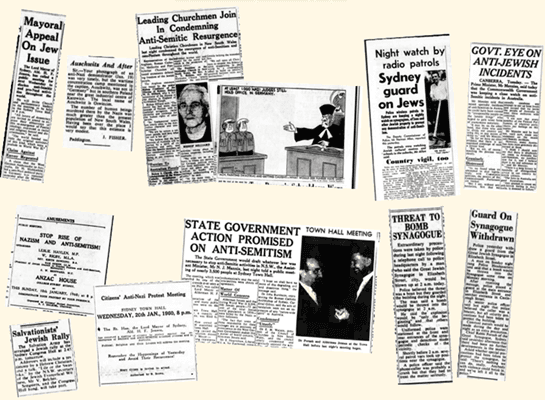
The media was also overwhelmingly sympathetic as reflected in numerous editorials condemning antisemitism. The Sydney Morning Herald (SMH) editorial of 6 January argued that the global manifestations of antisemitism had caused ‘a shudder of shame among civilized people the world over’. 

<em>A selection of clippings from the Sydney Morning Herald in January 1960</em> <em>(Image: Sydney Jewish Museum website).</em>
A selection of clippings from the Sydney Morning Herald in January 1960 (Image: Sydney Jewish Museum website).

The Liberal Party Prime Minister, Robert Menzies, also strongly condemned antisemitism, although his initial statement on 27 January seemed to trivialise the impact of these racist actions by equating them with partisan political attacks on himself as prime minister. Nevertheless, Menzies emphasised that "there is absolutely no room for antisemitism in Australia", and highlighted "the long history of distinguished service to our country by Jewish citizens". 

In a second statement on 7 February, Menzies dismissed antisemites as a "ratbag group". He added that 99 per cent of the Australian population "regarded antisemitic activities with contempt".  

The progressive difference

A major difference between then and now was that Australian progressives in 1960 unconditionally condemned the perpetrators of antisemitic actions, and offered strong solidarity to the Jewish community.

The President of the ACTU, Albert Monk, vigorously condemned the anti-Jewish outbreak, and warned that those who attacked Jews also posed a threat to trade unions and democratic rights. Other peak union bodies and individual unions including the Melbourne Trades Hall Council, the Queensland Trades and Labour Council, the Seamen’s Union, the South Australian Branch of the Australian Railways Union, the South Australian Boilermakers Society, and the Waterside Workers Federation passed resolutions condemning antisemitism. 

The Labor Party strongly sided with the Jewish community. The NSW state Labor Premier Bob Heffron assured the Jewish community that his government would not tolerate antisemitic incidents. The Deputy Leader of the Federal Opposition, Arthur Calwell, issued a strong statement offering support for all actions taken to "combat the evil of antisemitism". Other Labor Party figures such as Leslie Haylen, Federal MHR for Parkes; William Matthew Rigby, the NSW state Member for Hurstville; the Victorian ALP President Albert McNolty; and John Tripovich, the Victorian ALP Secretary, addressed protest forums. 

The Left’s anti-racist approach was typified by the reporting of Tribune, the weekly newspaper of the Communist Party of Australia (CPA), which published no fewer than 18 articles condemning antisemitism over seven editions.  

The left’s agenda, then and now

Tribune’s coverage in 1960 was influenced in part by two expedient political agendas. One was a concern to highlight the alleged failure of West Germany to denazify, and particularly to attack the presence of former Nazis in leading positions in the government, army, police force, the education sector, judiciary and economy. In contrast, the Communist German Democratic Republic of East Germany was presented (falsely) as an exemplar of a tolerant society where all forms of Nazism were eliminated, and Jews were welcomed as equal citizens able to live free of any threat of antisemitism. 

A second concern was to reject international allegations that Communist agents had incited or influenced the antisemitic incidents in Germany and beyond. In fact, recent scholarship establishes without doubt that the East German Stasi Department for Disinformation directly organised many of the antisemitic daubings within Germany and Western Europe (See J. Boulter, First class comrades, p.737). 

Nevertheless, Tribune still displayed a sincere anti-racist solidarity with Australian Jews, describing antisemitism as "a barbarous weapon used by demagogues to divide people for reactionary purposes" (27 January 1960). Their numerous reports attacked the antisemitic outbreak, which was equated with right-wing attempts to attack democracy and trade unions, and provoke international conflict. They insisted that a specific contributing factor to the local outbreak was government migration policies which allowed previous members of the Nazi Party to freely enter Australia. A typical CPA statement published in Tribune on 20 January urged government action "to eliminate Nazism and antisemitism from Australia". Members of the CPA were also active in local resident campaigns against antisemitism. 

The Australian Left’s universal anti-racist response to the Swastika Epidemic of 1960 stands in sharp contrast to the contemporary response of many progressive organisations including, most notably, the union movement. Sadly, some progressive groups have at best acted as bystanders during the current antisemitism crisis. In other cases, particularly that of the Greens, they have actively and shamefully aligned with the perpetrators of anti-Jewish racism.

Philip Mendes is grateful to University of NSW Doctoral student Dovi Seldowitz for sharing his collection of SMH articles from the period. 

You might also like
  • Sanctioning settlements is a defence of Israel, not an attack
    Elisheva Madar
  • Sanctions must influence, not just perform disapproval
    Adam Slonim
  • Mind the mentality: not every rejection is antisemitism
    Nomi Kaltmann
logomark.67a07ee3
We believe in the free flow of information

Republish our articles for free, online or in print, by using our Creative Commons licence

You might also like

    neo-nazis white supremacists corowaTEST
    Royal CommissionOpinionAustralia

    Antisemitism, homophobia and a radical response to both

    Dennis Altman
    Tame
    Australia

    Tame apologises – but with little grace

    Deborah Stone 1
    ANNIKA WELLS PRESSER
    Israel Hamas WarNewsAustralia

    No action to stop Hezbollah ally beaming antisemitic and anti-Israel content into Australia

    Michael Visontay

Comments

No comments on this article yet. Be the first to add your thoughts.

About the author

Philip Mendes

Philip Mendes

Professor Philip Mendes is teaches Social Policy and the Welfare State at Monash University. He is the author or co-author of 13 books, including Jews and the Left: The rise and fall of a political alliance, and Boycotting Israel is Wrong, co-authored with Nick Dyrenfurth.

More from the author

OpinionAustralia

Why progressives are failing on contemporary antisemitism

AnalysisAustralia

Why have many Australian progressives abandoned Israel and the Jews?

ReviewArts & Culture

‘Israelophobia’ considers a new form of the old hatred