Aa
  • Read, Watch, Listen
  • TJI Series
  • Community Action
  • Events
  • Zedi
Follow us and continue the conversation
  • LinkedIn
  • Instagram
  • FaceBook
  • X
  • YouTube
Test yourself with the TJI Quiz!

Adjust size of text

Aa

Follow us and continue the conversation

  • LinkedIn
  • Instagram
  • FaceBook
  • X
  • YouTube

Your saved articles

You haven't saved any articles

What are you looking for?

Original reporting, insightful analysis and diverse views, delivered straight to your inbox

  • LinkedIn
  • Instagram
  • FaceBook
  • X
  • YouTube
Your support fuels our mission to inform, entertain and inspire.

The Jewish Independent is bound by the Standards of Practice of the Australian Press Council. If you believe the Standards may have been breached, you may approach The Jewish Independent or make a complaint to the Australian Press Council in writing at www.presscouncil.org.au. The Council may also be contacted on 1800 025 712.

  • Our Story
  • Contact us
  • Our Team
  • Support us
  • Guidelines
  • Pitch your idea
  • Republishing us
  • Community Action
  • Our Awards
  • LinkedIn
  • Instagram
  • FaceBook
  • X
  • YouTube
Aboriginal FlagTorres Strait Islanders Flag

The Jewish Independent acknowledges Aboriginal and Torres Strait Islander peoples as the Traditional Owners and Custodians of Country throughout Australia. We pay our respects to Elders past and present, and strive to honour their rich history of storytelling in our work and mission.

© The Jewish Independent 2026All Rights Reserved
Website design and development by Your Creative, MelbourneTerms & ConditionsPrivacy Policy
HomeRead, Watch, ListenAustralia
AnalysisAustraliaIsrael

Why have many Australian progressives abandoned Israel and the Jews?

The position known as ‘Progressive Except for Jews’ is being driven by three theoretical influences.
Philip Mendes
Print this
Syd Uni Palestine students Nick Riemer x

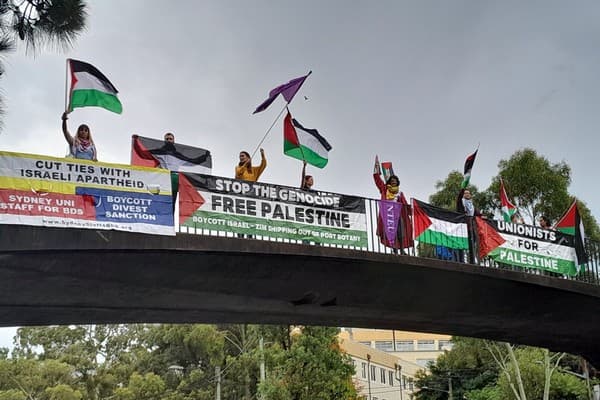
Pro-Palestine banners at the University of Sydney (Nick Riemer/X)

Published: 15 April 2024

Last updated: 16 April 2024

For more than 40 years, I have argued that both Israeli Jews and Palestinian Arabs have legitimate rights to national self-determination, and so any realistic conflict resolution strategy has to advance and protect the national rights of both peoples. Unfortunately, that moderate two-state perspective is no longer the dominant view on the Australian Left and has probably not been since September 2000 when the outbreak of the Second Palestinian Intifada induced many progressives to retreat to a binary view of the conflict.

Instead of seeking a win-win solution that involved saying “Yes to Israel and Yes to Palestine”, many regressed to a zero-sum approach based on chanting “Yes to Palestine and no to Israel”.

In essence, the new pro-Palestinian orthodoxy assumed that national and human rights for Palestinians could only be advanced by harming Israelis and denying their national and human rights. That binary perspective was informed and reinforced by a number of political and ideological factors and events:

  • The emergence of the Boycott, Divestment and Sanctions (BDS) movement from May 2002, which framed all Israeli Jews as an evil oppressor people, and conversely infantilised Palestinians as oppressed victims without any agency;
  • The rise of the ultra-right racist Hamas group as the most dynamic group within Palestinian politics;
  • The associated collapse of the mainstream Israeli Zionist Left, which has fallen from 56 seats for Labor and Meretz combined in 1992 to four seats in the current 120-person Knesset;
  • A general end to any realistic hopes that moderates on both sides could forge a peacefully negotiated compromise settlement.

Since October 7, that unqualified endorsement of the hardline Palestinian nationalist agenda seems to have become the new norm, not only in segments of the fringe Marxist Left where it was always prevalent, but in far wider sections of the Australian community.

It has been accompanied by a widespread intolerance for any alternate, non-binary view, resulting in an active hostility directed at many Australians – mostly but not exclusively Jews – who reject its privileging of one national group over another. In my opinion, many progressives have espoused what can only be called a “Progressive except for Jews: PES” position: approximating what the 19th century German Socialist leader August Bebel famously labelled the “Socialism of Fools”.

There are three theoretical influences that appear to have informed this transition to a PEP position. One is settler-colonial theory which equates Israel with other states such as Australia, New Zealand and North America that were formed by colonial powers sending residents from their home countries to displace the Indigenous population.

This theory is then used to imply that Israeli Jews are not Indigenous to the region, and hence the state is not legitimate. However, the theory does not fit the facts. The vast majority of Jews who settled in Palestine during the British mandate period from 1917-1948 were not settlers from Britain but rather refugees from antisemitic fascist regimes across Europe.

Equally, the majority of those who immigrated to the new State of Israel from 1948-67 were not colonial settlers, but rather refugees from institutional and popular anti-Semitism in the Arab states and North Africa..

Uqualified endorsement of the hardline Palestinian nationalist agenda seems to have become the new norm.

The second is critical race theory, which holds that only black or coloured people can be victims of racism, but white people cannot, because they hold structural power. Hence, this theory implies that coloured Palestinians are the victims of widespread racism by white Israeli Jews, and no Jews can be oppressed, only oppressors. Again, the theory does not fit the facts, given that at least half the Israeli Jewish population are Misrahim, who arrived mostly as refugees from Arab and North African countries.

It also allows local Palestinian ultra-nationalists to make xenophobic attacks on Australian Jews, and then absurdly, avoid responsibility for their prejudice on the grounds that it is not possible for a so-called structurally oppressed people to be racist.

In fact, Jews are the exemplar of an historically oppressed people. Violent and genocidal antisemitism over the past 150 years in both Europe and the Middle East has been perpetrated against both white/Ashkenazi Jews and black/Misrahi Jews. For example, there are obvious similarities between the well-known Kristallnacht in Germany 1938 and the lesser known Farhud in Baghdad 1941.

The third and perhaps most important influence is intersectionality – recognition of the impact of multiple forms of disadvantage to inform social justice responses. For example, my principal research area is examining the adult lives of young people who have transitioned from forms of out-of-home care (known as care leavers or care experienced youth).

Many care leavers have experienced multiple manifestations of disadvantage including childhood abuse and neglect, poor quality placements, and lack of support from responsible adults on transitioning from state care to independent adulthood. An intersectional understanding of how multiple systems and structures limit their life chances and opportunities is essential for planning a holistic social justice-based intervention framework.

But intersectionality has never meant condoning bad behaviour by disadvantaged groups which harms or traumatises other people. That is what may be called reactionary, rather than progressive responses to disadvantage.

Social justice advocates do not argue that family violence is okay because some perpetrators were themselves victims of violence or oppression; racist behaviour is acceptable because some perpetrators experienced childhood trauma; institutional child sexual abuse is alright because some perpetrators were themselves abused as children.

Similarly, the October 7 Hamas death squad massacre and equally, the long history of suicide bombings and other indiscriminate attacks on civilian populations by Hamas, cannot be justified by referring to the general oppression of Palestinians by Israel.

Evidence-based education can influence Australians who are not wedded to a one-sided Palestinian viewpoint.

Yet many Palestine solidarity supporters on the Left do just that. For example, the American radical feminist and professor of philosophy, Judith Butler, has stated that the Hamas massacre was “an act of resistance” and not “terrorist”, and denied it should be described as “antisemitic”.

Locally, leading BDS advocate Dr Nick Riemer, from the University of Sydney, tweeted: “No progressive should feel the need to publicly condemn any choices by the Palestinian resistance. Doing so just adds to the perception that their cause is unjust. Condemnation is the speech-act you perform when breaking contact off with someone, not when standing in solidarity.”

It should be obvious that such distorted framings confuse nationalism and universalism, imply a racist stereotyping of all Israelis (whatever their diverse class identity, family background or political beliefs) as evil, and obtusely conflate the impact of structural oppression with the methods chosen to attack it.

So what can be done by moderate Jews on the Left to counter or ideally reverse these distorted and inflammatory one-sided framings of the conflict that are intended to exclude many Jews from participation in progressive debates?

I would recommend evidence-based educational packages as an effective means of influencing the majority of Australians who are not wedded to a one-sided Palestinian nationalist viewpoint. That material would aim to shift the framing of the Israeli-Palestinian conflict from a simplistic clash of good and evil to instead being understood as the result of a complex historical, political and cultural context.

Educational packages should emphasise that:

  • The Israeli-Palestinian conflict is a clash between two legitimate national rights. Both Israeli Jews and Palestinian Arabs have a right to national self-determination.
  • Conflict resolution will only be advanced by dialogue and negotiations that encourage both sides to compromise on their national narratives, not by racist boycotts.
  • Moderate voices on both sides should be approved, whilst extremist voices on both sides should be rejected.

This is an edited version of the paper presented by Philip Mendes to a Kehilat Nitzan Panel in Melbourne, October 7: Jews and the Left, held on April 7, 2024

You might also like
  • The West Bank After Tel: a line in the sand has been crossed
    Mohammad Asideh
  • IDF ordered to evict West Bank camp in election show of strength
    Ben Lynfield
  • The riches to rags story of Indonesia’s Iraqi Jews
    Deborah Cassrels
logomark.67a07ee3
We believe in the free flow of information

Republish our articles for free, online or in print, by using our Creative Commons licence

You might also like

    Sami Abu Shehadeh
    AnalysisIsrael

    Arab party ban won’t hold but reveals a changed Israel

    Ben Lynfield
    syd uni globalise the intifada
    NewsAustralia

    Sydney Uni commissions independent review after ‘Globalise the Intifada’ campaign

    Deborah Stone
    Zoe Better pillars of light crop
    FeatureAustralia

    NDIS changes threaten disabled participation in community life

    Jarod Rhine-Davis

About the author

Philip Mendes

Philip Mendes

Professor Philip Mendes is teaches Social Policy and the Welfare State at Monash University. He is the author or co-author of 13 books, including Jews and the Left: The rise and fall of a political alliance, and Boycotting Israel is Wrong, co-authored with Nick Dyrenfurth.

More from the author

AnalysisAustralia

Australia’s last antisemitism crisis was different

OpinionAustralia

Why progressives are failing on contemporary antisemitism

ReviewArts & Culture

‘Israelophobia’ considers a new form of the old hatred