Aa
  • Read, Watch, Listen
  • TJI Series
  • Community Action
  • Events
  • Zedi
Follow us and continue the conversation
  • LinkedIn
  • Instagram
  • FaceBook
  • X
  • YouTube
Test yourself with the TJI Quiz!

Adjust size of text

Aa

Follow us and continue the conversation

  • LinkedIn
  • Instagram
  • FaceBook
  • X
  • YouTube

Your saved articles

You haven't saved any articles

What are you looking for?

Original reporting, insightful analysis and diverse views, delivered straight to your inbox

  • LinkedIn
  • Instagram
  • FaceBook
  • X
  • YouTube
Your support fuels our mission to inform, entertain and inspire.

The Jewish Independent is bound by the Standards of Practice of the Australian Press Council. If you believe the Standards may have been breached, you may approach The Jewish Independent or make a complaint to the Australian Press Council in writing at www.presscouncil.org.au. The Council may also be contacted on 1800 025 712.

  • Our Story
  • Contact us
  • Our Team
  • Support us
  • Guidelines
  • Pitch your idea
  • Republishing us
  • Community Action
  • Our Awards
  • LinkedIn
  • Instagram
  • FaceBook
  • X
  • YouTube
Aboriginal FlagTorres Strait Islanders Flag

The Jewish Independent acknowledges Aboriginal and Torres Strait Islander peoples as the Traditional Owners and Custodians of Country throughout Australia. We pay our respects to Elders past and present, and strive to honour their rich history of storytelling in our work and mission.

© The Jewish Independent 2026All Rights Reserved
Website design and development by Your Creative, MelbourneTerms & ConditionsPrivacy Policy
HomeRead, Watch, ListenIsrael
OpinionIsrael

The West Bank After Tel: a line in the sand has been crossed

The settler attack which left four people from my home town dead has shifted the public feeling among Palestinians in a way I haven't felt before. We must be ready for a new reality
Mohammad Asideh
Print this
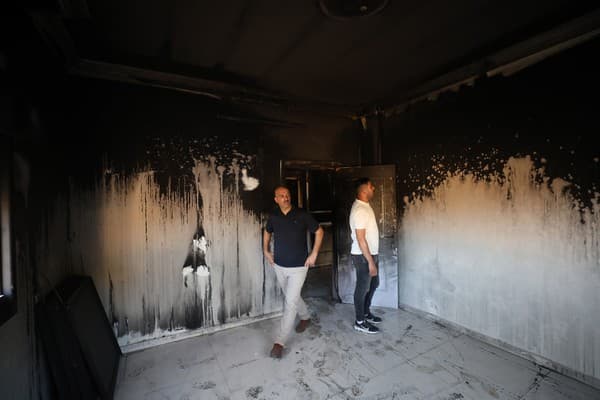
Palestinians Inspect Fire-Damaged Home Following Settler Attack Near Nablus

Palestinians inspect the damage to a house destroyed by fire following an attack by Israeli settlers in the village of Tel, West of Nablus, in July 2026 (Nedal Shtieh/JNA PRESS)

Published: 6 August 2026

Last updated: 6 August 2026

Ten days ago, I was walking into a meeting to discuss the International Fund led by the UK, Canada and Australia, organised by ALLMEP, the (Alliance for Middle East Peace). Just before it started, a friend texted me: “what had happened in your town, Tel?”

I didn't see his next message until the meeting ended. Four young men were killed in my town on what was supposed to be another quiet Friday morning. He listed their names. I knew all four. We went to the same school and I played football with two of them.

A settler and a soldier were killed too.

Just a week before, the settlers from a nearby settlement attacked my town and set a house on fire. The woman and the children escaped just in time. Men in the town went to defend their houses when they saw the settlers approaching their neighbourhood.

There have been more dramatic events than this one. But something about it shifted the public feeling among Palestinians in a way I haven't felt before. It’s common now to hear the following: what came before Tel is not the same as what came after.

We should all be ready for a new reality. On your next visit to the West Bank, don't be surprised if you see Israeli military jeeps patrolling Palestinian cities and no stones thrown back. There will be resistance, but this time with different tools, and I have no idea what they would be.

For a month now, everyone has been struggling to get fuel. I take taxis to my meetings with the Rozana organisation these days if I go outside Ramallah city, because I don't know if I'll get another chance to fill my car. My brother waited from morning until evening yesterday just to refill his car. If he hadn't, he couldn't have gone to work. No work, no food on the table.
Basics are in short supply

Water, electricity, medication, all of it that reaches the West Bank has been reduced. Most people I know now think twice before they take a shower.

One of the projects that Rozana runs is mobile clinics in remote communities in and around Hebron. Getting our teams safely to and from clinics has become harder and riskier. Moving medical supplies, or something as basic as water, through checkpoints that open and close without warning, has become harder. None of this stops the work Rozana does, because the people who need healthcare and support don't stop needing it.

I’m not the complaining type. I say that because I think these injustices are rarely covered in the media. Gaza remains our biggest pain and challenge and now we fear for the safety of the people we love, even when we are with them at home inside Palestinian cities.  

Radicals thrive on the actions of other radicals. There is no such thing as only one radical side. And yet, despite everything I've just described, there has been no violent uprising here. I ask myself why. I think it's because we've entered a new phase of this conflict.

I know many people are waiting for the election in Israel and Palestine at the end of this year. I'm almost 40. I grew up hearing that things would be better after the next one. This is rarely the case.

I believe people in a position to act need to have a serious conversation about what might be coming, for the sake of Palestinians, Israelis and Jews around the world alike.

Settlers are fuelling antisemitism

Antisemitism has never needed a reason to exist. It was always there. But radical settlers in the West Bank are fuelling antisemitism. On my last trip to Paris, I came out of a meeting with a Jewish colleague and watched her take off her kippah before we stepped onto the street. She didn't feel safe.

Just yesterday, a BBC interview went viral here: a settler, a lawyer, called for everyone in my town to be killed, and everyone in other Palestinian towns too, after a settler was killed in the recent settler attack on my town.

I keep thinking of a line associated with Constantine, before he went to war and died at Constantinople: what does it benefit someone to gain the whole world, and lose their soul in the process? It's part of why I have always rejected violence. I felt, watching suicide bombings once justified in this place, that we were losing our souls as a people to win the war.

Israel could take every part of this land. But nothing about it would stay holy in the process. So who wins? Israel, if it loses its soul building a state on another people's suffering? Or Palestinians, who may lose everything and still refuse to surrender? In the end, I think both sides lose.

We at Rozana will keep doing what we can. Keeping clinics open and keeping people cared for, even if it takes a team of five to reach a remote community to care for one Palestinian kid. This work is supported by all Australians, Muslims, Jewish, Christians and others.

Let's use what time is left to save what can still be saved.

You might also like
  • ‘Israel is systemically eliminating Palestinian collective life’:  B’Tselem
    Deborah Stone
  • Australia to increase sanctions against West Bank settlements
    Deborah Stone
  • LGBT asylum seekers caught between Palestinian violence and Israeli bureaucracy
    Jarod Rhine-Davis
logomark.67a07ee3
We believe in the free flow of information

Republish our articles for free, online or in print, by using our Creative Commons licence

You might also like

    Ofer_Winter_2026
    Israel Votes 2026AnalysisIsrael

    Who is Ofer Winter and could he upset Netanyahu’s election?

    Shahar Burla
    Erdogan Turkey
    AnalysisIsrael

    Turkey emerges as military threat to Israel

    Dror Doron
    altalena
    Israel Votes 2026OpinionIsrael

    The Altalena should be a warning, not a political weapon

    Shahar Burla 1

Comments

No comments on this article yet. Be the first to add your thoughts.

About the author

Mohammad Asideh

Mohammad Asideh

Mohammad Asideh is executive director of Rozana Palestine.