Aa
  • Read, Watch, Listen
  • TJI Series
  • Community Action
  • Events
  • Zedi
Follow us and continue the conversation
  • LinkedIn
  • Instagram
  • FaceBook
  • X
  • YouTube
Test yourself with the TJI Quiz!

Adjust size of text

Aa

Follow us and continue the conversation

  • LinkedIn
  • Instagram
  • FaceBook
  • X
  • YouTube

Your saved articles

You haven't saved any articles

What are you looking for?

Original reporting, insightful analysis and diverse views, delivered straight to your inbox

  • LinkedIn
  • Instagram
  • FaceBook
  • X
  • YouTube
Your support fuels our mission to inform, entertain and inspire.

The Jewish Independent is bound by the Standards of Practice of the Australian Press Council. If you believe the Standards may have been breached, you may approach The Jewish Independent or make a complaint to the Australian Press Council in writing at www.presscouncil.org.au. The Council may also be contacted on 1800 025 712.

  • Our Story
  • Contact us
  • Our Team
  • Support us
  • Guidelines
  • Pitch your idea
  • Republishing us
  • Community Action
  • Our Awards
  • LinkedIn
  • Instagram
  • FaceBook
  • X
  • YouTube
Aboriginal FlagTorres Strait Islanders Flag

The Jewish Independent acknowledges Aboriginal and Torres Strait Islander peoples as the Traditional Owners and Custodians of Country throughout Australia. We pay our respects to Elders past and present, and strive to honour their rich history of storytelling in our work and mission.

© The Jewish Independent 2026All Rights Reserved
Website design and development by Your Creative, MelbourneTerms & ConditionsPrivacy Policy
HomeRead, Watch, ListenWorld
OpinionWorld

Random digital encounters are a new weapon in the information wars

The case of the Sydney nurses caught on video threatening Israeli patients was an example of the creative use of new platforms by Israel’s advocates.
Michelle Braunstein
Print this
nurses antisemitism

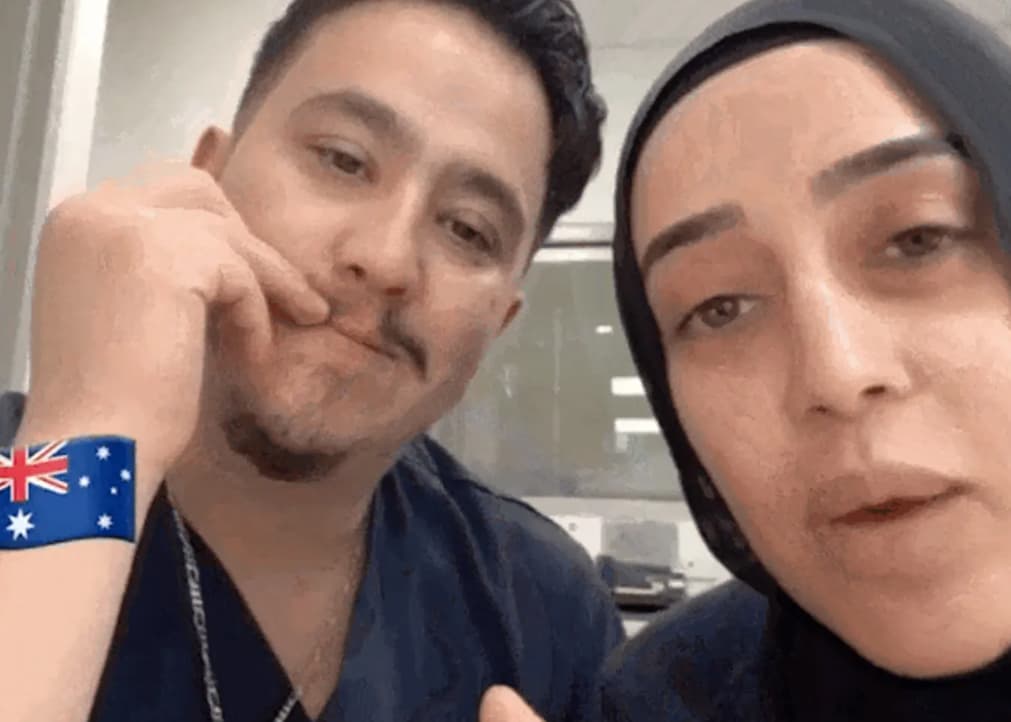
Nurses Ahmad Rashad Nadir and Sarah Abu Lebdeh who threatened not to treat Israeli patients

Published: 12 November 2025

Last updated: 12 November 2025

When two Sydney nurses were caught on camera threatening Israeli patients in February, most of the focus was on the employment implications of the nurses’ violent threats and claims.  

Months after Ahmad Rashad Nadir and Sarah Abu Lebdeh were sacked from Bankstown Hospital for boasting of “sending Israeli dogs to Jahannam” and saying they would refuse to treat Israelis, there has been little examination of the platform which enabled their exposure. 

Rashad Nadir and Abu Lebdeh were caught because of a particular kind of chat platform interaction. Israeli online content creator Max Veifer connected with them via a Russian-clone chat-roulette platform called Chatruletka, filming their comments and sharing the video online.

Veifer’s​ work​ is part of a new digital phenomenon: random chat video encounters which have opened opportunities for human interaction between people who would never meet in real life.  

These chat platforms have enabled a form of entrapment where content creators reveal genuine animosities. The creators then use their own platform to document, expose and comment on those interactions.  

Public exposure makes formerly hidden hate speech audible. It raises awareness of the kinds of sentiment Jews are facing, documents its raw appearance in everyday digital spaces, and creates accountability.  

Exposure is valuable. It helps break the silence around anti-Jewish animus that might otherwise remain hidden. It lets people know that certain forms of hatred will not go unnoticed or unchallenged. It also offers a form of self-defence: by alerting Jews and Israelis to the cultural spaces where threats may arise, the content-creators are performing a kind of digital alert function. In the context of the recent/current wave of global hate such exposure is necessary.  

The Sydney nurses episode showed how video-chat can unmask egregious antisemitism in surprising settings, and how Jewish creators can serve as digital witnesses and accountability actors. 

But if the exposure aspect of this digital encounter phenomenon was its only feature, perhaps the spectacular nature of it might soon wear off. Viewers might tire of the caricature qualities of the exposed haters, even though they are frighteningly real. Looking at video after video of pure hate is an exercise in doom-scrolling on steroids and psychedelics.  

But some content creators are moving into another way of using these random chat encounters as platforms for creative engagement, dialogue and bridge-building.  

Tal Oran, a Mizrahi Israeli, who shifted from travel-vlogging to advocacy in the wake of the October 7, 2023 attacks and the global surge in antisemitism, is a creative example. 

With Torah in one hand, Koran in the other, keffiyeh on his shoulder and Israeli flag on the wall, Oran refuses to be boxed. Using spoof monikers such ​as ​the White Colonizer (he is definitely not a white-passing Jew) and Sweet Zionist Prince, he personalises Israeli history, and ​Mizrahi narrative​s​ in particular, contextualising Jewish history and trauma, and humanising the Jewish and Israeli experience.  

Oran doesn’t do traditional hasbara (public relations), which he considers defensive. Rather he uses a combination of code-switching, potty-mouthed jocularity, dancing around his interlocutors sometimes with a now-you-see-me, now-you-don’t jester-like playfulness and sometimes with no holds-barred confrontation. This style is ​​​well​​​-​suited to the mash-up mind of contemporary digital consumers​.​​     ​​​ 

Importantly, Oran’s approach is based on opening a stage for dialogue not just capturing hate speech. Creators like Oran demonstrate that the same platforms and communication techniques that allow the dissemination of hate can be used for constructive contact.  

Rather than simply bracketing the Arab/Muslim random chat partner as enemy, Oran’s approach engages with those who express problematic sentiments as human beings with their own narratives and grievances, seeking opportunities for connection.  

The Sydney nurses episode showed how video-chat can unmask egregious antisemitism in surprising settings, and how Jewish creators can serve as digital witnesses and accountability actors. 

The work of content creators such as Tal Oran illustrates how the same medium can be turned toward correction, dialogue, connection and nuance, leveraging cultural fluency, personal narrative, and digital reach to try to bridge divides.  

Both modes, exposing and engaging, are valid responses to the contemporary surge of hate in a hyper-connected, hyper-hostile world. 

Jewish creators who seek to influence the online discourse should consider adopting this multi-pronged approach: one foot in observation, one foot in outreach; one eye on hostility, the other eye on humanity. There is a world of possibility in these evolving platforms.

You might also like
  • The leadership a wounded society needs
    Esther Takac
  • Fauda and the illusion of vengeance
    Ittay Flescher
  • How not to apologise
    Zac Klugman
logomark.67a07ee3
We believe in the free flow of information

Republish our articles for free, online or in print, by using our Creative Commons licence

You might also like

    bialik Jewish schools shabbat
    OpinionAustralia

    Jewish schools are the marinade that infuses continuity

    Jeremy Stowe-Lindner
    JDC Joint Nepal
    FeatureWorld

    ‘Your help is extremely needed’: Jewish aid group on the ground after Nepal flood

    Peter Kohn 1
    Ms. Foundation Women of Vision Awards: Celebrating Generations of Progress & Power
    ReflectionWorld

    My memory of Gloria Steinem

    Michael Visontay

About the author

Michelle Braunstein

Michelle Braunstein is a writer, researcher and investigator who works in tertiary education and cybercrime responses.

More from the author

OpinionWorld

The shadow of the rhizome: A challenge to academic thinking 

Comments

No comments on this article yet. Be the first to add your thoughts.