Published: 13 December 2016
Last updated: 4 March 2024
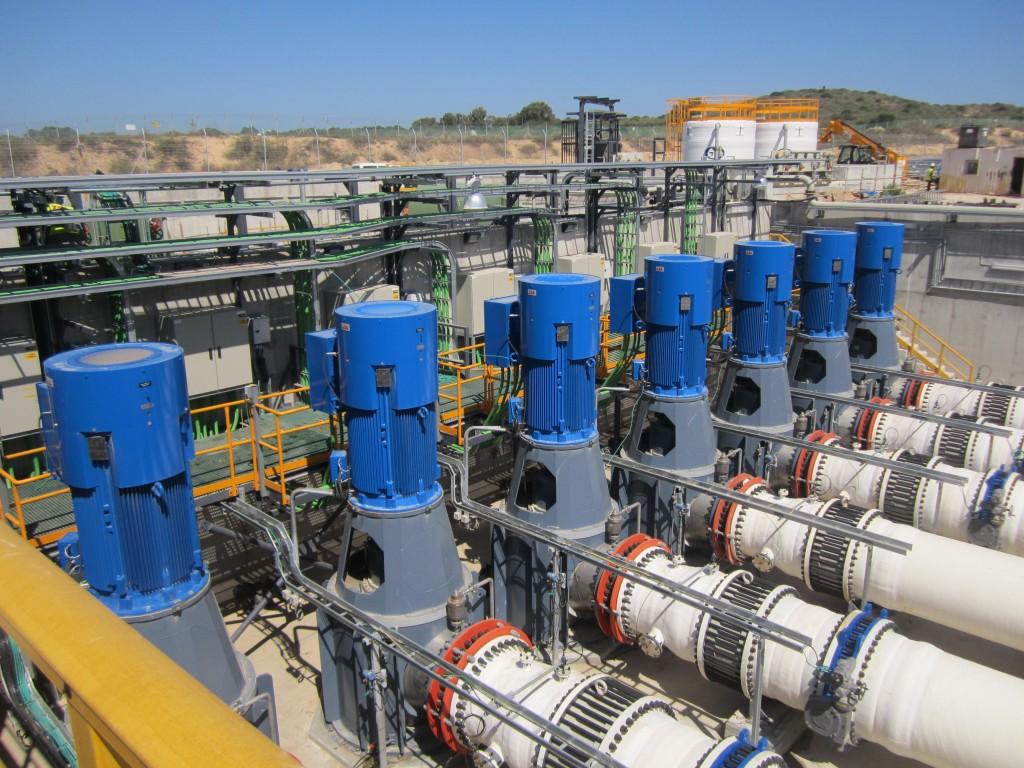
Today, Israel desalinates 600 million cubic meters of sea water a year in five plants along the Mediterranean coast, accounting for some 75% of its total water consumption, according to the Israeli Water Authority. Within a few years, Israelis will no longer have to worry about the declining water level of the Sea of Galilee, formerly Israel’s main source of fresh drinking water.
Many believe that Israel is now poised to utilise its cutting-edge technology to benefit its arid neighbors, leveraging its innovative prowess to advance the cause of peace.
A conference titled Can Water Bring the Political Process to a Safer Shore? held at the Institute for National Security Studies (INSS) at Tel Aviv University on December 8 brought water experts and foreign diplomats together to discuss the possibilities facing Israeli decision makers on the issue.
“Israel’s water independence creates the opportunity to share its resources more fairly with the Palestinians and help advance cooperation and stability region wide,” said Gidon Bromberg, Israeli director of EcoPeace Middle East, a regional environmental organization, that convened the gathering at INSS together with the German Konrad Adenauer Foundation.
Such regional cooperation is already underway. A new desalination plant in the southern Jordanian city of Aqaba, using Israeli technology, will soon provide water to communities and agriculture on both sides of the border. A new canal connecting the Red and Dead Seas will be used to generate hydroelectric energy and replenish the shrinking Dead Sea.
“Water can be used to combat Islamic extremism,” asserted Member of Knesset Ayoub Kara, who as Deputy Minister for Regional Cooperation oversees the Israeli-Jordanian projects.
Cooperation with the Palestinians has been more tenuous, however. The Israeli-Palestinian Joint Water Committee, created in 1995 as part of the Oslo Peace Accords, was accused by Amnesty International in 2009 of institutionalising Israel’s discriminatory system of water distribution, and hasn’t met in years. Yosi Dreizin, a former Israel Water Authority official who headed the Joint Water Committee, said the Palestinian side was largely to blame for the standstill.
“In our discussions with the Palestinians, it was only Israel which put forward solutions, while the Palestinians didn’t,” Dreizin told the audience. He said the Palestinian Authority insisted carrying out water drilling in the West Bank, insisting that Israel not supply water to Jewish settlements as a condition for cooperation.
“The water issue will not block a [political] solution, but the lack of a solution causes problems with the water issue,” he stated.
Nowhere in the Palestinian territories is the water situation more dire than in the Gaza Strip. Back in 2012, the UN warned that the Gaza Strip will be uninhabitable by 2020, due - among other reasons - to a sharp increase in water demand and the low quality of water in the coastal enclave. With plans for a new purification plant in Gaza stalled, Israel currently sells Gaza less than 10 million cubic meters of water a year, a fraction of what it requires. Earlier this year, Israel’s Ashkelon desalination plant was closed for days due to the flow of untreated sewage from Gaza into the Mediterranean, Bromberg of EcoPeace told the conference.
Professor Arnon Soffer, an Israeli expert from Haifa University, doubted whether cooperation on water could bring about peace. Israel should rather assist its neighbors, he argued, for purely humanitarian and moral reasons.
“We should give [the Palestinians] water so that we can look at ourselves in the mirror without being ashamed,” he said.
A panel of European ambassadors spoke of the financial contributions of Germany and Sweden to the Palestinian water crisis. Ambassador Lars Faaborg-Andersen, head of the EU delegation to Israel, asserted that water was a classic issue that could easily be agreed upon in negotiations, irrespective of agreement on thornier issues.
“No one is expecting a big bang, a fast agreement on final status issues,” Faaborg-Andersen said, in what seemed to be a break from the EU’s typical all-or-nothing approach to the conflict. “The level of trust between the sides simply doesn’t make this feasible.”
Faaborg-Andersen said he was encouraged by a notice by the Israeli Coordinator for Government Activities in the Territories (COGAT) that the Joint Water Committee will soon reconvene. What is needed, the ambassador said, was such “confidence building steps on the ground.”
Bromberg of EcoPeace would agree.
“We need to stop holding water issues hostage to broader political issues,” he said. “The fact that israel is now willing to sell more water and electricity to Gaza shows a deeper understanding that water and sanitation issues are part of national security.”
This The Jewish Independent article may be republished if acknowledged thus: ‘Reprinted with permission from www.thejewishindependent.com.au ’


