Aa
  • Read, Watch, Listen
  • TJI Series
  • Community Action
  • Events
  • Zedi
Follow us and continue the conversation
  • LinkedIn
  • Instagram
  • FaceBook
  • X
  • YouTube
Test yourself with the TJI Quiz!

Adjust size of text

Aa

Follow us and continue the conversation

  • LinkedIn
  • Instagram
  • FaceBook
  • X
  • YouTube

Your saved articles

You haven't saved any articles

What are you looking for?

Original reporting, insightful analysis and diverse views, delivered straight to your inbox

  • LinkedIn
  • Instagram
  • FaceBook
  • X
  • YouTube
Your support fuels our mission to inform, entertain and inspire.

The Jewish Independent is bound by the Standards of Practice of the Australian Press Council. If you believe the Standards may have been breached, you may approach The Jewish Independent or make a complaint to the Australian Press Council in writing at www.presscouncil.org.au. The Council may also be contacted on 1800 025 712.

  • Our Story
  • Contact us
  • Our Team
  • Support us
  • Guidelines
  • Pitch your idea
  • Republishing us
  • Community Action
  • Our Awards
  • LinkedIn
  • Instagram
  • FaceBook
  • X
  • YouTube
Aboriginal FlagTorres Strait Islanders Flag

The Jewish Independent acknowledges Aboriginal and Torres Strait Islander peoples as the Traditional Owners and Custodians of Country throughout Australia. We pay our respects to Elders past and present, and strive to honour their rich history of storytelling in our work and mission.

© The Jewish Independent 2026All Rights Reserved
Website design and development by Your Creative, MelbourneTerms & ConditionsPrivacy Policy
HomeRead, Watch, ListenIsrael
FeatureIsrael

Everything you need to know to understand Israel’s election

Ittay Flescher
Print this

Published: 28 October 2022

Last updated: 5 March 2024

Israel goes to the polls on November 1. ITTAY FLESCHER explains the who, what and why of the fifth election in four years.

Why is Israel holding its fifth election in less than four years?

The unstable coalition led by two Centrist parties, Yair Lapid’s Yesh Atid and Naftali Bennett’s Blue and White, collapsed after defections from minor coalition partners Yamina (Right), Meretz (Left), and Ra’am (Arab). Yamina MK Idit Silman quit over a tweet from Health Minister Nitzan Horowitz ordering hospitals to follow a Supreme Court ruling allowing patients to eat chametz on Pesach. Yamina’s  Nir Orbach, Meretz’s Ghaida Rinawie Zoabi, and Ra’am’s Mazen Ghanem quit the coalition over the West Bank regulation law, which recognises Israeli settlements in the West Bank.  

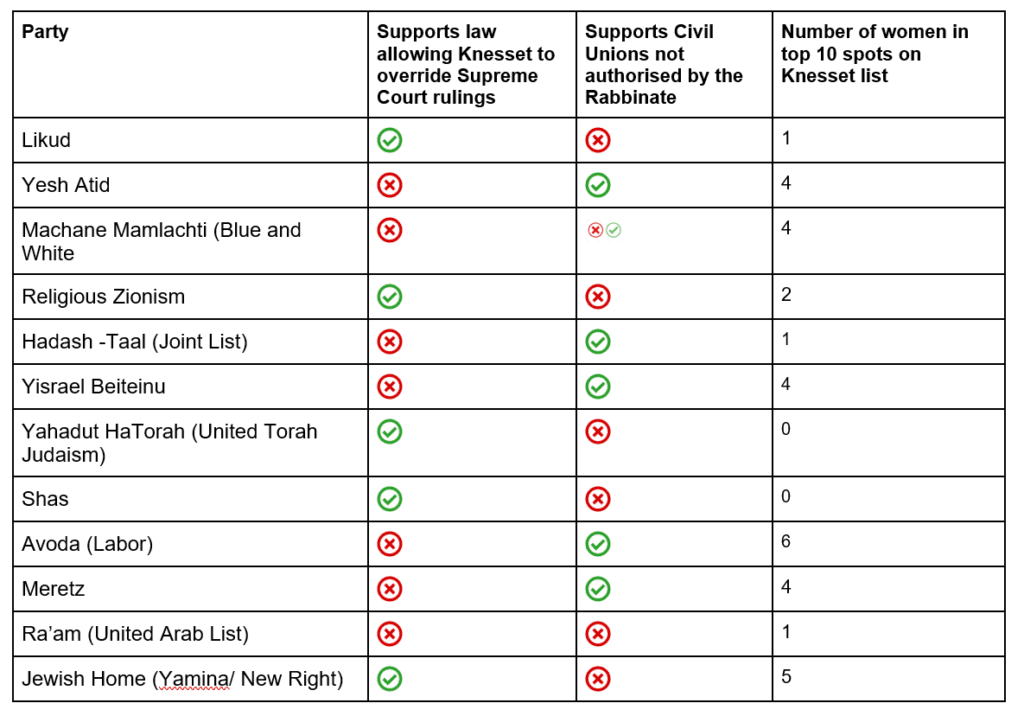
What are the parties and what does each stand for?

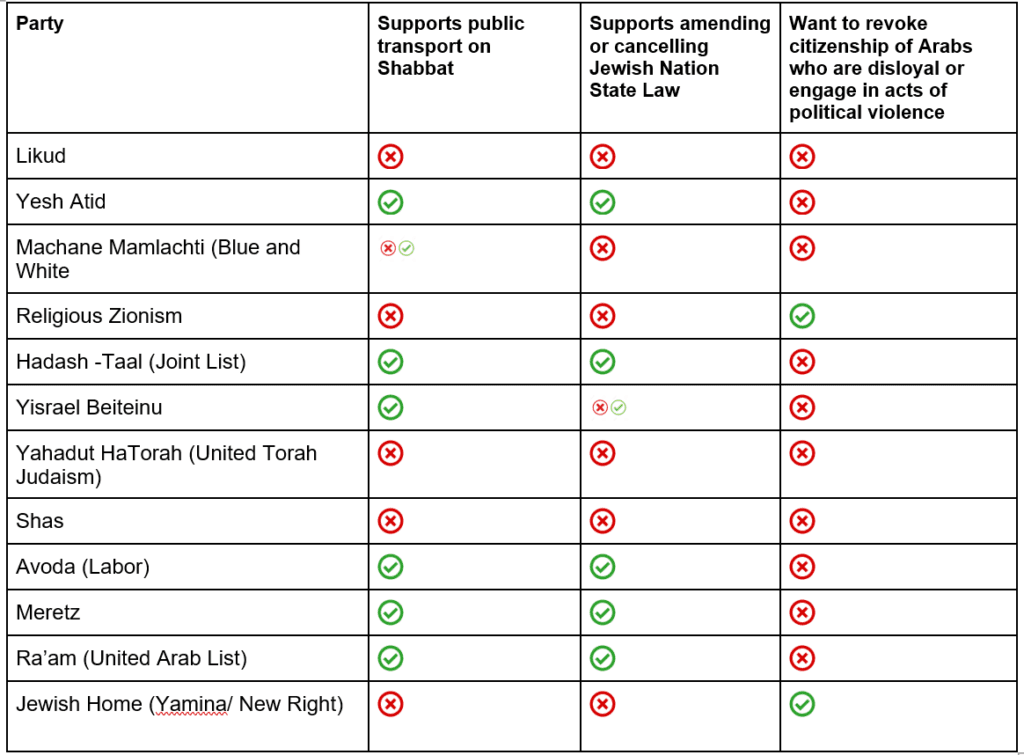
There are 40 parties running for seats in the 26th Knesset. Only parties expected to pass the electoral threshold of 3.25% based on recent polls have been included in this list.

Parties views on key issues are outlined below. The opinions/stances that are reported here are either based on stated policies or inferred from past statements or actions.

The Jewish Independent

Who could be prime minister?

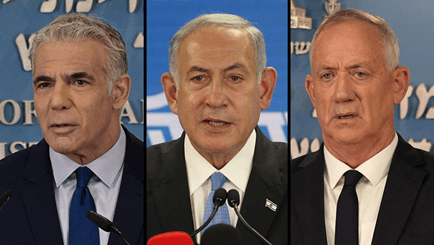
The three leading parties in this election are Likud, Yesh Atid and the Machane Mamlachti. Their candidates for prime minister are:

Benjamin Netanyahu: As Israel’s longest serving prime minister, Netanyahu is both the most popular and most divisive MK in the Knesset, generating polarised opinion from complete adoration to intense loathing from the different parts of the Israeli electorate. His opponents note his multiple corruption charges and alliance with the Religious Zionist populist Itamar Ben-Gvir. His supporters note his great successes in reforming the Israeli economy, stopping the Iran deal, and achieving the Abraham Accords. His key promises this election are to reduce the cost of living, show a strong hand against terrorism and restore stability and pride to the people of Israel.

Yair Lapid is the current prime minister and the founder and leader of the Yesh Atid party. After being the first PM in over five years to speak with Palestinian President Mahmoud Abbas, Lapid recently offered his support for the two-state solution at the UN, and has promised to amend to contentious Jewish Nation-State law if he retains the premiership and leads the centre-left bloc following the November 1 election. He is running on a campaign to lower the cost of living and continue the work of the ground-breaking eight-party coalition led by Naftali Bennett.

Benny Gantz: Also coming from the centre-left bloc is former IDF Chief of Staff Benny Gantz who feels that only he can form a stable coalition comprised of parties from both the so-called Bibi bloc and Lapid bloc. This will include Haredi, Zionist and Arab parties totalling 71 seats based on current polls. Together with his top two, Gidon Saar and Gadi Eisenkot, the Machane Mamlachti argue that only they can unite the diverse tribes of Israel in a manner that no one else can.

Possible prime ministers: From left: Yair Lapid, Benjamin Netanyahu, Benny Gantz

What are the most important issues for Israelis this election?

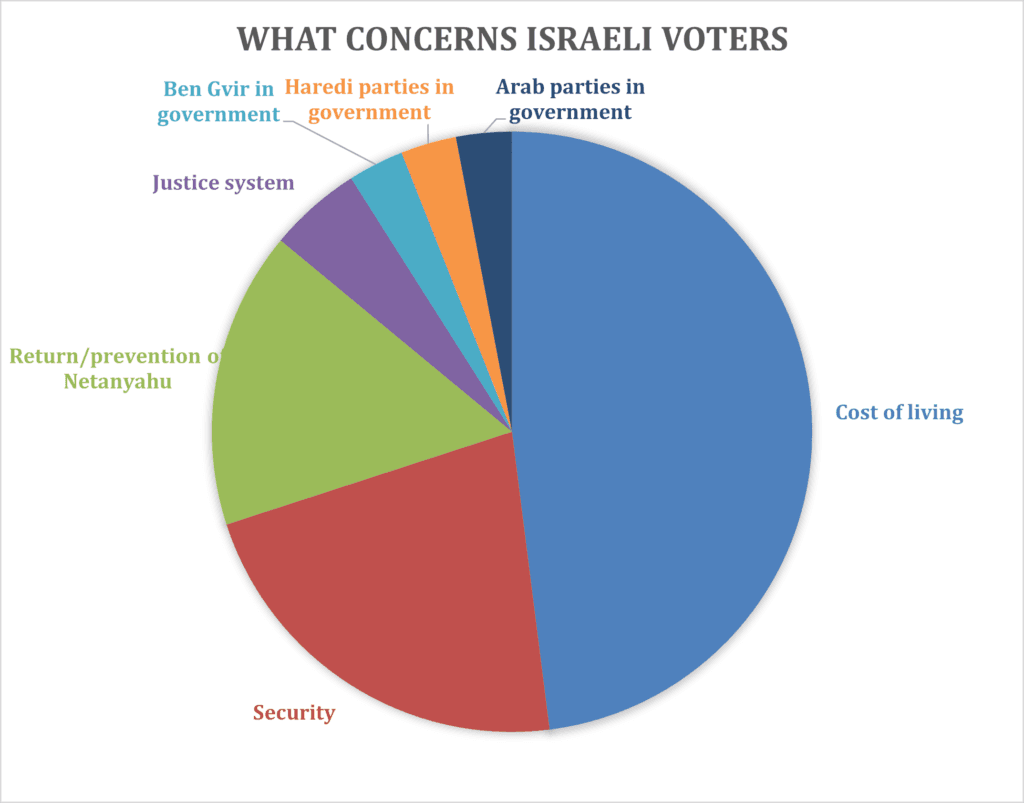
The key issues determining the vote of Israelis according to the latest N12 poll taken on the eve of the elections are:

  • Cost of living 48%
  • The security situation 22%
  • Return or prevention of Netanyahu’s return to power 16%
  • Reforming the justice system 5%
  • The prospect of far-Right politician Itamar Ben-Gvir being a minister in the next government 3%
  • The inclusion of Haredi parties into the coalition 3%
  • The inclusion of Arab parties into the coalition 3%
The Jewish Independent

Although Israelis say they vote on issues, they mostly vote based on how religious they are. More religious voters tend to support parties in the right-wing bloc and secular voters support centre-left parties.

 “If you look at the demographics, it’s clear that people vote according to their social identity and maybe later on they justify their choice by relating to issues or by relating to the specific properties of the leader of party,” says Gideon Rahat, director of political reform at the Israel Democracy Institute.

Why is Israel's government always a coalition?

Israel follows a proportional representation system. Voters choose a party and seats are allocated according to a party list.

No Israeli party has ever won 61 seats required to command a majority in the 120-seat Knesset so government always happens through coalitions. The most seats ever won in an Israeli election was in 1969 when the Alignment led by Golda Meir won 56 seats.

Who are the likely coalition groupings?

If Gantz is prime minister, he has stated that his coalition will include Haredi, Arab and Zionist parties including Blue and White, Yesh Atid, Meretz, Labor, Yisrael Beiteinu, United Torah Judaism, Shas, and Ra'am.

If Netanyahu is prime minister, he has stated his coalition will only include Haredi and Right-wing parties including Likud, United Torah Judaism, Shas and Religious Zionism.

If Lapid is prime minister, his coalition will include Yesh Atid, Blue and White, Meretz, Labor and Ra’am, all members of his current coalition.

All three candidates for prime minister have stated that they will not include the far-Left Arab Hadash-Taal list in their coalitions.

Who are the far Right and why has there been so much focus on them?

The far Right Religious Zionism Party led by Bezalel Smotrich and Itamar Ben-Gvir have been doing incredibly well in the polls, more than doubling their current size in the Knesset. Should they end up with more than 14 seats on election day, this would mean more than half a million Israelis endorse their vision of Zionism which is deeply anti-Arab, anti-women and anti-LGBT.

One of their ads placed on a prominent billboard in Ramat Gan uses the blessing for one of the simanim (special foods) from Rosh Hashanah, “may our enemies be removed” with pictures of Ayman Odeh, Ahmad Tibi (the heads of the Arab party Hadash-Ta’al), and Ofer Cassif (the only Jewish member of the Arab party Hadash). “Ben-Gvir’s time has arrived,” the sign reads.

Why is the Arab vote so important?

If the Arabs of 1948 who live within Israel’s borders vote in large numbers, it’s highly unlikely Netanyahu will have 61 seats in his bloc. If they stay home on election day, as many have said they will do due to a feeling of frustration with the manner in which they have been treated by both Left and Right, Netanyahu is far more likely to have 61 in his bloc.

Will any result improve the chances for peace?

This doesn’t have a short answer, so thankfully I wrote a whole article on this question.

You might also like
  • Why I’m still voting Labor in Victoria
    Dean Sherr
  • Netanyahu pushed Shin Bet head to spread racist misinformation at election
    Eetta Prince-Gibson
  • The Israelis who flew home to vote
    Gideon Cohen
logomark.67a07ee3
We believe in the free flow of information

Republish our articles for free, online or in print, by using our Creative Commons licence

You might also like

    August Victoria Hospital
    PeacebuildingOpinionIsrael

    My vision for Palestinian cancer patients

    David Adler
    Arab league
    Israel Votes 2026FeatureIsrael

    Dear Israel, we don’t care who your next prime minister is

    Michal Yaari 1
    Eisenkot Herzog
    Israel Votes 2026NewsIsrael

    Diaspora Jews urge Israel’s change bloc to form a Jewish–Arab coalition

    Sharon Offenberger 2

About the author

Ittay Flescher

Ittay Flescher

Ittay Flescher is the Jerusalem Correspondent for The Jewish Independent. For over 20 years, he has worked as an educator, journalist, and peacebuilder in Melbourne and Jerusalem. His book, The Holy and the Broken: A Cry for Israeli-Palestinian Peace from a Land that Must Be Shared, was longlisted for the 2025 Walkley Book Awards.

More from the author

FeatureArts & Culture

The eight most Jewish songs of Leonard Cohen

OpinionIsrael

Even on October 7, we are not united

AnalysisArts & Culture

Fauda and the illusion of vengeance

AnalysisIsrael

What ‘Zionism’ means in Israel:  it’s not what you think