Aa
  • Read, Watch, Listen
  • TJI Series
  • Community Action
  • Events
  • Zedi
Follow us and continue the conversation
  • LinkedIn
  • Instagram
  • FaceBook
  • X
  • YouTube
Test yourself with the TJI Quiz!

Adjust size of text

Aa

Follow us and continue the conversation

  • LinkedIn
  • Instagram
  • FaceBook
  • X
  • YouTube

Your saved articles

You haven't saved any articles

What are you looking for?

Original reporting, insightful analysis and diverse views, delivered straight to your inbox

  • LinkedIn
  • Instagram
  • FaceBook
  • X
  • YouTube
Your support fuels our mission to inform, entertain and inspire.

The Jewish Independent is bound by the Standards of Practice of the Australian Press Council. If you believe the Standards may have been breached, you may approach The Jewish Independent or make a complaint to the Australian Press Council in writing at www.presscouncil.org.au. The Council may also be contacted on 1800 025 712.

  • Our Story
  • Contact us
  • Our Team
  • Support us
  • Guidelines
  • Pitch your idea
  • Republishing us
  • Community Action
  • Our Awards
  • LinkedIn
  • Instagram
  • FaceBook
  • X
  • YouTube
Aboriginal FlagTorres Strait Islanders Flag

The Jewish Independent acknowledges Aboriginal and Torres Strait Islander peoples as the Traditional Owners and Custodians of Country throughout Australia. We pay our respects to Elders past and present, and strive to honour their rich history of storytelling in our work and mission.

© The Jewish Independent 2026All Rights Reserved
Website design and development by Your Creative, MelbourneTerms & ConditionsPrivacy Policy
HomeRead, Watch, ListenWorld
World

From Berlin with hope: the dream of a Middle-East Union

Mati Shemoelof
Print this

Published: 17 September 2021

Last updated: 4 March 2024

MATI SHEMOELOF was one of the curators of a bold arts festival to create a united Middle-East - for a weekend. His dream overcame a rough start to finish on a high

OPENING NIGHT OF the recent Middle East Union festival in Berlin almost ended in disaster. The multilingual literature event was held at the famous Babylon cinema and opened with a panel of Berlin-based Arab and Jewish intellectuals.

Following the panel, the Sistanagila, a band comprised of Iranian and Israeli musicians, took the stage. But after just one song, the bass player collapsed on stage screaming in pain. Luckily, there was a doctor in the audience.

I was one of the curators of the festival. The idea of ​​a united Middle East came to me after almost a decade of living in the European Union. If Europe could unite after centuries of colonialism, two world wars and one Holocaust, then the Middle East, North Africa, Iran and Turkey could also unite in such a union.

Three hours before the bass player’s health emergency, I had stood outside the Babylon, in the Mitte neighbourhood, filled with a wonderful feeling that my dream had come true. From a line in one of my poems, I could see it spreading in the city I love and sending its arms all over the world. I imagined peace between Palestinians and Israelis as the first step, then a union with Turkey and Iran.
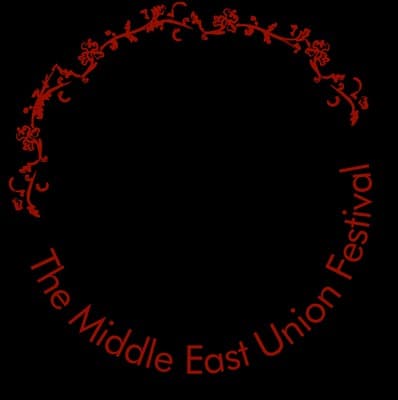
Poster from the festival

On the panel, Palestinian artist Steve Sabella showed his beautiful work and talked about his dream of true equality in the Middle East. Dr Dekel Peretz, from the Fraenkelufer synagogue, talked about the Jewish history of Berlin and community’s responsibility to the Middle East.

The activist and psychoanalyst Iris Hefets talked about the need to decolonise Israel, and the curator of the city’s Arab film festival, Iskandar Ahmad Abdalla, referred to similar struggles in the region.
The Berlin night was warm, an ambulance arrived and my head was full of new thoughts. Only six months before, we didn’t know what to do when we received funding. We scheduled weekly meetings to discuss each level of development. Our first decision was that we needed to reach the Palestinian community, to avoid the perception that we were forging a Middle East peace without them.

Alaa Obeid, an environmental activist based in Cologne, curated a Middle East panel about climate change and the common need to think about the environmental future of the region.

The idea of a “Queeristan” was brought to the agenda by the queer Arab-Jewish writer Hila Amit Abbas. This panel discussed how the LGTBQI community could be part of such a Middle-East union. It also deconstructed the idea that we middle eastern people want to be western.

The German media wrote wonderful reviews. We had expected a strong critical reaction because most of our participants were critical of Israeli politics. But nothing happened.

About 100 people came to the first event at the Babylon. It was a thrill to see our idea on the billboard outside the famous cinema. Even Klaus Lederer, a politician and Berlin’s Senator for Culture, turned up. He had to listen to critical ideas, including that the Middle East is more a European and less a Levantine idea.

Things were supposed to become light and happy when the music started. But then the bassist collapsed. The paramedics said he would be ok. Before being carried out, he asked the band to continue performing – and they did.

More panels were held the following day, starting with “Writing the Arab-Jew: Reflections on Displacement and Middle Eastern Diasporas”, then “Middle East Environmental Majlis” (councils) and “Agents of Change: pioneering female MENA voices in Film & TV”.

At night, Eden Cami and the Kayan Project (pictured) performed on the shore of Lake Wannsee (on the other side of the lake to where, in 1942, the Wannsee conference took the decision to pursue The Final Solution). By the third day we were working in good rhythm and the queer event was held.

The German media wrote wonderful reviews. We had expected a strong critical reaction because most of our participants were critical of Israeli politics. But nothing happened. No accusations of antisemitism. We wondered why? Maybe because one of the events took place in the Fraenkelufer synagogue. We were almost disappointed.

I cannot forget the moment when I heard the musician cry out with pain. Only now do I understand why I felt strangely guilty. Perhaps this utopia of a Middle East Union making economic, cultural and political connections between enemies, is an impossible dream. If not impossible, it’s a long way off.

Photo: Eden Cami and the Kayan Project (courtesy of the festival)

You might also like
  • Terror plot to kill hundreds of Arab Israelis thwarted
    Ben Lynfield
  • British Greens equate Zionism with racism
    Ruth Eglash
  • Diaspora Jews can’t vote, but Israel’s election result will affect them
    Vanina Vaisman-Levy
logomark.67a07ee3
We believe in the free flow of information

Republish our articles for free, online or in print, by using our Creative Commons licence

You might also like

    Pro-Palestine Rally Outside Foreign Commonwealth Development Office
    AnalysisWorld

    UK’s dramatic policy change on Israel-Palestine

    Colin Shindler 3
    Shocked New Yorker Watches the World Trade Center on September 11, 2001
    ReflectionWorld

    A new generation reckons with 9/11

    Gideon Cohen 1
    Jerusalemites_Muslim_Quarter_email (1)
    NewsArts & Culture

    Jerusalemites photos cancelled by Indian Festival

    Deborah Stone

About the author

Mati Shemoelof

Mati Shemoelof

Mati Shemoelof is a poet and an author. His writing includes seven poetry books, plays, articles and fiction, which have won significant recognition and prizes. He has written a radio play for German radio WDR. A German edition of his bi-lingual poems was published by AphorismA Verlag.

More from the author

ReflectionIsrael

An Israeli abroad: grieving, alienated, ashamed

OpinionWorld

Israeli expats are becoming Diaspora Jews

OpinionWorld

The surprising trend among anxious Jewish parents in Berlin

OpinionWorld

How do Germans views Israelis who live among them?