Published: 6 September 2021
Last updated: 4 March 2024
Shimon Riak and his family have just completed their conversion. He tells NOMI KALTMANN why a refugee started studying Hebrew and decided to become a Jew
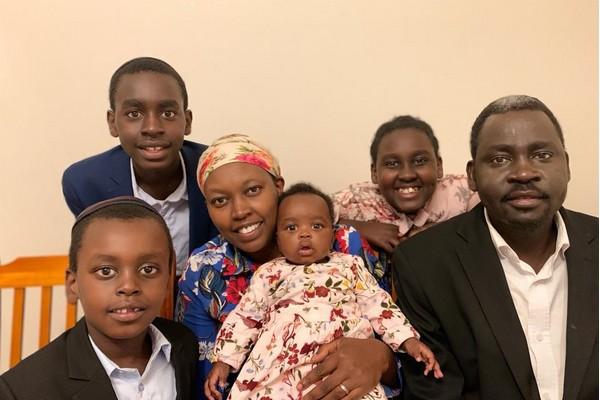
SHIMON RIAK IS a religious man living a typical Jewish life in the suburbs of Melbourne. Together with his wife he attends weekly Synagogue services at Chabad of Bentleigh and keeps a strictly kosher home. Their children attend the local Hasidic schools Yeshivah College and Beth Rivkah Ladies College.
While these practices are hallmarks of an ordinary Orthodox lifestyle, Riak’s backstory is anything but ordinary: he is a survivor of the South Sudanese civil war and a former child soldier who was granted refugee status by Australia in 2004.
When the second Sudanese civil war broke out in 1983, Riak became one of what he calls one of “the lost boys of Sudan” and was recruited to be a child soldier in a messy ethnic war. A member of the Dinka people (a group native to the now newly independent South Sudan) his tribe had been singled out by the government in Khartoum in the North of Sudan who slaughtered them by the thousand.
“The Central government in the North, committed ethnic cleansing,” he says. “After leaving the village, I spent three years fleeing and running away from bombs. It was very difficult,” he told The Jewish Independent.
Escaping persecution, Riak fled to neighbouring Kenya where he was resettled in the Kakuma Refugee Camp.
In the refugee camp, Riak began to look for God. “I was hungry for meaning, I attributed my survival during the civil war in Sudan to God, it was obvious to me that the finger of God was in my life,” he says.
He had been exposed to spirituality in Sudan, “I would not describe the Dinka’s as having a religion in the modern sense; they were never Muslims nor Christians, but their practices fall under the broad category of African religious practices,” he says.
Along with his friends in the refugee camp, he discovered a diverse group of Kenyans who practiced a hybrid form of Christianity, which incorporated some Jewish practices like celebrating Passover and Succot. “When I found this group of Kenyans, it was an amazing spiritual experience,” according to Riak.