Aa
  • Read, Watch, Listen
  • TJI Series
  • Community Action
  • Events
  • Zedi
Follow us and continue the conversation
  • LinkedIn
  • Instagram
  • FaceBook
  • X
  • YouTube
Test yourself with the TJI Quiz!

Adjust size of text

Aa

Follow us and continue the conversation

  • LinkedIn
  • Instagram
  • FaceBook
  • X
  • YouTube

Your saved articles

You haven't saved any articles

What are you looking for?

Original reporting, insightful analysis and diverse views, delivered straight to your inbox

  • LinkedIn
  • Instagram
  • FaceBook
  • X
  • YouTube
Your support fuels our mission to inform, entertain and inspire.

The Jewish Independent is bound by the Standards of Practice of the Australian Press Council. If you believe the Standards may have been breached, you may approach The Jewish Independent or make a complaint to the Australian Press Council in writing at www.presscouncil.org.au. The Council may also be contacted on 1800 025 712.

  • Our Story
  • Contact us
  • Our Team
  • Support us
  • Guidelines
  • Pitch your idea
  • Republishing us
  • Community Action
  • Our Awards
  • LinkedIn
  • Instagram
  • FaceBook
  • X
  • YouTube
Aboriginal FlagTorres Strait Islanders Flag

The Jewish Independent acknowledges Aboriginal and Torres Strait Islander peoples as the Traditional Owners and Custodians of Country throughout Australia. We pay our respects to Elders past and present, and strive to honour their rich history of storytelling in our work and mission.

© The Jewish Independent 2026All Rights Reserved
Website design and development by Your Creative, MelbourneTerms & ConditionsPrivacy Policy
HomeRead, Watch, ListenIsrael
Israel

Golda never identified as a feminist; others projected that onto her

Gilad Greenwald
Print this

Published: 21 September 2023

Last updated: 5 March 2024

Despite her desire to avoid being cast as a ‘feminist’ through becoming PM, the war ironically established a distinct gender discourse around her historical character.

Golda Meir never identified herself as a feminist, and almost never played (at least directly) the "gender card" or being a woman in a male political and public environment. Scholars and historians define Golda's relationship with the feminist movement as an "ambivalent relationship," and they provide various examples of the complex attitudes she had towards feminism.

During the Jewish Yishuv period, Golda felt alienated from the struggle of women organisations, such as the Union of Hebrew Women for Equal Rights in Erez Israel, for equality, right to vote, and political participation of women. The reason for this was her preference to associate herself in political alliances with men rather than with women, as she recognized that men could better help her in advancing her political and public career.

Some have argued that Golda was in fact "an appointment of the male leadership of Mapai and the Histadrut." Therefore, she tended to adopt the Zionist narrative, according to which the national struggle takes priority over any other social struggle, including the struggle for women’s rights. As part of this concept, even during her tenure as Prime Minister (1969-1974), Golda did not appoint a single female minister in her government.

There is a paradox in Golda's character - feminism was deeply embedded in her career, whether she wanted it or not.

However, one cannot ignore the fact that there is a certain paradox in Golda's character, because feminism was deeply embedded in her career, whether she wanted it or not. Firstly, feminism was extremely significant in Golda’s personal life as a prominent public figure, one of the founders of her state, who often had to balance housework and taking care of her children with activities in the public sphere. In this context, it should be noted that Golda’s children have stated more than once that they “sometimes felt an absence of a mother figure during their childhood”.
Secondly, throughout her career, Golda experienced gender discrimination. One of the most famous, well-known examples for this was the municipal elections for Mayor of Tel Aviv in 1955, in which the religious lists of HaMizrachi, Ha-Poel HaMizrachi, and Agudat Yisrael refused to support her for the position of mayor (despite the fact that Mapai won the largest number of seats for the council in those elections.)

The three lists then explicitly stated that they were not ready to appoint a woman for the position of mayor, and as a result, Haim Levanon was elected by the council, instead of Golda.

This difficult experience, which had a misogynistic and gender discriminatory taste, did not prevent Golda from declaring more than once that her gender was “never an obstacle” for her, a statement that, as mentioned, was inaccurate, to say the least, and probably stemmed from Golda's assessment that she must humble her “femininity” to better integrate into senior political and public positions.

It is interesting to discover that when Golda was elected Prime Minister of Israel for the first time in 1969, the religious parties no longer repeated the same thesis, that a woman cannot hold a senior leadership position.

The Jewish Independent

Thirdly, the leadership model that Golda presented, although mainly unconsciously, made use of her "femininity" as a political asset. She served as a symbol for women in Israel and all over the world (by the way, most significantly in the United States), and by simply being a female leader, she conveyed a first-of-its-kind feminist message.

Golda's image as the "legendary Jewish mother" served her and raised her popularity in public opinion. She held the image of the "mother of her nation" who “takes care” of her "children." This image was of course also connected to the well-known metaphor of "Golda's kitchen cabinet," where on the one hand, Golda is a leader who makes existential political and security decisions; and on the other hand, she is a "caregiver" who serves the IDF Chief of Staff and the Minister of Defense tea, biscuits, and fruit.

It can be argued that the Yom Kippur War was a turning point in the gender attitude of the Israeli public towards Golda, and two main lines of thought need to be taken into account in this respect. The first is related to what society perceives as "masculine" issues (security, economy, and foreign policy).

The war was a turning point in the gender attitude of the Israeli public towards Golda.

If, until October 1973, Golda was seen as a gifted stateswoman, who through an excellent diplomatic approach, high-level English, and persuasiveness, made a significant contribution to the security and international status of her country; after the war, quite a few people began to connect the security failure of Yom Kippur to the fact that Golda is "a woman who lacks military experience."

This claim, of course, was fundamentally inaccurate, because the failure of the war (which resulted in unprecedented national trauma) was also the result of problematic intelligence and operational assessments by male “generals,” such as Defence Minister Moshe Dayan and Chief of Staff David Elazar.

A second line of thought, which was emphasised by Golda's biographer, Professor Pnina Lahav, was anchored in a stereotypical attitude towards Golda after the Yom Kippur War as a "nasty old woman”. This attitude included misogynistic attacks, which focused on her age, appearance, and the fact that as a woman she was allegedly too "sensitive" to deal with the horrors of the war.

This stereotypical view was also refuted by many military historians, who showed that after the outbreak of the war, Golda demonstrated strength and power that very few leaders in the history of the State of Israel have demonstrated.

But all this did not help Golda. Ironically, despite her desire to “escape” an unequivocal "feminine" image all these years, it was the last and most memorable move in her political career. The Yom Kippur War established a distinct gender discourse and perspective around her historical character.

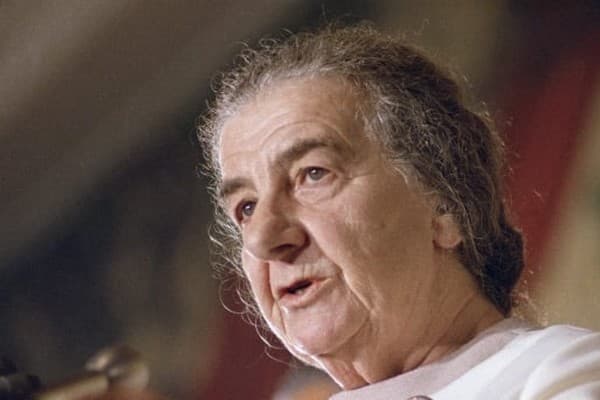
Photo: Prime Minister Golda Meir and Defence Minister Moshe Dayan in the Golan Heights, November 21, 1973. (Ron Frenkel/GPO)

You might also like
  • My tallit is fraying; my prayer should not
    Caryn Granek
  • Nobody wants this, but as a student rabbi I can’t look away
    Merissa Nathan Gerson
  • Jonah’s unfinished story echoes louder after October 7
    Leah Justin
logomark.67a07ee3
We believe in the free flow of information

Republish our articles for free, online or in print, by using our Creative Commons licence

You might also like

    Ofer_Winter_2026
    Israel Votes 2026AnalysisIsrael

    Who is Ofer Winter and could he upset Netanyahu’s election?

    Shahar Burla
    Activists attempt to deliver supplies to Palestinian families near Nablus
    OpinionIsrael

    Qusra siege exposes shared agenda of IDF and settler extremists

    Ben Lynfield
    Ibrahim Khatatbe
    NewsIsrael

    Abuse by IDF soldiers humiliates Muslim Palestinians

    Ben Lynfield 3

About the author

Gilad Greenwald

Gilad Greenwald

Dr Gilad Greenwald is a lecturer in Bar-Ilan University's School of Communication

More from the author

AnalysisIsrael

Why Israel is unlikely to be banned from the Eurovision song contest

FeatureIsrael

Why it is better to have far-Right candidate Itamar Ben-Gvir inside the tent

FeatureIsrael

Why opinion polls are partly to blame for Israel’s fifth election