Published: 16 September 2022
Last updated: 5 March 2024
His popularity is personal not ideological. But even if he gains more seats, the politician once convicted of supporting terrorism is less dangerous in the Knesset, writes GILAD GREENWALD.
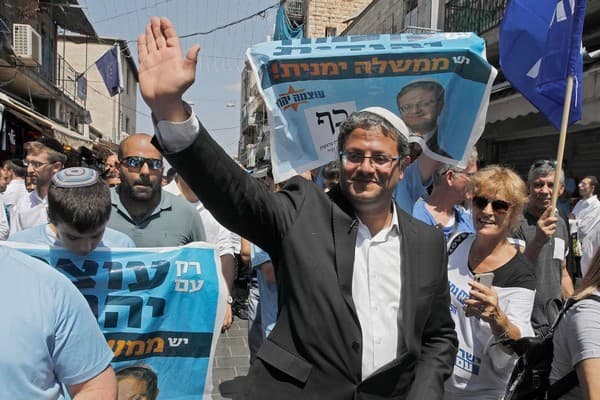
For the past few weeks, the far-Right candidate Itamar Ben-Gvir, from the Religious Zionist Party led by Bezalel Smotrich, has become one of the most prominent politicians on the media agenda in Israel. He appears almost daily on television; he is one of the most “viral” politicians on social media; and every physical appearance of him, whether in a demonstration, a settlement, or a high school, receives a huge media response.
Ben-Gvir, who was convicted of supporting a (Jewish) terrorist movement in the 1990s, and is remembered to this day as an enthusiastic advocate of prime minister Yitzhak Rabin’s assassination in 1995, is provoking unprecedented hysteria in the “liberal camp” in Israel.
The main concern from many leftists is anchored in the potential significant increase of his party’s seats in the November election, from six seats in the current Knesset, to 11, according to opinion polls. In addition, many fear the possible appointment of Ben-Gvir as a senior minister in a far-Right, ultra-religious government led by Benjamin Netanyahu.
In my view, this fear is exaggerated. To a large extent, it is also one of the reasons why Ben-Gvir has reached such a significant degree of prominence and exposure in the public discourse. I will try to explain why, through the following five points.
First, the Left tries to present a dichotomous picture of politics, as if the Israeli "mainstream" is so radically right-wing, that the ideas of “Rabbi” Meir Kahane (whose racist movement Kach was outlawed in the 1980s) became a central ideology. This is an inaccurate portrait. In order to persuade the "Israeli mainstream", Ben-Gvir has had to work hard; the ideological and practical compromises he has made over the past year are far-reaching, compared to the teachings of Kahane.
For instance, as a symbolic act, Ben-Gvir removed a photograph of Baruch Goldstein (a terrorist who murdered 29 Palestinians in 1994) from his living room wall in 2019. Ben-Gvir also changed the extreme discourse regarding Israeli Arabs and LGBTQ people that characterised his rhetoric until recently. Today he claims that LGBTQ people are "his brothers and sisters", and that if he had a gay son, he "would embrace him".