Aa
  • Read, Watch, Listen
  • TJI Series
  • Community Action
  • Events
  • Zedi
Follow us and continue the conversation
  • LinkedIn
  • Instagram
  • FaceBook
  • X
  • YouTube
Test yourself with the TJI Quiz!

Adjust size of text

Aa

Follow us and continue the conversation

  • LinkedIn
  • Instagram
  • FaceBook
  • X
  • YouTube

Your saved articles

You haven't saved any articles

What are you looking for?

Original reporting, insightful analysis and diverse views, delivered straight to your inbox

  • LinkedIn
  • Instagram
  • FaceBook
  • X
  • YouTube
Your support fuels our mission to inform, entertain and inspire.

The Jewish Independent is bound by the Standards of Practice of the Australian Press Council. If you believe the Standards may have been breached, you may approach The Jewish Independent or make a complaint to the Australian Press Council in writing at www.presscouncil.org.au. The Council may also be contacted on 1800 025 712.

  • Our Story
  • Contact us
  • Our Team
  • Support us
  • Guidelines
  • Pitch your idea
  • Republishing us
  • Community Action
  • Our Awards
  • LinkedIn
  • Instagram
  • FaceBook
  • X
  • YouTube
Aboriginal FlagTorres Strait Islanders Flag

The Jewish Independent acknowledges Aboriginal and Torres Strait Islander peoples as the Traditional Owners and Custodians of Country throughout Australia. We pay our respects to Elders past and present, and strive to honour their rich history of storytelling in our work and mission.

© The Jewish Independent 2026All Rights Reserved
Website design and development by Your Creative, MelbourneTerms & ConditionsPrivacy Policy
HomeRead, Watch, ListenLifestyle
ReflectionLifestyle

Haman and Hamas: Purim’s chilling contemporary relevance

Beneath the masks and costumes, the festival contains a message that feels frighteningly contemporary: Jews must face and counter irrational hate.
Ralph Genende
Print this
haman hamas

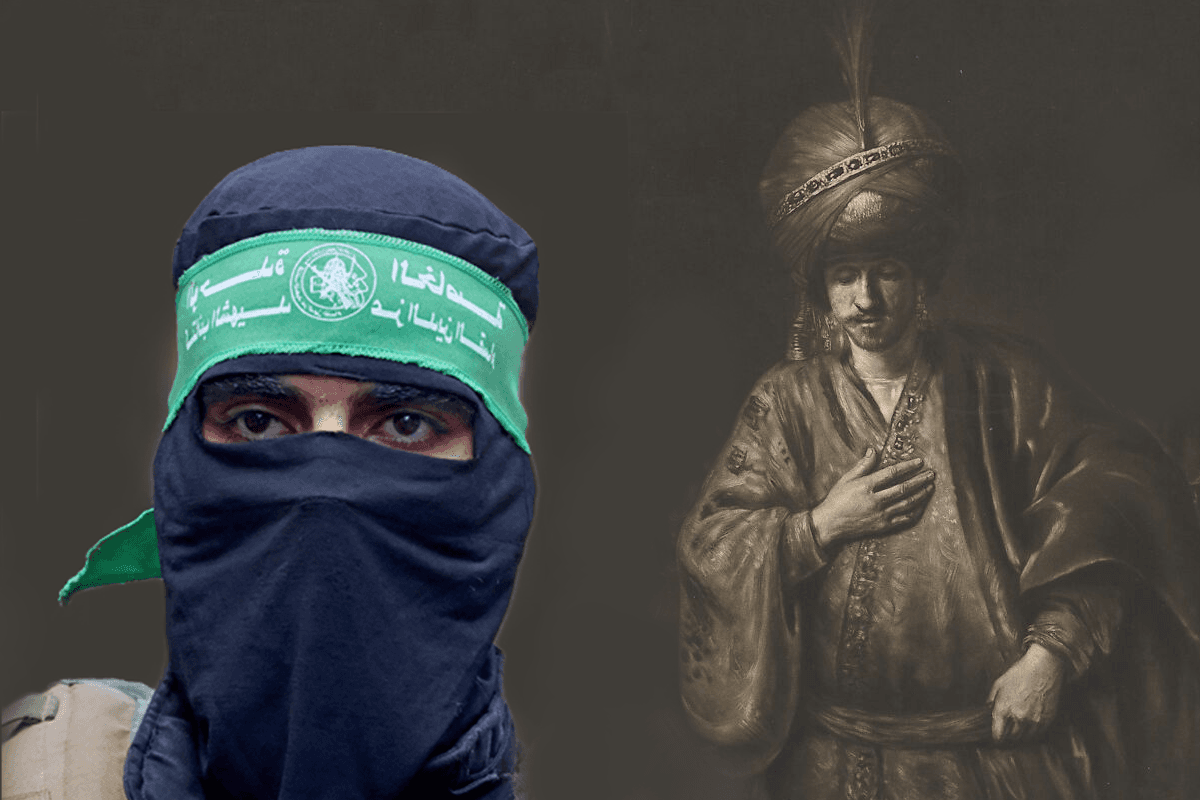
Haman, as painted by Rembrandt, and a Hamas fighter (TJI composite)

Published: 6 March 2025

Last updated: 4 March 2025

It’s a phantasmagorical tale of murderous Jew -hatred, a dynamism of horrific terror and the unabashed pursuit of power. A world upended. It’s the upside-down universe of today. It’s the absurd world of the Book of Esther   

The Megillah is a story of contradictions, peppered with coincidences and events of pure chance. At one moment the Jews of Persia are living in comfort and security assured of their respected place in the multicultural environment of ancient Iran, the next instance they face a devastating decree of destruction. With giddy intensity they move from terrifying fear to the festivity of a Jewish PM and powerful Jewish Queen. 

This is the critical lesson of Purim for today: to recognise the general agonising uncertainty of the human condition and the vulnerability of Jewish destiny.  

The chilling and exceptional mitzvah to “eradicate Amalek” makes more sense to me now than ever before. 

Disturbed by the horror of 9/11, American thinker Lee Harris has argued that liberal democracies have forgotten the true meaning of a real enemy: an individual that you simply can’t sit down and reason within the belief that you can find the solution for every conflict. An enemy says Harris, is “someone who is willing to die in order to kill you…They hate us simply because we are their enemy’’. 

In Haman, the Persian Jews meet the primeval, venomous evil of Amalek, the archetypal enemy of the Jews. Haman sometimes described as “the Agagite”, a reference to Agag, notorious King of the Amalekites, from whom he is said to be descended. The Amalekites attacked the new nation of Israel, fresh out of Egypt, not out of fear but with cynical impunity. Haman, like Amalek, cares little for human life especially if it gets in the way of his desperate pursuit of power and his narcissistic belief in his superiority. The Talmud asserts that Haman claimed he was a god. Like some other “Hs” —Hitler, Hamas and Hezbollah —he stands for the worst of all humanity. In the words of the poet WB Yeats, “The best lack all conviction, while the worst/ Are full of passionate intensity.” 

This is why we dare not forget how Amalek tried to destroy the nascent nation of Israel, targeting the weak and the vulnerable, and why we should always remember that their spirit still haunts the world. The difference between a Haman and Hamas is the little n or nth degree.  

Witnessing as we have the incalculably callous treatment of the hostages, the savage slaying of the emaciated young men and women and others in the tunnels of horror, the unbearable cruel murder of the Bibas family, the ghastly pantomimes around the release of the captives, the chilling and exceptional mitzvah to “eradicate Amalek” makes more sense to me now than ever before.  

Now more than ever the Talmudic assertion that if you are kind to the cruel you will land up being cruel to the kind strikes me with its s profound contemporaneity. Now is the time to heed the prognosis of Lee Harris that while compromise can achieve wonders, there are those with whom no compromise is possible, because they simply refuse to compromise. 

This lesson is closely linked to another important Purim message highlighted by Rabbi J B Soloveitchik, that while evil people are a threat to all of us, they are all too often a particular threat to the Jews. They may come from the right or left or a toxic ideology—be it communism or Islamism—but they become obsessed with Jews even if we are only incidental or tangential to their policies. Deborah Lipstadt has joked that it makes little difference to her where antisemitism comes from, she is against it, since she is an “equal opportunity” hater of antisemitism. 

The Persian exile taught the Jews that our mere presence makes many people feel uncomfortable and unsettled and when they are driven by a demonic irrationality, they are decidedly dangerous. Haman puts it simply and precisely: “Yet all this honour and prestige is worthless as long as long as I see Mordechai the Jew, sitting at the king’s gate” (Esther 5 :13). His genocidal plan to eradicate every Jew, is a precursor to the Hamas Charter. 

We dance and drink to a better future precisely because we retain a strong awareness of the genuine evil that can lurk in the hearts of all human beings

It’s a reminder, says Soloveitchik, that Jews everywhere, even those living in benign and liberal societies must answer decidedly: “Yes” to the troubling question, “Could it happen here?” Our Judaic commitment to the respect for all human life and what Einstein called our “fanatical pursuit of justice” will not insulate us from the visceral hate of an irrational enemy. 

But for all these dark messages, the Story of Esther is an odyssey of empowerment, carrying a message of hope and illumination. It reminds us that despite all the odds, with skill and courage we can defeat a hate-filled enemy. 

This is what Mordechi and Esther did by outwitting and outplaying Haman, with undaunted courage. The words of Mordechai to Esther who is rightly fearful of approaching the mercurial king ring out in every generation and resonate like a beautiful chord of music in our times: “If you persist in keeping silent at a time like this, relief and deliverance will come...from some other place. But …who knows whether it was just for such a time as this that you attained the royal position.” (Esther 4:14)  

None of us chose to live in a post October 7 era, but we can choose to act with clarity and moral courage to counter the egregious lies, the disgraceful antisemitism and brutal ideology of these times. 

We counter the obscenity of antisemitism with the amity of mutuality. We rejoice with abandon on Purim, we transform sorrow into celebration, failure into festivity. We dance and drink to a better future precisely because we retain a strong awareness of the genuine evil that can lurk in the hearts of all human beings.  

You might also like
  • Unlikely bedfellows: How Arab parties could deliver Israel’s next government
    Ben Lynfield
  • Haredi party may change sides, enabling Eisenkot to form new government
    Shahar Burla
  • Memo Usman Khawaja: Jesus was Jewish
    Adam Slonim
logomark.67a07ee3
We believe in the free flow of information

Republish our articles for free, online or in print, by using our Creative Commons licence

You might also like

    Ai goring ox
    AnalysisLifestyle

    The goring ox: who answers for ‘rogue’ AI?

    Yoni Genende
    “Pokies” – Gambling in Australia
    FeatureLifestyle

    So addicted, he gambled on Yom Kippur

    Jarod Rhine-Davis
    Futurism
    OpinionLifestyle

    Jewish Futurism? We’ve been practising it for millennia 

    Renata Zimbarg 1

About the author

Ralph Genende

Ralph Genende

Rabbi Ralph Genende is the Interfaith and Community Liaison at the Australia Israel and Jewish Affairs Council. He is also Senior Rabbi to the Australian Defence Force and Rabbi of Kehilat Kesher Community.

More from the author

ReflectionWorld

A celebration of chutzpah, from Moses to modern times

AnalysisAustralia

Interfaith relations after Bondi 

DebateAustralia

Stopping the sacrifice of children on a new altar 

OpinionLifestyle

Forgiving our parents: a Yom Kippur challenge