Aa
  • Read, Watch, Listen
  • TJI Series
  • Community Action
  • Events
  • Zedi
Follow us and continue the conversation
  • LinkedIn
  • Instagram
  • FaceBook
  • X
  • YouTube
Test yourself with the TJI Quiz!

Adjust size of text

Aa

Follow us and continue the conversation

  • LinkedIn
  • Instagram
  • FaceBook
  • X
  • YouTube

Your saved articles

You haven't saved any articles

What are you looking for?

Original reporting, insightful analysis and diverse views, delivered straight to your inbox

  • LinkedIn
  • Instagram
  • FaceBook
  • X
  • YouTube
Your support fuels our mission to inform, entertain and inspire.

The Jewish Independent is bound by the Standards of Practice of the Australian Press Council. If you believe the Standards may have been breached, you may approach The Jewish Independent or make a complaint to the Australian Press Council in writing at www.presscouncil.org.au. The Council may also be contacted on 1800 025 712.

  • Our Story
  • Contact us
  • Our Team
  • Support us
  • Guidelines
  • Pitch your idea
  • Republishing us
  • Community Action
  • Our Awards
  • LinkedIn
  • Instagram
  • FaceBook
  • X
  • YouTube
Aboriginal FlagTorres Strait Islanders Flag

The Jewish Independent acknowledges Aboriginal and Torres Strait Islander peoples as the Traditional Owners and Custodians of Country throughout Australia. We pay our respects to Elders past and present, and strive to honour their rich history of storytelling in our work and mission.

© The Jewish Independent 2026All Rights Reserved
Website design and development by Your Creative, MelbourneTerms & ConditionsPrivacy Policy
HomeRead, Watch, ListenAustralia
InterviewAustralia

Michal Herzog on antisemitism, education and sexual violence as a weapon of war

The wife of Israel’s president speaks candidly about the hostility lurking underneath, as well as divisions on the surface during her visit to offer comfort to Australia’s Jewish community.
Michael Visontay
Print this
Michal hug 1

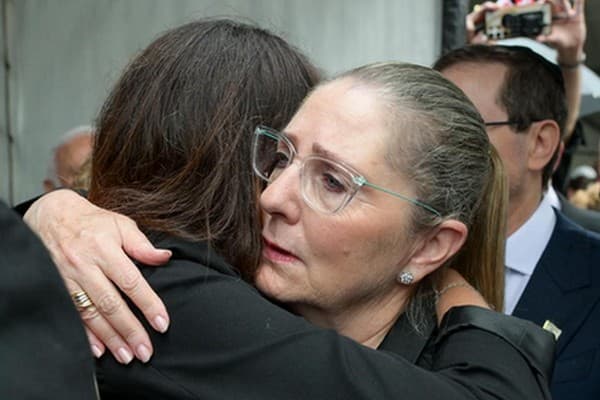
Michal Herzog comforts a Bondi Beach family member (Israeli Government Media)

Published: 12 February 2026

Last updated: 13 February 2026

Michal Herzog is no stranger to noisy demonstrations. Disagreement is ingrained in the Israeli national character. She also knew beforehand that when her husband, Israeli President Isaac Herzog, agreed to fly here to offer comfort and solidarity to Australia’s Jewish community, that the communal welcome would be accompanied by a very different reception on the streets.

But before she responds to the ugly confrontations in Sydney on Monday night, Herzog wants to focus on the reason for their visit, she tells The Jewish Independent in a sit-down interview the day after the protests.

“We're here to show the Jewish community of Australia that you're not alone. I know it has been a shock. Today we met the families, we met survivors, we met first responders. We hear that the Jewish community is not going to be the same, and Australia is not going to be the same. So, it was important to come here in person and show, with our actions, that the community is not alone.”

Herzog is still affected by her own experiences during the previous 24 hours, having laid a wreath at Bondi Beach and visited Moriah College before attending a rousing Jewish community event at the International Convention Centre.
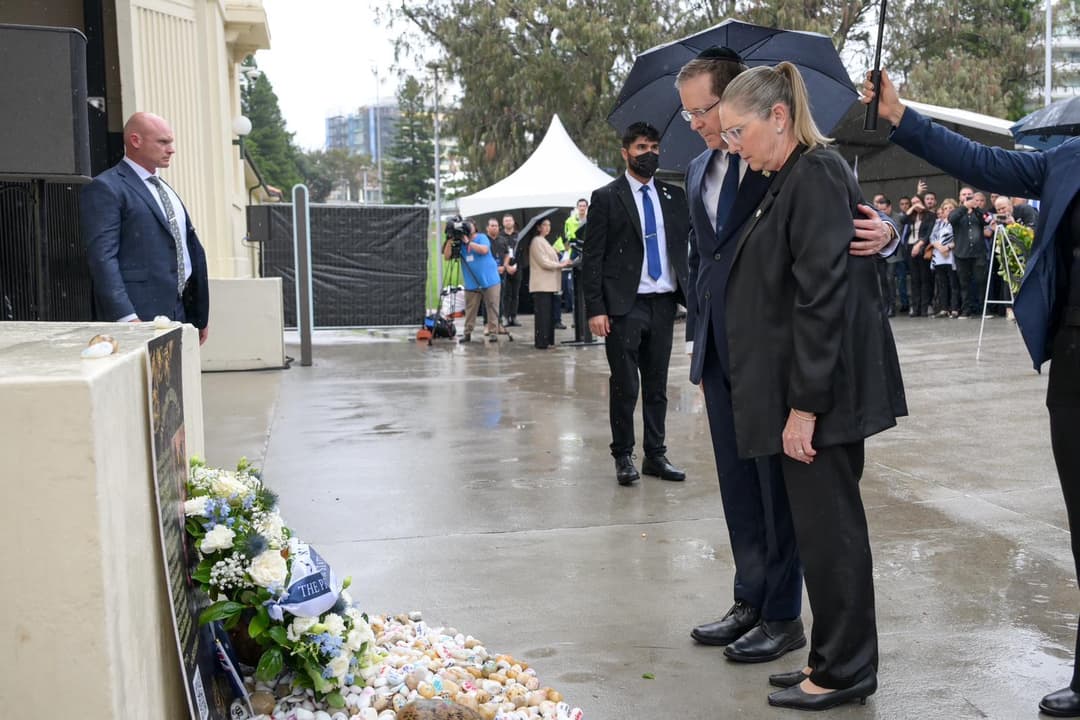
President Isaac Herzog and Michal Herzog lay a wreath at Bondi in memory of massacre victims(Israeli Government Media)

“The event we attended on Monday night was amazing. It was a strong show of solidarity, of compassion, of humanity. And it was very moving. It was one of those evenings you walk out with a ‘wow effect’.”
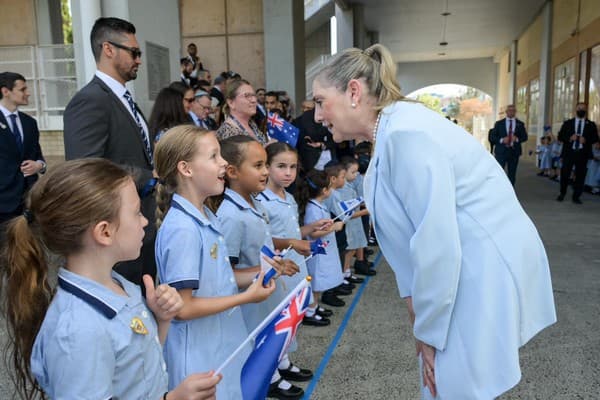
Herzog noted that the circumstances are a far cry from her first visit to Australia in 1986, when she came along with her husband’s parents after her father-in-law Chaim Herzog, Israel’s sixth president, was invited for a state visit. “It was a very different atmosphere. Definitely not as much security as now.”

It was, indeed, hard to avoid the security around the city in preparation for the demonstrations. What did Herzog think about the protests and violence that engulfed the streets just a few blocks away from the Convention Centre?

“People have every right to express their vision and their thoughts and shout out if they feel like it,” she replies, “but you have to check the facts. I think that mostly the protests come from ignorance, people demonstrating about things that they have not really checked the facts about beforehand.

What really alarmed me about the use of sexual violence by Hamas was the turning away from Israeli women by women's groups.

“In many ways, it's not only a show of hatred. It's also a show of not understanding. I wish people would learn more before they set down to the streets and scream ‘From the river to the sea’ or ‘genocidal president’ without checking the facts.

“It's a very vociferous group, but from what we have seen and the people we’ve met, I don't think it shows the real consensus in this country.”

The sheer intensity of the protests did not come as a shock. “Israel is a free, liberal and open society,” she says. “We have at least a million demonstrators out in the streets every week - against the government, for the government, against the judicial reform, for judicial reform (The Herzogs have been personally targeted on this subject). Sometimes it gets ugly. But most of the time, people say whatever they want to say, and they observe the law and continue on.

Hatred can spill into violence

But anger can fester into hatred and then over into violence, she adds. “I think most Australians now understand that the hatred can lead to really awful events like Bondi Beach.”

The religious massacre that left 15 people dead that day belatedly pushed the Albanese government to call a Royal Commission into antisemitism and social cohesion, an overdue acknowledgement of the accumulation of physical attacks, intimidation and hostility towards the Jewish community since October 7, 2023.

People have every right to express their vision and shout out if they feel like it. But you have to check the facts.

For Michal Herzog, who has spoken publicly about global antisemitism (including at the World Economic Forum in Davos), the hostility has been “lurking underneath the surface for a long time. The old form of antisemitism has always been there but in recent years, there has been a build-up and a mixture of anti-Zionism and anti-Israel sentiment mixed in with antisemitism. People do not differentiate between them. October 7 made it erupt.”

As for what is driving this eruption, she cannot pinpoint it to one source. “The far left and far right have moved into what we call ‘the horseshoe effect’” - where they are driven by different prejudices and motivations but end up focussing on a common scapegoat.

The right education

Like many others, she believes that education holds the key to combatting the ignorance that drives antisemitism, in particular by getting young people to physically meet others. “The world is now full of fake news, much of it driven by social media, and that is difficult for all of us, especially young people who live through their screens.

“I'm a great believer in bringing people together - having young Israelis and young Jewish members of communities around the world meet their counterparts (from other backgrounds). If you know someone who's not what you thought s/he was, I think that would be the greatest tool,” she explains - meeting one person is a powerful weapon in destigmatising an entire population or ethnic/religious group.

Michal Herzog talks to students at Moriah College (Israel Government Media)

There has been division in Australia about what to include in antisemitism education programs, a challenge currently being addressed by the federal government’s antisemitism taskforce headed by David Gonski. The ASECA report by Jillian Segal stressed the centrality of the Holocaust. Her report did not mention education about the history of the Middle East.

But Australian historian Suzanne Rutland says antisemitism education needs to address the settler-colonial narrative that Zionism is a political movement not a nationalist one. “Israel-Palestine is a conflict between two nationalisms,” says Rutland. “It has nothing to do with settler colonialism. More than half of Israel's population comes from Middle East. Antisemitism education should include teaching about Zionism, but not just modern Zionism, says Rutland.

Herzog comes down on Rutland’s side. She agrees strongly that the Middle East needs to be part of the education mix. “It shouldn’t be either or.”

Within this context, she says it is important to acknowledge Palestinian suffering but adds a caveat: “We're not blind. We see the suffering of the people in Gaza. But most of the suffering comes from Hamas itself, which abuses its own people.”

Sexual violence as a weapon of war

On the subject of denial, Michal Herzog has spoken out prominently about the use of sexual violence as a weapon of war, and the deafening silence from women’s organisations and other NGOs as reports of the barbaric behaviour by Hamas started to filter through in the aftermath of October 7.

“Sexual violence had not really been part of conflict in our region. Maybe sporadically in very individual cases. But it was not an issue. October 7 was an extreme example: a systematic and premeditated use of sexual violence as a weapon of war. It took us a while to understand what really happened.

“It took me a few days, only after I heard and met women. By the way, it was not only women. Sexual violence was used against male hostages as well. But I speak on behalf of women, women who don't have a voice anymore, because most of the victims were murdered that day, so they can't come forward.

“What really alarmed me, and was no less hurtful than the use of violence, was the turning away from Israeli women. When (the Nigerian terror group) Boko Haram kidnapped those schoolgirls in 2014, a lot of important people and celebrities all over immediately put up signs: ’Bring the girls home’. There was no doubt in their mind that sexual violence was used.”

Herzog has been a member of the Dinah project, an initiative formed following October 7 to pursue justice for survivors of sexual violence. The project, which has been led by Professor Ruth Halperin-Kaddari, a legal expert at Bar-Ilan University, who co-authored its report.

“Kaddari told me in tears that her colleagues from CEDAW (the Convention for the Elimination of Discrimination Against Women), a UN body she was a part of for 12 years, just turned away and did not reach out, not even to comfort or to ask or find out what happened.”

Herzog says that silence was almost as hurtful as the violence itself. “We said from the very beginning that this is a universal issue. We're speaking out on behalf of Israeli women because we experienced it now, but not only Israeli women. We're speaking out on behalf of all women. Period.

“Experts say that from one conflict to the other, there's an escalation in the use of sexual violence as a tool of war. “We’ve seen what happened to Druze women in Syria, the sexual violence there was awful. People don't talk about it. They don't report what's happening to young women in Tehran, and what happened to Kurdish women.”

Antisemitism in the women's movement

The sexual violence was terrible but the silence from women’s groups was even more painful. How does Herzog explain it? “I refrained for almost two and a half years from using the word antisemitism concerning this - but I'm not sure I can refrain anymore. I don't have an answer.

“I didn't really want to say this was antisemitism. But I think that this is an example of the mixture between anti-Israel and antisemitic views. In between, you have the victims, whose rights and experience were denied by ideology.

She says that since the Dinah project released its report late last year (aided by the work of Pramila Patten, the UN Special Representative on Sexual Violence in Conflict), there has been a belated acknowledgement by those women’s groups. In December the UN decided to blacklist Hamas for using sexual violence.

“The [Dinah] report is finally making it official. Other groups now cannot deny the evidence and the seriousness with which we investigated what happened.”

The mood in Israel

The Dinah report, important that it is, has stayed in the shadow of the return of the last of the hostages, including those tragically for burial. While the rest of the world waits for tangible signs of progress from the new authority to rebuild Gaza, Herzog says the ceasefire and return of hostages has had a major impact in Israel itself.

“The fact that all hostages came back is almost miraculous, and it has made people much more optimistic. Everything is so volatile, it could erupt again at any minute. But I think there's real hope now that we have seen the Board of Peace that was established by President Trump. I think it brings people hope.

“The changes in the Middle East region have also been a source of hope. We see so many countries now working with Israel, which we wouldn't dream of before the Abraham Accords.

“And so I think people have hope. Our national anthem is Hatikvah, which means ‘the hope’. We are a hopeful people; resilient and hopeful.”

You might also like
  • One year after the ceasefire, Gaza remains in ruins with no solution in sight
    Shahar Burla
  • Three years after Oct 7: an anniversary of reckoning
    The Jewish Independent
  • Sydney Uni commissions independent review after ‘Globalise the Intifada’ campaign
    Deborah Stone
logomark.67a07ee3
We believe in the free flow of information

Republish our articles for free, online or in print, by using our Creative Commons licence

You might also like

    Zoe Better pillars of light crop
    FeatureAustralia

    NDIS changes threaten disabled participation in community life

    Jarod Rhine-Davis
    Joni Fleischer
    Generation ChangeInterviewAustralia

    Joni Fleischer: Connecting charities with tech talent

    Gideon Cohen
    tame kostakidis west
    AnalysisAustralia

    How not to apologise

    Zac Klugman

About the author

Michael Visontay

Michael Visontay

Michael Visontay is Commissioning Editor of TJI and was Editor-in-Chief from 2017-22. Michael is a former Assistant Editor of The Sydney Morning Herald and columnist with The Australian Jewish News. He has written six books, including Who Gave You Permission? with Manny Waks, and Welcome to Wanderland: Western Sydney Wanderers and the Pride of the West. His most recent book is Noble Fragments: the Maverick who broke up the world's greatest book (Scribe, 2024).

More from the author

ReflectionWorld

My memory of Gloria Steinem

NewsAustralia

No action to stop Hezbollah ally beaming antisemitic and anti-Israel content into Australia

NewsAustralia

Beinart takes a wrecking ball to Israel

AnalysisAustralia

Prime minister’s absence exposes weakness in Royal Commission hearings