Aa
  • Read, Watch, Listen
  • TJI Series
  • Community Action
  • Events
  • Zedi
Follow us and continue the conversation
  • LinkedIn
  • Instagram
  • FaceBook
  • X
  • YouTube
Test yourself with the TJI Quiz!

Adjust size of text

Aa

Follow us and continue the conversation

  • LinkedIn
  • Instagram
  • FaceBook
  • X
  • YouTube

Your saved articles

You haven't saved any articles

What are you looking for?

Original reporting, insightful analysis and diverse views, delivered straight to your inbox

  • LinkedIn
  • Instagram
  • FaceBook
  • X
  • YouTube
Your support fuels our mission to inform, entertain and inspire.

The Jewish Independent is bound by the Standards of Practice of the Australian Press Council. If you believe the Standards may have been breached, you may approach The Jewish Independent or make a complaint to the Australian Press Council in writing at www.presscouncil.org.au. The Council may also be contacted on 1800 025 712.

  • Our Story
  • Contact us
  • Our Team
  • Support us
  • Guidelines
  • Pitch your idea
  • Republishing us
  • Community Action
  • Our Awards
  • LinkedIn
  • Instagram
  • FaceBook
  • X
  • YouTube
Aboriginal FlagTorres Strait Islanders Flag

The Jewish Independent acknowledges Aboriginal and Torres Strait Islander peoples as the Traditional Owners and Custodians of Country throughout Australia. We pay our respects to Elders past and present, and strive to honour their rich history of storytelling in our work and mission.

© The Jewish Independent 2026All Rights Reserved
Website design and development by Your Creative, MelbourneTerms & ConditionsPrivacy Policy
HomeRead, Watch, Listen
Feature

Israel shares an uncomfortable geopolitical stage with Russia

Sharon Offenberger
Print this

Published: 25 February 2022

Last updated: 4 March 2024

SHARON OFFENBERGER: Messy Mediterranean gas field deals and tacit co-operation in Syria have made Israel reluctant to be openly critical of Putin

WHO HAS THE energy for geo-politics? Israel does.

There has been a strong media focus on Israel’s role in evacuating Jews from an increasingly likely war in Ukraine. In the meantime, only a few handfuls of Ukrainian Jews have chosen to “escape” to Israel.

Although officials have cautiously backed Ukraine, and its biggest ally - the United States – Israel nonetheless is walking a fine line. Its friendship with President Putin is, among other things, crucial to its ability to hit Hezbollah targets in Syria. IDF “operations” in Syria, rarely publicly admitted, are only possible with Russia’s permission, which has a military base and political capital with Israel's enemies there. 

The showdown between Russia and the West over Ukraine is full of diplomatic complications which, like most geo-political crises, feeds speculation and rumour mills. Is it NATO, Russian disinformation or China pulling the strings? At one point Israel reportedly offered to mediate between the sides, a skill one can only imagine it learned from years of sitting through “marathon talks” and “shuttle diplomacy”.

But as Israel punches above its weight, or at least land size, on the world stage, it  is enmeshed  in what is now referred to as “energy diplomacy”.

Currently around 40% of European Union’s natural gas supply comes from Russia via the Nord Stream pipeline that runs under the Baltic Sea to Germany. Europe has seen record high gas prices over its winter and an increasing interest in purchasing liquified natural gas (LNG) from the United States. But no, this conflict is not about gas exports. Or is it?

For years, European countries and the EU have been seeking greater energy security, which not only means more renewables, but also, less dependence on Russia. The EU has had sanctions against Russia in place since 2014 in response to its destabilisation of Ukraine and annexation of Crimea and Sevastopol.

At the same time, Germany continued to build an additional bigger gas pipeline from Russia, Nord Stream 2, thus voluntarily remaining somewhat at Putin’s whim due to  this fundamental national need. While European countries are reassuring their citizens that they have sufficient energy stocks to get through this winter, the very question of whether Russia might cut supply to Europe in retaliation for sanctions does not make for warm, cosy sleeps.

With Russia’s aggression earlier this week, and before Putin could threaten to turn the lights off, Germany stepped in with its own sanctions, halting the Nord Stream 2 pipeline certification. Because suddenly it can, apparently, do without Russian gas.

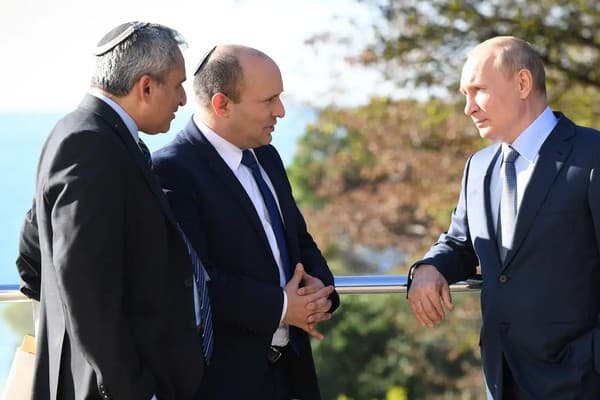
Vladimir Putin with Naftali Bennett in Sochi, Russia, in October 2021 (Kobi Gideon/GPO)

Enter Israel.

For the past few years Europe had also looked to Israel as a potential energy supplier, with its offshore gas fields Tamar, Tanin, Leviathan and Karish. Estimates were that Israel could contribute around 10% of Europe’s natural gas supplies. No substitute for Russia, but a useful supplementary source.

The EastMed gas pipeline project, signed in July 2020, brought Israel together with its neighbours Cyprus and Greece (joined also later by Italy as its major consumer) to develop a 2000 km, six billion Euro pipeline from Israel to Europe, a project that had been endorsed by the US.

This Eastern Mediterranean alliance created a turnaround in Israel’s previous antagonistic  relations with Greece. Friendship with Greece inherently requires enmity with Turkey, which was no biggie for Israel, already at odds with President Erdogan, who is known for fiery criticism of Israel as well as allowing Hamas operations from his territory. 

But just weeks ago, the US withdrew its backing for the East Med pipeline project, saying it doesn’t meet its  climate priorities. While the project was considered commercially unviable from the outset, driven more by geo-political ambition than economic returns, it was nonetheless a surprise for Israel to see it evaporate, like gas. Analysts said the US abandoned the project also to calm tensions with Russia and Turkey.

Since the US announcement, Turkey has kindly stepped in and offered to cooperate with Israel on a new pipeline that would more conveniently run via Turkey rather than Greece. Also considered a commercially unviable project, it reflects a rapprochement developing between Israel and Turkey that will see President Herzog visit Ankara next month.

This is all without mentioning that Israel’s biggest gas customers are Egypt and Jordan, with some of that gas supply reaching further north to Syria and Lebanon. Confused yet?

Israel may find itself under increasing pressure to be more critical of Russia than it would like to be.

Israel also sits with the  Palestinian Authority  in the East Med Gas Forum – a working group created to improve energy cooperation in the region, from which Turkey is excluded. Meanwhile, the UAE’s Mubadala Investments recently purchased a 22% stake in Tamar’s offshore field.

Israel is still revelling in its title of “regional energy powerhouse” even if that is a little overstated.

Have its  gas exports really been a winning card?  Not if you ask Israelis. The licenses provided to the gas giants were given hastily in less than transparent circumstances. It took more than five years for electricity prices to go down, and many believe the State should be earning more from its natural resources.

A gas processing platform for the Leviathan field was constructed only 10km into the beautiful Mediterranean Sea, making it both an eyesore and environmental risk for large stretches of the highly populated central Israeli coastline.

Whilst Israel will not have the answer to the Ukraine crisis or Europe’s energy security, it is no longer just launching daring missions to rescue Jews around the world but an actor on a complicated geo-political stage. While Israel tends to see its diplomatic relations through a prism of "with us or against us", it may find itself with the shoe on the other foot, under increasing pressure to be more critical of Russia than it would like to be.

Photo: Rigs in the Leviathan gas prospect off the coast of Israel (Albatross Aerial Photography)

You might also like
  • Peacebuilding through the eyes of a sceptic
    Ron Finkel
  • The Altalena should be a warning, not a political weapon
    Shahar Burla
  • Turkey emerges as military threat to Israel
    Dror Doron
logomark.67a07ee3
We believe in the free flow of information

Republish our articles for free, online or in print, by using our Creative Commons licence

You might also like

    Jewish-diversity copy
    Feature

    The three questions that will define the Jewish future

    Shahar Burla 1
    Funeral for top military commander of Hamas’ armed wing in Gaza
    Israel Hamas WarAnalysisIsrael

    Gaza ceasefire falters as Israel and Hamas prepare for next war

    Shahar Burla 1
    Copy of Politica Podcast Social Tiles (600 x 400 px)
    Israel Iran WarPodcastIsrael

    Politica – Israeli Politics Explained

    The Jewish Independent 1

About the author

Sharon Offenberger

Sharon Offenberger

Sharon Offenberger was raised in Melbourne and made aliyah in 2004. She spent over 15 years in various roles for the European Union, including managing the peacebuilding program, communications officer and spokesperson. She moved with her family in 2020 to Bellingen, NSW where she works as a writer and communications consultant.

More from the author

FeatureArts & Culture

Why we had to make Pita with Vegemite

Israel

The Contenders: a visual guide to Israel’s political blocs

OpinionIsrael

The film tells a hellish story but Tantura was my heaven

OpinionAustralia

Holocaust remembrance is different in regional Australia