Aa
  • Read, Watch, Listen
  • TJI Series
  • Community Action
  • Events
  • Zedi
Follow us and continue the conversation
  • LinkedIn
  • Instagram
  • FaceBook
  • X
  • YouTube
Test yourself with the TJI Quiz!

Adjust size of text

Aa

Follow us and continue the conversation

  • LinkedIn
  • Instagram
  • FaceBook
  • X
  • YouTube

Your saved articles

You haven't saved any articles

What are you looking for?

Original reporting, insightful analysis and diverse views, delivered straight to your inbox

  • LinkedIn
  • Instagram
  • FaceBook
  • X
  • YouTube
Your support fuels our mission to inform, entertain and inspire.

The Jewish Independent is bound by the Standards of Practice of the Australian Press Council. If you believe the Standards may have been breached, you may approach The Jewish Independent or make a complaint to the Australian Press Council in writing at www.presscouncil.org.au. The Council may also be contacted on 1800 025 712.

  • Our Story
  • Contact us
  • Our Team
  • Support us
  • Guidelines
  • Pitch your idea
  • Republishing us
  • Community Action
  • Our Awards
  • LinkedIn
  • Instagram
  • FaceBook
  • X
  • YouTube
Aboriginal FlagTorres Strait Islanders Flag

The Jewish Independent acknowledges Aboriginal and Torres Strait Islander peoples as the Traditional Owners and Custodians of Country throughout Australia. We pay our respects to Elders past and present, and strive to honour their rich history of storytelling in our work and mission.

© The Jewish Independent 2026All Rights Reserved
Website design and development by Your Creative, MelbourneTerms & ConditionsPrivacy Policy
HomeRead, Watch, Listen
Feature

Israeli-US farmer who masterminds international rescue missions

Nomi Kaltmann
Print this

Published: 7 January 2022

Last updated: 4 March 2024

NOMI KALTMANN meets Moti Kahana, whose extraordinary success in organising the rescue of people trapped in dangerous Middle-Eastern countries has made him a figure of legend

WHEN MOTI KAHANA describes himself as a “humble American-Israeli farmer living a quiet life in New Jersey”, you can almost believe him.

As he speaks to me on the phone while walking his dog Lafayette in Randolph, New Jersey, at times interrupting our conversation to yell at his dog not to chase the chickens, his claim is almost plausible.

However, the multitude of stories written about extraordinary rescues he has coordinated over the years - from dangerous countries such as Syria, Iraq, Yemen and Afghanistan - Kahana’s description of himself seems unlikely.

“Up until a few years ago, I was involved in business my whole life and I had nothing to do with politics,” he says. “I am an Israeli, I used to vote Likud and I grew up in a poor neighborhood in Jerusalem, where everyone was a fan of Beitar Yerushalayim [an Israeli football team].”

Kahana, now 53, served in the Israeli air force, before moving to the United States around 30 years ago. Like so many Israelis before him, he arrived armed with spades of Israeli chutzpah and a desire to create an American dream. Kahana says he originally went for a 10-day visit but liked it so much he decided to stay.

“I am an out of the box kind of a guy, and on a personal level, I always need a challenge or problem to work on,” he says.

In America Kahana founded the rent2buy car rental company, which became extremely successful.

“When I started my business, I thought about how I could be better than other existing car rental companies…I created systems that recycled the gasoline, I created a novel idea of having video camera inspection systems, and I started to rent cars to people under 21 years of age to create new business opportunities.”
His innovative approach paid off and the global car rental giant Hertz took note of his successful company and acquired it for an undisclosed sum.

I empathised a lot with the people of all nationalities in the Middle East who were getting shot, and I decided to get involved and see what I could do to help.

Despite fulfilling the American dream of becoming a self-made millionaire, Kahana found that he was bored. “I always need challenges and problems in order solve them to keep myself entertained,” he explains.

Shortly after the sale of his company, Kahana visited Israel around the beginning of the Arab Spring.

“When the Arab Spring began in 2011, I had money, nothing to do, and I had recently visited Yad Vashem. I empathised a lot with the people [of all nationalities] in the Middle East who were getting shot, and I decided to get involved and see what I could do to help,” he says.

“Around the time I visited Israel, the Libyan civil war against Gaddafi had begun. I knew people from business who connected me with Chuck Perry [the US senator from Texas].”

Perry was trying to get SIM cards and satellite phones to Libyan citizens in Libya who wanted to upload videos to the internet showing Gaddafi shooting and killing his own people.

“Chuck Perry contacted me via mutual business associates and asked me to source satellite phones with internet access for Libyans. Perry connected me to a Palestinian guy working in Libya called Mouaz, who grew up in Damascus,” says Kahana.

Together, Mouaz and Kahana were successful in delivering SIM cards and satellite phones to the Libyans.

“Right after Libya, in March 2011, the Syrian revolution started and Mouaz became involved in Syria because he had family living there,” Kahana continues. Having formed a strong bond with Mouaz through their successful mission in Libya, Kahana became involved in Syria.

“After the chemical attack [on his own people by Syrian dictator Bashar Al Assad], I decided that that this was the time to get more involved in the humanitarian diplomacy side,” Kahana says.

At first, he was involved in smuggling passports in and out of Syria for dissidents, later moving on to missions that helped extract people from Syria and the occasional mission to bring people into Syria.

Originally, Kahana’s rescue missions were humanitarian in nature and all the people he rescued were not Jewish. But in 2014, as his reputation grew, expat Syrian Jewish leaders living in New Jersey, where there is a large community, began contacting him concerned about the welfare of the small number of Syrian Jews that remained in the country.

A rabbi in New Jersey asked me to bring a Syrian man with cancer to Istanbul. I said, I am not the Jewish Agency, I can’t do it! But he was very persistent.

“I got a call from a rabbi in New Jersey saying that there was a Jewish Syrian man who had cancer. The rabbi asked me to help bring him to Istanbul.”

Kahana obliged and took a critical role in rescuing the man and his family. “I had already been active in Syria for a few years, but after this rescue, another rabbi who had heard of my work in Syria called me to his office and said he needed help rescuing 47 Jews from Yemen.”

“I said to the rabbi, I am not the Jewish Agency, I can’t do it! But he was very persistent.”

Kahana agreed to help and after months of complicated planning, logistics and paperwork, he successfully orchestrated a rescue mission helping these 47 Jews leave Yemen.

As his reputation and success in extracting people from inaccessible countries began to spread further, he was not overly surprised when the family of American-Israeli journalist Stephen Sotloff contacted him to ask for help. Sotloff had been captured in Syria in 2013 and was being held by ISIS, who were keen to negotiate his release for a hefty sum.

While American government policy does not allow for direct negotiations with terrorist groups nor the payment of ransoms, Sotloff was a dual Israeli-American citizen. Kahana waited to see if he could get tacit approval from the Israeli government to begin negotiations for Sotloff’s release.

“ISIS did not know that in addition to being American, Stephen was also Jewish and an Israeli citizen. After the Israeli government allowed me to proceed with organising Stephen’s release, I negotiated a $US5 million payment to release Stephen, along with his fellow hostages [British] James Foley and [American] Kayla Mueller.”

But sadly, the rescue mission and ransom payment did not take place.

“After the $5 million ransom was negotiated, it took three days to organise the funds to transfer to the people who were holding Stephen and the others. During this time, the city of Mosul in Iraq fell to ISIS. Once ISIS had taken over [the oil-rich] Mosul, they had billions of dollars in the banks, so they decided that they no longer needed the ransom payment,” he says.

In Kahana’s mind, there is no doubt why this ransom was rebuffed. “I consider the case of Stephen Sotloff one of my biggest failures,” he says.

 “Once Mosul fell, ISIS needed media attention more than a $5million ransom. They already had enough money from Mosul, so they decided to chop off Stephen’s head.”

Sotloff and James Foley were publicly beheaded by ISIS in 2014. Mueller was killed in an airstrike.

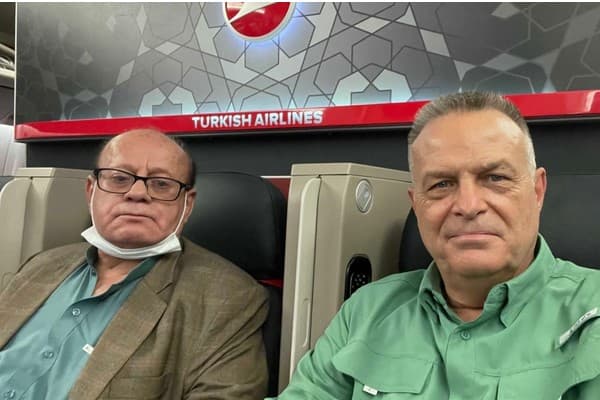
When the Taliban took control of Afghanistan in August 2021, Kahana was the obvious choice to try to help rescue the last Jew remaining in the country, Zevulun Simantov.

Kahana says that rescue, though ultimately successful, “[It] was very difficult. While the actual mission was very short, convincing Zevulun to leave Afghanistan took many sleepless days and nights on my end.”

Simantov (left) on his flight to safety

According to Kahana, extracting someone is usually the least complicated part of the rescue.

“Most complications are the people you rescue, not the enemy,” he says.

“The people you rescue, they don’t have papers, or they often have complicated family situations. The most difficult thing is actually the talking you do with them prior to the mission, where you are required to behave like a psychiatrist 90% of the day, where you have to listen and reassure them.”

Extracting someone is usually the least complicated part of the rescue. Most complications are the people you rescue, not the enemy.

After Simantov refused Kahana’s first rescue mission, there was an opportunity to use the people  he had already organised to be redeployed to rescue other Afghanis who were desperately seeking to leave the country.

“Because of the mission to rescue Zevulun Simantov, I have been able to save thousands of people from Afghanistan,” says Kahana. “To this day, practically every day of the week my company [GDC Security] continues to rescue people from Afghanistan.”

When asked about his next mission, Kahana laughed down the phone. “I am no Elon Musk, but maybe getting to Mars will be harder! If you set your mind to it, you can get anywhere. I believe anything can be done.”

Photo: Moti Kahana (Eliot La Mer)

You might also like
  • Western ‘Palestinianism’ colonises everything – and hurts Palestinians
    Andres Spokoiny
  • Israel is cementing its control over the West Bank and East Jerusalem while the world is distracted
    Martin Kear
  • Abuse by IDF soldiers humiliates Muslim Palestinians
    Ben Lynfield
logomark.67a07ee3
We believe in the free flow of information

Republish our articles for free, online or in print, by using our Creative Commons licence

You might also like

    Copy of Politica Podcast Social Tiles (600 x 400 px)
    Israel Iran WarPodcastIsrael

    Politica – Israeli Politics Explained

    The Jewish Independent 1

    Alerts over antisemitic threats and attacks in Europe and US

    TJI Wrap
    Israel Hamas War

    IDF: Hamas will steal fuel for tunnel ventilation systems and rockets

    TJI Wrap

About the author

Nomi Kaltmann

Nomi Kaltmann

Nomi Kaltmann is an Australian lawyer and journalist. Her writing has appeared in major Australian and international publications including Crikey, Griffith Review, Mamamia, Tablet Magazine, The Australian Financial Review, The Daily Beast, The Forward, The Guardian, The Jewish Telegraphic Agency and The Spectator. She regularly appears on radio and podcasts to discuss Australia’s Jewish community, including NPR (USA), CBC (Canada), LBC (London), Call Me Back, Unholy: Two Jews on the News, SBS and The Times of Israel. An influential Orthodox feminist leader and founding president of the Jewish Orthodox Feminist Alliance (JOFA Australia), she is a sought-after speaker on religion, interfaith and contemporary Jewish life.

More from the author

OpinionAustralia

Cancellation backfires but we are at it again

OpinionWorld

From NY to Melbourne, local politicians are whipping up hate 

ReflectionAustralia

I have lost faith in our multicultural institutions 

InterviewIsrael

Dreams, nightmares and realities from a bereaved mother