Aa
  • Read, Watch, Listen
  • TJI Series
  • Community Action
  • Events
  • Zedi
Follow us and continue the conversation
  • LinkedIn
  • Instagram
  • FaceBook
  • X
  • YouTube
Test yourself with the TJI Quiz!

Adjust size of text

Aa

Follow us and continue the conversation

  • LinkedIn
  • Instagram
  • FaceBook
  • X
  • YouTube

Your saved articles

You haven't saved any articles

What are you looking for?

Original reporting, insightful analysis and diverse views, delivered straight to your inbox

  • LinkedIn
  • Instagram
  • FaceBook
  • X
  • YouTube
Your support fuels our mission to inform, entertain and inspire.

The Jewish Independent is bound by the Standards of Practice of the Australian Press Council. If you believe the Standards may have been breached, you may approach The Jewish Independent or make a complaint to the Australian Press Council in writing at www.presscouncil.org.au. The Council may also be contacted on 1800 025 712.

  • Our Story
  • Contact us
  • Our Team
  • Support us
  • Guidelines
  • Pitch your idea
  • Republishing us
  • Community Action
  • Our Awards
  • LinkedIn
  • Instagram
  • FaceBook
  • X
  • YouTube
Aboriginal FlagTorres Strait Islanders Flag

The Jewish Independent acknowledges Aboriginal and Torres Strait Islander peoples as the Traditional Owners and Custodians of Country throughout Australia. We pay our respects to Elders past and present, and strive to honour their rich history of storytelling in our work and mission.

© The Jewish Independent 2026All Rights Reserved
Website design and development by Your Creative, MelbourneTerms & ConditionsPrivacy Policy
HomeRead, Watch, ListenIsrael
InterviewIsrael

Dreams, nightmares and realities from a bereaved mother 

Rachel Goldberg-Polin became a symbol of resilience after her son Hersh was kidnapped and murdered by Hamas. Now she has written a memoir about the experience
Nomi Kaltmann
Print this
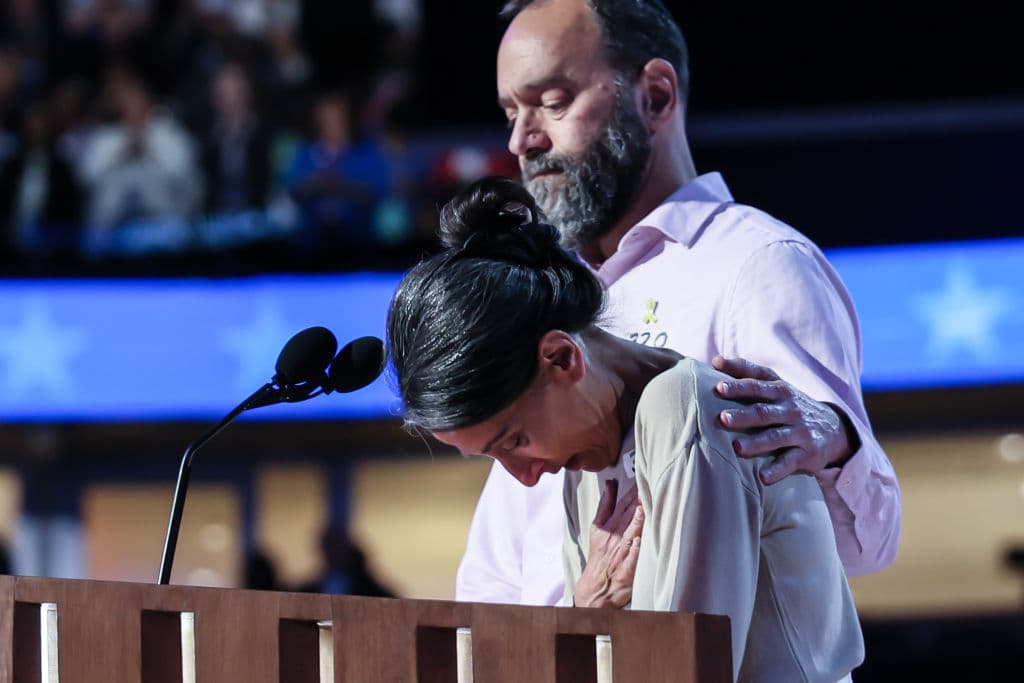
Jon Polin and Rachel Goldberg-Polin speaking in August 2024, soon after learning of the death of their son Hersh, who was killed as a Gaza hostage (Robert Gauthier/Los Angeles Times via Getty Images)

Jon Polin and Rachel Goldberg-Polin speaking in August 2024, soon after learning of the death of their son Hersh, who was killed as a Gaza hostage (Robert Gauthier/Los Angeles Times via Getty Images)

Published: 9 June 2026

Last updated: 9 June 2026

When We See You Again
by Rachel Goldberg-Polin

Rachel Goldberg-Polin admits that she is not usually interested in hearing others retell their dreams. She doubts most people remember them properly, and suspects details may get embellished in the retelling. Yet in her memoir When We See You Again she devotes an entire chapter to disturbing dreams she experienced before and after her son Hersh’s kidnapping and murder in Hamas captivity in Gaza.

Anticipating scepticism, she writes: “What I am relieved about is that with each of the following dreams I have the validation of having told someone upon awakening … so let’s make it clear for the record, I am not making these up.” 

One dream, in particular, feels impossible to shake. In late September 2023, Rachel dreamt she was standing in her kitchen when Hersh suddenly ran across the living room and out onto the porch. He grabbed the railing, propelled himself upwards, and tipped forward. She watched him fall headfirst over the edge.

“But even as I ran, I knew it was too late. He had run too fast and with too much energy. And I knew he was going to die before I could get to him.” The next morning, when she recounted the dream to Hersh, he replied, “Why didn’t you save me?” and Rachel answered, “I tried, but I couldn’t get to you in time.” 

It’s a haunting refrain in a raw and heartbreaking book written by Goldberg-Polin, about the agonising 328 days she spent trying to save her son from Hamas’s tunnels after he was kidnapped on October 7, 2023, from a roadside bomb shelter after attending the Nova desert rave party. His left forearm blown off, Hersh was kept starved, filthy and with five other hostages underground in a tunnel in Rafah for months, until he was executed by Hamas despite his mother’s agonised efforts to save him. He was returned for burial in Israel on day 330 of the war in Gaza. 
Goldberg-Polin, still in the thick of grief knows that her book is not an easy read and warns readers before immersing themselves in her world of agony. “What I realise now, since my heart is shattered into tiny pieces, is that it is easier to share than when it was one mighty solid and strong heart. So please take a shard. Be careful, they are sharp,” she writes.  

Goldberg-Polin’s eloquence and grace in the face of devastating circumstances is inspiring as much as it is devastating

In an interview with The Jewish Independent about the memoir, Goldberg-Polin reflected on the way grief has reverberated far beyond Israel’s borders, even in Australia. “The Aussie Jewish community is powerfully connected to Israel in ways that run deep,” she said. “The sharing, carrying, and holding of the grief is a transcendent bond. I don't think it matters that we are thousands of miles away from each other.” 

Goldberg-Polin’s eloquence and grace in the face of devastating circumstances is inspiring as much as it is devastating.  

She has tried to resist the increasingly toxic and polarised rhetoric surrounding Israel since October 7. “I refuse to debase, cheapen and degrade the holiness of the people who have been killed by falling into a trap of adversarial rhetoric,” she said. “The norm has become to scream; the method has become using hate, and the genre has become ugliness.” 

The physical toll on her body after fighting such a gargantuan battle remains with Goldberg-Polin. “Often I don’t recognise myself,” she writes, listing physical changes to her body from the fight to save Hersh. “Even my teeth have shifted. So now I have a slight speech impediment that I did not have before. My hair has gotten thin and streaked with grey. I’m shorter. For real – even the nurse said it is weird I’ve shrunken so much at this [relatively] young age. My handwriting is different. But no one really writes anymore, so it’s okay. I can no longer read signs from far away. Or my book close-up. After October 7, 2023, I never got my period again. My body died.” 

Her faith, too, has shifted shape in the aftermath of Hersh’s death. In her interview with The Jewish Independent, Goldberg-Polin described her spirituality as becoming “stronger and more physical” since October 7. “I am a believer. To me it is clear,” she said. “I live in the unknowing. I don't try to pretend otherwise or to make sense of it. But I attempt to describe it, so it doesn't choke me.” 

Her faith in humans has been severely dented, not only from contact with the brutality of the terrorists, but also from the “important men” who promised to help but did not. She believes she was frequently lied to as she campaigned for her son’s release. 

“I started to understand more about how the world works and who holds the strings to move the marionettes.” 

It’s impossible to read Goldberg-Polin’s book and not feel the longing for a child that was taken too soon from his mother. One of the most poignant parts of the book is when she imagines meeting Hersh again in the future.  

“Every night, I switch off the lights and I say, 'Another day closer until I see you again'. I believe that. No. I am surer than believing. I know it,” she writes.  

Goldberg-Polin is determined that Hersh be remembered not as a symbol, but as a real person. “Hersh was glorious in his normalness,” she told The Jewish Independent. “He was gentle and curious. He was easy.” She added that what stays with her most is his ability to listen deeply, “Especially to people with whom he disagreed. I wish I could be more like that. I'm trying. In his honour and memory ... I am trying.” 

When We See You Again is not an easy read, but it is beautiful. When you finish it, you will want to hug your loved ones a little tighter, knowing how fragile life can be.  

You might also like
  • Tame apologises – but with little grace
    Deborah Stone
  • Confronting Richard Flanagan and the myth of the Israel lobby
    Mary Garden
  • UK’s dramatic policy change on Israel-Palestine
    Colin Shindler
logomark.67a07ee3
We believe in the free flow of information

Republish our articles for free, online or in print, by using our Creative Commons licence

You might also like

    Netanyahu
    Israel Hamas WarFeatureIsrael

    New evidence Netanyahu was warned about October 7

    Shahar Burla 2
    haredi street guitar
    Photo EssayArts & Culture

    Jerusalemites through the lens

    Sharon Gabay
    Segalovitz Abbas
    Israel Votes 2026AnalysisIsrael

    Segalovitz decision to join Arab party is a paradigm change for Israel

    Eetta Prince-Gibson

About the author

Nomi Kaltmann

Nomi Kaltmann

Nomi Kaltmann is an Australian lawyer and journalist. Her writing has appeared in major Australian and international publications including Crikey, Griffith Review, Mamamia, Tablet Magazine, The Australian Financial Review, The Daily Beast, The Forward, The Guardian, The Jewish Telegraphic Agency and The Spectator. She regularly appears on radio and podcasts to discuss Australia’s Jewish community, including NPR (USA), CBC (Canada), LBC (London), Call Me Back, Unholy: Two Jews on the News, SBS and The Times of Israel. An influential Orthodox feminist leader and founding president of the Jewish Orthodox Feminist Alliance (JOFA Australia), she is a sought-after speaker on religion, interfaith and contemporary Jewish life.

More from the author

OpinionAustralia

Cancellation backfires but we are at it again

OpinionWorld

From NY to Melbourne, local politicians are whipping up hate 

ReflectionAustralia

I have lost faith in our multicultural institutions 

Comments

No comments on this article yet. Be the first to add your thoughts.