Aa
  • Read, Watch, Listen
  • TJI Series
  • Community Action
  • Events
  • Zedi
Follow us and continue the conversation
  • LinkedIn
  • Instagram
  • FaceBook
  • X
  • YouTube
Test yourself with the TJI Quiz!

Adjust size of text

Aa

Follow us and continue the conversation

  • LinkedIn
  • Instagram
  • FaceBook
  • X
  • YouTube

Your saved articles

You haven't saved any articles

What are you looking for?

Original reporting, insightful analysis and diverse views, delivered straight to your inbox

  • LinkedIn
  • Instagram
  • FaceBook
  • X
  • YouTube
Your support fuels our mission to inform, entertain and inspire.

The Jewish Independent is bound by the Standards of Practice of the Australian Press Council. If you believe the Standards may have been breached, you may approach The Jewish Independent or make a complaint to the Australian Press Council in writing at www.presscouncil.org.au. The Council may also be contacted on 1800 025 712.

  • Our Story
  • Contact us
  • Our Team
  • Support us
  • Guidelines
  • Pitch your idea
  • Republishing us
  • Community Action
  • Our Awards
  • LinkedIn
  • Instagram
  • FaceBook
  • X
  • YouTube
Aboriginal FlagTorres Strait Islanders Flag

The Jewish Independent acknowledges Aboriginal and Torres Strait Islander peoples as the Traditional Owners and Custodians of Country throughout Australia. We pay our respects to Elders past and present, and strive to honour their rich history of storytelling in our work and mission.

© The Jewish Independent 2026All Rights Reserved
Website design and development by Your Creative, MelbourneTerms & ConditionsPrivacy Policy
HomeRead, Watch, ListenIsrael
ReflectionIsrael

Neither Israel nor Hamas has broken me: A Gazan woman’s story 

Caught between Hamas oppression and Israeli attacks, what Abeer Abdullatif wants most is the right to earn a living.
Rami Aman
Print this
Abeer Gaza

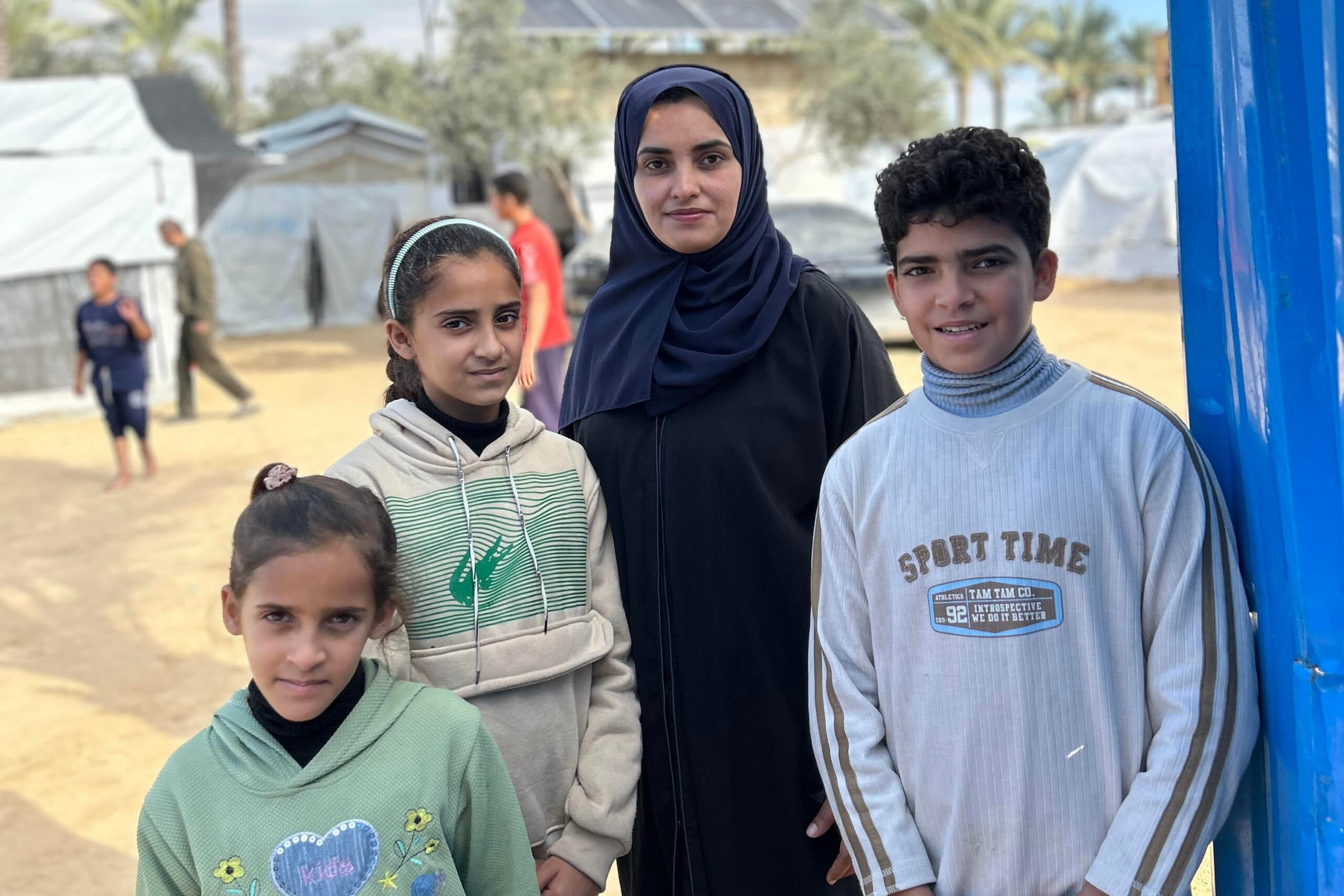
Abeer Abdullatif Abu Tair, with her three children (from left) Dana, Nabila and Majd

Published: 16 March 2026

Last updated: 16 March 2026

My name is Abeer Abdullatif Abu Tair. I am a Palestinian woman from Gaza, and a mother of three children: Majd, Nabila and Dana, my youngest. 

Before the devastating war on the Gaza Strip, I lived a normal life. I used to wake up early with energy, prepare breakfast, and get my children ready for school, then organize my house. I loved taking care of my flowers and making myself a cup of coffee before starting my day. I took care of my skin, wore cosmetics, and had a wardrobe of elegant clothes. 

I spent a lot of time checking job websites, hoping to find a job that used my degree in English language and teaching methods from Al-Aqsa University. Before each interview,  I prepared my documents and reviewed my CV, entering each one saying to myself, “Maybe this time”.  

Life under Hamas 

There was no explicit rejection, but over time, I began to understand why I never got these jobs. The problem was not my language, my degree, or my ability to work. The problem was that I did not belong to political party (Hamas), nor did I have connections or influence. 

My husband Ahmed worked at MAMID a French organization which supports people with disabilities, but the organisation was shut down when it resisted a Hamas takeover.  

In Gaza, anyone who refuses to obey Hamas is classified as an enemy, so Ahmed became a target. He was falsely accused of collaborating with Palestinian Authority in Ramallah.  

There was no trial, but he was detained and subjected to physical and psychological torture multiple times. He returned home exhausted, his body bearing marks of beatings, and his eyes filled with shock and fear. He did not like to talk about what happened, but his silence spoke volumes. 
Life under fire 

I was preparing breakfast for my children when the rocket fire started in October 2023. At first, we did not understand what was happening, but a sense of danger filled the place. We packed essential items and ran, looking for a place to hide. 

 I tried to reassure my children, repeating calmly “Hold on to me, everything will be okay.” But inside, I was choking with fear as well. 

We finally reached a school that had been turned into a temporary shelter for families. The place was crowded, the floors covered with dust, and the smells were strange, mixed with the simple food being provided, sweat, and fear. The children cried from fatigue, hunger, and fear, and the women tried to calm each other. I held Dana on my chest, held Majd and Nabila by the hand, and tried to smile at them, read them a story, or sing something to ease the terror surrounding us. 

On May 5, 2024 the Israeli army withdrew from the Abasan al-Kabira area, and we decided to return home. Many houses were destroyed, but our house was only partially damaged and we did what we could to repair it, though there were no materials.  

But then, on July 15, 2024, we were asleep in our beds when one of the young men in the neighborhood started shouting "Evacuation! Get out quickly! The army has entered with tanks because Abasan is a border area."  We left immediately, carrying our children and panting from fatigue. 

Eventually, we reached a school that had been turned into a shelter, but there was no space. We found a classroom and asked if we could pray there, before carrying on to find food and shelter, but a man shouted at us, “This classroom is ours. No one is allowed to enter. Go somewhere else.” 
 
That night remains deeply engraved in my memory—not only because of exhaustion and fear, but because of the realization that war does not only destroy homes; it also exhausts hearts. 

Caught between Israel and Hamas 

There were days when we could not find enough food for our children. The price of a kilogram of flour at that time reached $40. Sometimes there was nothing, due to the Israeli blockade. Sometimes it was there but unaffordable, due to the greed of some Hamas traders who increased pressure on Gaza citizens. 

 I felt powerless seeing my children sometimes go to sleep hungry. Those moments made me feel that Hamas and the occupation were two sides of the same coin, each pressing on the lives of Gazans. 
 
Ahmed was arrested twice during the war by Hamas, accused of collaborating with a group called Abu Al-Shabab. Nothing was proven, but they tortured him multiple times, which greatly affected his mental and physical health.  

Even amid all the chaos, bombing, and displacement, we were not safe from the cruelty of Hamas.  

Surviving and rebuilding  

The children were exhausted from the war but they began to share tasks among themselves. Majd would sometimes say: “The water truck has come! Hurry!” and other times: “I am tired, but I will go, Mom, to fetch water, and Nabila can go to the food distribution center to get some food to eat.” 

Despite fatigue, hunger, and fear, I made sure to show them hope: to hold onto life and remind them that, no matter how difficult the situation, we are together and will protect each other. Every movement, every smile, every calm word tried to alleviate the terror of the war from the children’s hearts. 

In every stage of displacement, I tried to provide assistance to others too. I volunteered to teach English to young children at temporary educational points, worked as a translator in some local institutions, and helped document women and children’s experiences of the war. 

I also volunteered in an organization supporting Palestinian women and children in Gaza, providing psychological support sessions for children through play, and assistingwomen in sessions to strengthen their resilience in facing the harsh conditions of war. 

I still stand, holding my children with one hand and my hope with the other. I am ready to continue working passionately and to use all my skills and abilities to serve my community and children and make a real difference in people’s lives around me. 

Now the war has ended I am looking for work again teaching English, translating, providing training for volunteers or aid workers, or supporting international organisations to facilitate access to support and humanitarian aid. 

I believe that continuous giving, no matter how difficult the circumstances, can make a difference. Every experience I gain today will enable me tomorrow to better serve my community, educate my children, and support those in need. 

My story is not an exception, but a reflection of the suffering of thousands of women in Gaza, forced to give without reward, and deprived of the simplest rights to decent work.  

But I believe that anyone who listens sincerely will have their conscience moved, and anyone who reads these words with their heart will realize that investing in women is not a favor but a human and ethical duty. 

I still stand, despite everything, holding my children with one hand and my hope with the other. We do not want the impossible; we only want a chance to live with dignity. That is the least we deserve. 

You might also like
  • ‘Israel is systemically eliminating Palestinian collective life’:  B’Tselem
    Deborah Stone
  • Tame apologises – but with little grace
    Deborah Stone
  • Confronting Richard Flanagan and the myth of the Israel lobby
    Mary Garden
logomark.67a07ee3
We believe in the free flow of information

Republish our articles for free, online or in print, by using our Creative Commons licence

You might also like

    haredi street guitar
    Photo EssayArts & Culture

    Jerusalemites through the lens

    Sharon Gabay
    Rozana Beit Oula
    PeacebuildingOpinionIsrael

    Peacebuilding through the eyes of a sceptic

    Ron Finkel
    Arab Israeli Palestinian election vote
    Israel Votes 2026FeatureIsrael

    Fear of Netanyahu victory may drive big surge in Palestinian voter turnout

    Ben Lynfield

About the author

Rami Aman

Rami Aman

Rami Aman is a Palestinian journalist and peace activist in the Gaza Strip. He is founder of the Gaza Youth Committee.

More from the author

OpinionIsrael

An open letter from the Gaza Youth Committee to Australia

ReflectionIsrael

Voice from Gaza: ‘Asking me if I condemn Hamas is an insult’

‘I no longer belong to ISIS, I want Hamas to… let me live a normal life’

Comments

No comments on this article yet. Be the first to add your thoughts.