Aa
  • Read, Watch, Listen
  • TJI Series
  • Community Action
  • Events
  • Zedi
Follow us and continue the conversation
  • LinkedIn
  • Instagram
  • FaceBook
  • X
  • YouTube
Test yourself with the TJI Quiz!

Adjust size of text

Aa

Follow us and continue the conversation

  • LinkedIn
  • Instagram
  • FaceBook
  • X
  • YouTube

Your saved articles

You haven't saved any articles

What are you looking for?

Original reporting, insightful analysis and diverse views, delivered straight to your inbox

  • LinkedIn
  • Instagram
  • FaceBook
  • X
  • YouTube
Your support fuels our mission to inform, entertain and inspire.

The Jewish Independent is bound by the Standards of Practice of the Australian Press Council. If you believe the Standards may have been breached, you may approach The Jewish Independent or make a complaint to the Australian Press Council in writing at www.presscouncil.org.au. The Council may also be contacted on 1800 025 712.

  • Our Story
  • Contact us
  • Our Team
  • Support us
  • Guidelines
  • Pitch your idea
  • Republishing us
  • Community Action
  • Our Awards
  • LinkedIn
  • Instagram
  • FaceBook
  • X
  • YouTube
Aboriginal FlagTorres Strait Islanders Flag

The Jewish Independent acknowledges Aboriginal and Torres Strait Islander peoples as the Traditional Owners and Custodians of Country throughout Australia. We pay our respects to Elders past and present, and strive to honour their rich history of storytelling in our work and mission.

© The Jewish Independent 2026All Rights Reserved
Website design and development by Your Creative, MelbourneTerms & ConditionsPrivacy Policy
HomeRead, Watch, ListenAustralia
Generation ChangeInterviewAustralia

Madeleine Buchner: a voice for young carers

Madeleine Buchner was only 16 when she used her own experience to found Little Dreamers. Less than 10 years later she has a team of more than 400 people working to support siblings of sick children.
Ruby Kraner-Tucci
Print this
Madeleine Buchner founded Little Dreamers, a non-profit supporting young carers

Madeleine Buchner founded Little Dreamers, a non-profit supporting young carers (Image: TJI).

Published: 20 March 2024

Last updated: 15 September 2025

Tell me about your journey to founding Little Dreamers.

I grew up as a young carer for both my brother and my mum.

My brother has a range of chronic health conditions and an acquired brain injury and was in and out of hospital since he was six months old. He is two and a half years younger than me, so I didn't really know any different when he started going into hospital.

My mum was diagnosed with breast cancer when I was 14. She's now in remission but has been left with a range of chronic health conditions that require ongoing care and support.

For most of my childhood, we were in and out of hospitals and doctors' offices, while providing additional medical and emotional support at home. I'm very lucky – I have the most incredible father. Dad and I shared a lot of the caring load, but my childhood was still very different to that of my friends. I often felt quite isolated and alone, and I had a lot of emotional and mental health challenges that I didn't know how to deal with.

When I was very young, my parents found an organisation that was like Big Brother Big Sister called CareNet, and it provided a mentoring program for siblings of sick kids. When I was nine years old, two of my friends and I started what we called the CareNet Kids Club. We wanted to raise money to help other kids who had a very sick sibling to receive support from CareNet – and it went from there.

After four years, we decided that we didn't want to just fund CareNet, but we wanted to fund other sibling support organisations. We ran a fundraiser for Very Special Kids to launch their siblings camp and for the Asylum Seeker Resource Centre to run a sibling support program.
When my mum got sick in 2007, we decided that we didn't want to raise money and hand it off to other organisations – we wanted to be able to create the change in the world that we still weren't seeing, which was an organisation specifically designed for kids providing unpaid care for a parent or a sibling. We launched Little Dreamers Australia in 2009.

Last year, we had 10,000 engagements with our programs, and I now have 58 staff and 350 active volunteers operating out of Victoria, New South Wales and Queensland.

"Young carers are such an overlooked group of young people, mainly because they are a hidden group of people."

Madeleine Buchner

Did you ever think Little Dreamers would have that reach?

Because I was 16 when we started Little Dreamers, I thought it would be a side project that I would do while I went off and had a proper adult career. I studied marketing and I always thought that I would have a job in a corporate marketing team or in an advertising agency and Little Dreamers would be the feel-good thing that I did for the universe on the side.

I'm so happy and proud that Little Dreamers is what I get to do all day every day. I'm blown away about how big it is, but at the same time, the need is so great. It’s a double-edged sword.

Tell me more about that need. How many young carers are there in Australia?

Little Dreamers works with kids aged four to 25, and the statistics say one in 10 kids grow up as a young carer – which is around two to three kids in every classroom.

The government statistics are interesting because they're captured from reports like the Census, which only asks kids over the age of 15, and also only asks if you've been a carer in the last two weeks. That doesn't capture people who have chronic illnesses or mental illnesses where over the last two weeks, you might not have had to provide care, and it also misses all those kids under the age of 15.

There are a few other reports in Australia, one of which asks parents to identify whether their kids are carers. What we find is that often parents won't acknowledge that their child has a caring role in their family, especially when they're a carer for a parent. In most cases, a child will be referred to us as a carer of a sibling and then during our intake process, we'll find out that they are also a carer for a parent who has a mental illness or drug or alcohol addiction, and that young carer is not documented anywhere. It's often because the parents have a fear of child protection, or there's a lot of stigma attached to it.

So, the actual number of young carers is very hard to define.

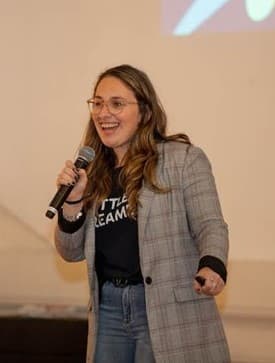
Madeleine Buchner in action (supplied)

Did you see yourself as a young carer for your brother and mum?

I didn't identify as a young carer growing up, even though I fit into the definition – it was just what I did around the house.

At Little Dreamers, we say that we support any young person between the ages of four and 25 who provides unpaid care in their households or have a parent or sibling who requires extra care. We do use the term ‘young carers’, but we have a lot of kids in our programs who probably wouldn't call themselves a young carer. They have the caring responsibilities, but they just don't identify with the terminology.

Taking out the bins, making your bed, helping with dinner – that is all stuff we consider a normal part of childhood. When you think about responsibilities for a young carer, it's things like supporting with medication, helping with injections, providing a level of emotional support and care that is above and beyond the age of the child. It’s also doing a lot more around the house, such as all of the cooking and all of the cleaning.

We have kids right across the spectrum – from those who are providing more care than what would be considered a full-time job alongside their schoolwork, to others who are providing more ad hoc care. It depends on the reason for providing care. If it's mental health, addiction, disability, chronic health, that impacts the amount and consistency of care.

"You can't put a young carer on a billboard and evoke the same amount of emotion as you could with other types of illnesses and disabilities."

Madeleine Buchner

You mentioned the stigma involved in being a young carer. Can you elaborate on this?

Stigma exists within different illnesses, disabilities, addiction, mental health, cancer, and so on. Young people may not necessarily want to tell their friends, because they think they will judge them or treat them differently.

We often see kids who want to go to school and not have to think about what's going on at home, and so they won't tell anyone, but their caring role might have an influence on their education or their attention or their ability to participate in after-school activities. Some young carers won’t have friends over to their house because they’re worried about what they might see and the impact this will have for them at school.

How active is the government in this space? Is the system as it stands now providing enough support for young carers?

It depends on the state. In Victoria, we have a Victorian Carer Strategy, which invests quite a lot of funding into carers and young carers in the state. We have a card that carers can access, which provides discounted public transport, movie tickets and things like that.

At the last election, a promise was the development of a National Carer Strategy, which we’re starting to see come through. We also have a piece of legislation called the Carers Recognition Act, but most people don't know it exists, which is part of the problem. We've just had a Parliamentary Inquiry into the recognition of unpaid carers. Little Dreamers was the only organisation to present from a young carer perspective at the inquiry.

I would say we are miles ahead of other countries around the world, but we're also miles behind some of the more progressive countries. There's a lot more we should be doing as a government and as a community.

That is a big feat for you to present at the Parliamentary Inquiry.

It was amazing. I worked on the submission, which was the very first Parliamentary Inquiry submission I have ever written, which was massive in itself – and that was accepted. We were invited to present at the public hearing, and I was able to bring two young carers with me and give them an opportunity to present and for the politicians to hear directly from them. Hudson was 13 and Jacqueline was 18, and they presented very different experiences. It was surreal. I had to pause and watch the moment.

How has your Jewish identity influenced your work and outlook on life?

I was brought up in a culturally Jewish family in South Caulfield, which was very large and close knit.

The values that I was taught as a kid around doing good for the world, but also not letting things you disagree with go by have really defined what I do and how I do it – how I support my team, how I create a community at Little Dreamers. It very much mirrors the community that I was so lucky to grow up in.

I went to Bialik and Brighton Secondary College, and I went to Jewish youth movement Hineni as a kid. The way we run a lot of our programs and camps [at Little Dreamers] mirrors the camps that I went to at Hineni. Growing up in the Jewish community in a way that I have has absolutely defined not only how I run my business, but also why I'm doing this in the first place.

We've also got quite a few Jewish kids in our programs, not as many as there should be or as many as I know there should be. We’re working on getting more into Jewish schools, and into the public schools and private schools where other Jewish kids go. We also have a lot of funding support from within the Jewish community, for which I’m forever grateful.

Buchner received a Queen's Young Leaders award from Her Majesty the Queen at Buckingham Palace in 2017 (supplied)

You received an Order of Australia Medal, became 2023 Young Victorian of the Year and named among the 2019 AFR Women of Influence and Women’s Weekly Women of the Future. In 2017, you were part of the Queen’s Young Leaders Program, and you met the Queen.

I am around five foot and had heels on when I met the Queen, and I was only just taller than her, but not by very much! The presence she had was phenomenal and larger than life.

What do those experiences and awards mean for your work?

Young carers are such an overlooked group of young people, mainly because they are a hidden group of people. You can't put a young carer on a billboard and evoke the same amount of emotion as you could with other types of illnesses and disabilities.

It is a challenge to raise awareness about young carers. It is a challenge when it comes to identification and support. The awards mean that we are able to put young carers onto a platform that other people see. But while awards are great, and they help with impostor syndrome, more than anything they show us and they show the community that young carers exist.

They also show young carers who are growing up thinking they’re just a carer and it's what they must do for the rest of their life that the world is bigger than that, and that other young carers are doing incredible things. The world is their oyster, and they can reach their full potential as well.

You might also like
  • Confronting Richard Flanagan and the myth of the Israel lobby
    Mary Garden
  • Facing a new year with the knowledge life can be better
    The Jewish Independent
  • No action to stop Hezbollah ally beaming antisemitic and anti-Israel content into Australia
    Michael Visontay
logomark.67a07ee3
We believe in the free flow of information

Republish our articles for free, online or in print, by using our Creative Commons licence

You might also like

    neo-nazis white supremacists corowaTEST
    Royal CommissionOpinionAustralia

    Antisemitism, homophobia and a radical response to both

    Dennis Altman
    Beinart Doogue 600
    Israel Hamas WarNewsAustralia

    Beinart takes a wrecking ball to Israel

    Michael Visontay 2
    Tame
    Australia

    Tame apologises – but with little grace

    Deborah Stone 1

Comments

No comments on this article yet. Be the first to add your thoughts.

About the author

Ruby Kraner-Tucci

Ruby Kraner-Tucci

Assistant Editor

Ruby Kraner-Tucci is a journalist and TJI's assistant editor. Her writing has appeared in The Age, Australian Jewish News, Time Out and Broadsheet, among others. Ruby was awarded Multicultural NSW’s Best Report in Multicultural Media 2025 and has been named a Top 36 Under 36 Jewish Changemaker by B'nai B'rith.

More from the author

FeatureAustralia

‘True essence of being an ally’: The non-Jews choosing to work in the Jewish community

InterviewAustralia

Elliot Szafran: food that feels like a hug from Zaide

NewsAustralia

Antisemitic incidents down from peak but still triple pre-Gaza war

FeatureArts & Culture

Bringing Terezin music to life