Aa
  • Read, Watch, Listen
  • TJI Series
  • Community Action
  • Events
  • Zedi
Follow us and continue the conversation
  • LinkedIn
  • Instagram
  • FaceBook
  • X
  • YouTube
Test yourself with the TJI Quiz!

Adjust size of text

Aa

Follow us and continue the conversation

  • LinkedIn
  • Instagram
  • FaceBook
  • X
  • YouTube

Your saved articles

You haven't saved any articles

What are you looking for?

Original reporting, insightful analysis and diverse views, delivered straight to your inbox

  • LinkedIn
  • Instagram
  • FaceBook
  • X
  • YouTube
Your support fuels our mission to inform, entertain and inspire.

The Jewish Independent is bound by the Standards of Practice of the Australian Press Council. If you believe the Standards may have been breached, you may approach The Jewish Independent or make a complaint to the Australian Press Council in writing at www.presscouncil.org.au. The Council may also be contacted on 1800 025 712.

  • Our Story
  • Contact us
  • Our Team
  • Support us
  • Guidelines
  • Pitch your idea
  • Republishing us
  • Community Action
  • Our Awards
  • LinkedIn
  • Instagram
  • FaceBook
  • X
  • YouTube
Aboriginal FlagTorres Strait Islanders Flag

The Jewish Independent acknowledges Aboriginal and Torres Strait Islander peoples as the Traditional Owners and Custodians of Country throughout Australia. We pay our respects to Elders past and present, and strive to honour their rich history of storytelling in our work and mission.

© The Jewish Independent 2026All Rights Reserved
Website design and development by Your Creative, MelbourneTerms & ConditionsPrivacy Policy
HomeRead, Watch, ListenIsrael
FeatureIsraelLifestyle

Meet the young, secular Israelis flirting with religion

Earlier generations of secular Israelis rejected religion, but some of their children are learning Talmud and experimenting with religious observance.
Hannah Moshinsky
Print this
Copy of Website article template (11)

Published: 3 April 2025

Last updated: 3 April 2025

There’s a new play on at Beit Lessin Theatre in Tel Aviv called “Datilonim”, a combination of dati (religious) and chilonim (secular). It's a romantic comedy that follows a young secular couple, Dafna and Avichai, navigating the lead up to their wedding when the unimaginable happens: Avichai is propelled by an unrelenting, deep desire to turn religious.

"Would you say this is common?" I turn to my Israeli friend Amit*, while we wait for the split dati and chiloni crowd to take their seats.

"A lot more than you’d think," 25-year-old Amit, who is Jewish, non-binary and raised secular, replies. "I was seriously thinking about this exact trend this morning, I was thinking about how if all else fails, at least we’ll have our Judaism."

The traditional image of the secular Israeli is someone who rejects religion as the dregs of the shtetl. But since making aliyah a year ago, I have come across many secular Israelis like Amit, who are driven to fill in the blanks of their Jewish identity rather than erase it.

Today, Zionism as a secular project without deep Jewish values is not a large enough motivation

It’s hard to define today's generation of secular Israelis because the last reputable survey about religious observance in Israel was done almost a decade ago in 2016 by the Pew Research Centre. Most religious observance surveys – the most recent being pre-COVID in 2020 – only classify observance as Orthodox or secular, ignoring grey areas in which Jewish culture, spirituality and literature are being infused into the lives of many of Israel's secular Gen-Zs (those born after 1995).

'More whole than any ideology'

Amit is interested in exploring Judaism in part to integrate their queer and Jewish identities, and to see if they can be compatible.

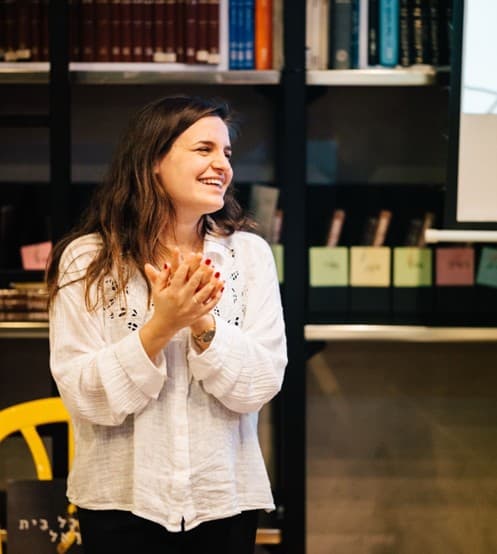
"Judaism allows me to be more whole than any ideology. Judaism is smart and interesting, it gives me a connection to god and offers different attitudes for thinking about life and society," Amit explained.

"In terms of my secular identity, it definitely does [threaten it], that’s why calling myself secular does not fully characterise me. And in terms of my queerness… [this] is why I’m on an important but hard process of exploring if my queer and Jewish identities can be compatible."

But Amit thinks the ideological climate after October 7 is also driving the trend to explore religion.

"For my parents' generation it was enough to be a secular Israeli… but today, Zionism as a secular project without deep Jewish values is not a large enough motivation to keep paying the price that it requires."

'As a secular Jew I’m in a real place to ask questions'

Matan Zeevi grew up on an established secular kibbutz in northern Israel. He has since become religious, keeping shabbat, attending Gemara lessons and learning from the Zohar – a kabbalistic text.

24-year-old Matan Zeevi (Image: supplied).

"As a secular Jew I’m in a real place to ask questions. It’s exciting for secular Jews to be free enough not only to have eastern philosophies, but to not be threatened by the idea of a 'Jewish Society' – which is mine also."

Rather than avoiding or resenting the Rabinate's enforcement of Jewish law on wider Israeli society, Zeevi sees the strictures as a reason to learn more. "I want the discussion to be on women’s rights, LGBTQ+ rights, and not Judaism versus liberalism. I want the debate to become Judaism versus Judaism. Only from these Jewish values can I truly claim my need to be free, equal… [and] be part of this rich, inner Jewish debate."

Does this mean Zeevi is going to become religious? "Depends which day you ask me. Maybe religious isn’t the right word, maybe more Jewish?"

'Cultivating a new breed of Israelis'

The charged dichotomy between religious and secular Israeli society is often depicted in the media, but there’s been a boom in interest for spaces that fuse the two, allowing Israelis across the spectrum to explore their Judaism, Zionism and spirituality without conditions of observance.

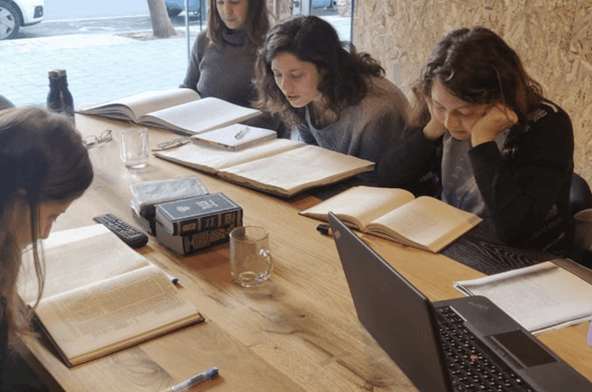
Mabua participants studying in Tel Aviv (Image: Mabua website). 

Emblematic of this shift is Mabua, one of the largest networks of pluralist betei midrashim (houses of learning) for Israelis in their 20s. Through its syllabus of secular, Jewish and Zionist texts, Mabua seeks to provide a framework for the "renewed mainstream of Israeli society” to delve into their heritage in order to “cultivate a new breed of Israelis”. Mabua is best known for its annual summer Elul program, which sees 200 Israeli young adults from across the religious spectrum take part in 40 days of intensive Jewish learning.

Hila Cohen, who co-heads Mabua's Tel Aviv branch, says they have seen an increase in numbers and demand over the last few years – primarily from many secular Israelis who are keen to find their Judaism "from a cultural point of view, not necessarily religious". 

"The first secular Israelis, such as Bialik, had a religious background. As the generations went on, that secularism deepened and tradition weakened, so much so that there are some Jewish kids born here who don't know their context and connection."

It’s not just Mabua: Kesher Yehudi, Shteygen, and Mitchabrim are all examples of projects responding to this phenomenon and drawing secular Israelis towards Jewish content in an approachable manner.

Cohen believes many Gen-Z secular Israelis feel more secure than their parents’ generation, with an attitude of "if I learn about something, it doesn’t necessarily change me [or] have to define me". 

Hila Cohen co-heads the Mabua branch in Tel Aviv (Image: supplied).

There are also pockets of secular society, including Israeli hostages and their families, who have become religious during the current Israel-Hamas conflict.

Such a public pivot in tradition, seen for example in ex-hostage Agam Berger’s testimonies around faith during and post captivity, will likely prompt ripple effects. This may include more secular Israelis turning to Judaism as well as increased connectivity between religious streams of Israeli society.

In the play “Datilonim”, Dafna and Avichai call off the wedding but, heartbroken, find their way back to each other and marry. Both make concessions and compromises. Through their mutual hope, understanding and need for each other, they are able to begin building their blended, yet shared, future. 

It's a plot twist that rings true to an increasing number of young Israelis.

*Name changed to protect privacy.

You might also like
  • ‘Israel is systemically eliminating Palestinian collective life’:  B’Tselem
    Deborah Stone
  • Tame apologises – but with little grace
    Deborah Stone
  • Confronting Richard Flanagan and the myth of the Israel lobby
    Mary Garden
logomark.67a07ee3
We believe in the free flow of information

Republish our articles for free, online or in print, by using our Creative Commons licence

You might also like

    Arab Israeli Palestinian election vote
    Israel Votes 2026FeatureIsrael

    Fear of Netanyahu victory may drive big surge in Palestinian voter turnout

    Ben Lynfield
    haredi street guitar
    Photo EssayArts & Culture

    Jerusalemites through the lens

    Sharon Gabay
    Futurism
    OpinionLifestyle

    Jewish Futurism? We’ve been practising it for millennia 

    Renata Zimbarg 1

About the author

Hannah Moshinsky

Hannah Moshinsky

author

Hannah Moshinsky completed a Bachelor of Arts in History and Politics at the University of Melbourne and was involved in various Melbourne-based community organisations, including Kehilat Kolenu and Habonim Dror. Hannah made aliyah at the start of 2024 and is currently the madricha (youth leader) of Habonim Dror Shnat.

More from the author

FeatureIsrael

Meet some young Aussies weathering war during their gap year

AnalysisIsrael

One in three Israelis does not have shelter from missiles

FeatureIsrael

When the party moves to the bomb shelter

OpinionAustralia

A Palestinian Solidarity Sukkot needs to invite Israelis

Comments1

  • Avatar of Roni

    Roni6 April at 01:47 pm

    Thanks for an interesting article! When most of the Jews of the world will live in Israel, the question of the place of Judaism in the private lives of the citizens of Israel will increase. The differences between Israeliness and Judaism will increase, for example in the crisis around the law of conscription into the army or the place of holidays in the public-secular space. The desire of Israelis to be a state like all other states will obscure the reason and purpose of the State of Israel in general – the protection of the Jews and the development of their culture of life. The secular public in Israel is therefore required to grasp its Judaism before extremist religious elements change the primary goal of the state.