Aa
  • Read, Watch, Listen
  • TJI Series
  • Community Action
  • Events
  • Zedi
Follow us and continue the conversation
  • LinkedIn
  • Instagram
  • FaceBook
  • X
  • YouTube
Test yourself with the TJI Quiz!

Adjust size of text

Aa

Follow us and continue the conversation

  • LinkedIn
  • Instagram
  • FaceBook
  • X
  • YouTube

Your saved articles

You haven't saved any articles

What are you looking for?

Original reporting, insightful analysis and diverse views, delivered straight to your inbox

  • LinkedIn
  • Instagram
  • FaceBook
  • X
  • YouTube
Your support fuels our mission to inform, entertain and inspire.

The Jewish Independent is bound by the Standards of Practice of the Australian Press Council. If you believe the Standards may have been breached, you may approach The Jewish Independent or make a complaint to the Australian Press Council in writing at www.presscouncil.org.au. The Council may also be contacted on 1800 025 712.

  • Our Story
  • Contact us
  • Our Team
  • Support us
  • Guidelines
  • Pitch your idea
  • Republishing us
  • Community Action
  • Our Awards
  • LinkedIn
  • Instagram
  • FaceBook
  • X
  • YouTube
Aboriginal FlagTorres Strait Islanders Flag

The Jewish Independent acknowledges Aboriginal and Torres Strait Islander peoples as the Traditional Owners and Custodians of Country throughout Australia. We pay our respects to Elders past and present, and strive to honour their rich history of storytelling in our work and mission.

© The Jewish Independent 2026All Rights Reserved
Website design and development by Your Creative, MelbourneTerms & ConditionsPrivacy Policy
HomeRead, Watch, Listen
Feature

No Bibi, but will anything else be different about this government?

Eetta Prince-Gibson
Print this

Published: 8 June 2021

Last updated: 4 March 2024

EETTA PRINCE-GIBSON: The ill-fitting coalition will pass a budget and probably cut back on settlement expansion, but hold tight on religious and human rights, the occupation and Iran

ALTHOUGH THEY STILL HAVE to jump over several high political hurdles, a new government may be in place within the next ten days, or even sooner. And if they make it, this will be the first government in 12 years without Benjamin Netanyahu at its head.

It will also be strangest collection of political parties and personalities ever to make up an Israeli government. 

The eight parties span the ideological spectrums from left to extreme right; from fervently progressive to devoutly conservative, from neo-liberal to social democratic; from feminist and pro-LGBTQ rights to religious anti-feminist and anti-gay.

One common thread holds this assorted crew together: All of them detest Benjamin Netanyahu. And quite a few of them also can't stand his wife, Sarah Netanyahu, who is reported to be the arbiter of her husband's political alliances and has been responsible for some of Netanyahu's most egregious political betrayals and deceptions.

It remains to be seen if loathing of Netanyahu can serve as enough of a glue to keep this government from imploding

It remains to be seen if loathing can serve as enough of a glue to keep this government from imploding. Yet even before it has been officially ensconced, this coalition already has several achievements to its credit.

First, it has broken Netanyahu's mystique.  Netanyahu has invested most of his personal and political energies in fostering the myth that he, and only he, can run the country. At least in the near future, Netanyahu will continue to kick, scream, and incite as he always does, but it is likely to be from the opposition-side of the Knesset.

Second, for the first time, an Arab party, Ra’am, will be part of the coalition. True, its leader Mansour Abbas will not be a minister, and his party will not be holding any of the more powerful and influential Knesset committees. And Abbas, who represents the conservative, Islamic party, is not the progressive left-wing and pro-Palestinian representative of the Arab population that many leftists, in Israel and abroad, had hoped to see.
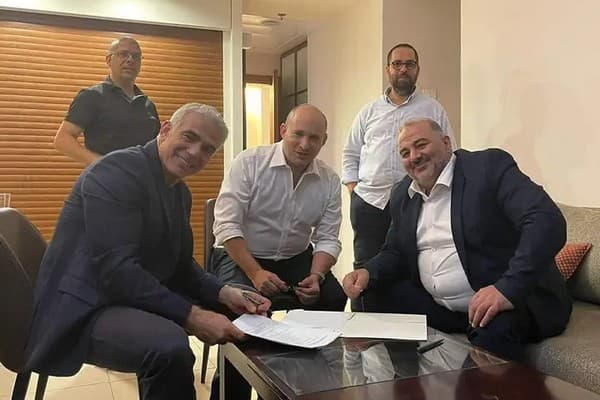
From left: Yair Lapid, Naftali Bennett and Mansour Abbas

But after years of the delegitimisation that Netanyahu fomented, Israelis watched their screens as Abbas  negotiated with Lapid and Bennett just like all the others and as noted by Noa Landau in Haaretz, Jewish citizens suddenly had to get used to hearing about the needs of the Arab population on prime-time media.

Coalition agreements are rarely released much before, and often after, the government is established. Yet from an overview of the relevant players, and from the few agreements that have been released to the press, we can point to some of the directions and decisions this government is likely to take.

First and foremost, the agreement requires the coalition to pass a budget for 2021 and 2022 within 100 days of its inception. Although ostensibly an obvious responsibility of every government, Israel has been without a national budget for over two years. 

Netanyahu has repeatedly used the budget as a political tool, and to date, Israel has been using a pro-rated version of the 2019 budget (that was actually ratified in mid- 2018, which has handcuffed all of the government's activities. 

With no ultra-Orthodox parties in the coalition, it is likely to stop the disproportionate benefits to which they have become accustomed.

Since, in their essence, budgets are statements of political priorities, it is still difficult to predict whether the budget will promote greater income equality and social equity through housing, health, education and so forth, especially since incoming Finance Minister Avidgor Lieberman is a strong advocate of free-market policies.

One thing is already clear: with no ultra-Orthodox parties in the coalition, the government is likely to put a stop to the disproportionate allocations and benefits to which they become accustomed. This will have a significant effect on the community, especially with regard to employment rates.

With regard to the occupation, we should not expect any major changes. Two of the parties (Yamina and New Hope) are clear right-wing parties with expansionist policies, and two (Yisrael Beiteinu and Kachol Lavan) could potentially support such policies.

On the other hand, this is not an explicitly right-wing government, either.  Centrist Yesh Atid party will be the largest party in the coalition, while the Labor and Meretz have long-supported compromise with the Palestinians and territorial withdrawal.  

Since, due to its flimsy majority, any single vote by any party member can dissolve this coalition, all of the parties will try to avoid controversy, so we are most likely to see a fragile Israeli balancing act that will offer little to the Palestinians.

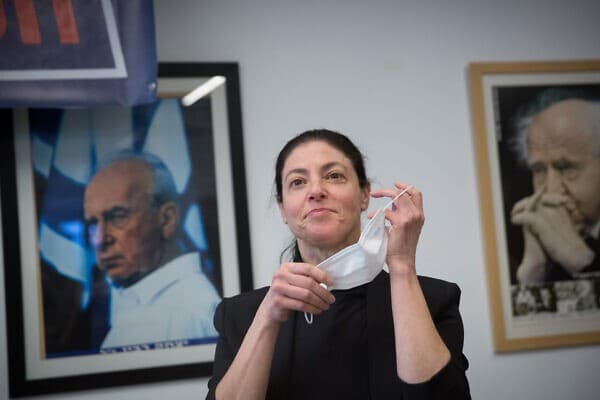
Labor leader Merav Michaeli

On the other hand, we can expect a cut back on building in the territories.  And with ministers such as Merav Michaeli (Labor) as transportation minister, and Orna Barbivai (Yesh Atid) as economic minister, there is also likely to be a cut back on some of the less obvious ways in which the settlement movement has been funded in the past, such as allocations for roads, financial incentives for settlers, and so forth.

With regard to Arab-Jewish relations within the state, the coalition agreement reportedly includes a two-year freeze on the 2017 Kaminetz law, which disproportionately cracks down on unauthorised construction in the Arab sector.

The agreement also includes immediate recognition of several of the unrecognised Bedouin villages in the Negev with additional following, and an aid package of more than 50 billion shekels.  The government is also likely to act strenuously to put an end to the intra-community violence that has been terrorising the Arab sector for years.  These are concrete gains that are supremely important to the Arab community.

Despite the progressive democratic character of some of the parties, this coalition is likely to approve additional restrictions on the Supreme Court, which has been a hot-button issue dividing the left from the right in Israel for several years.

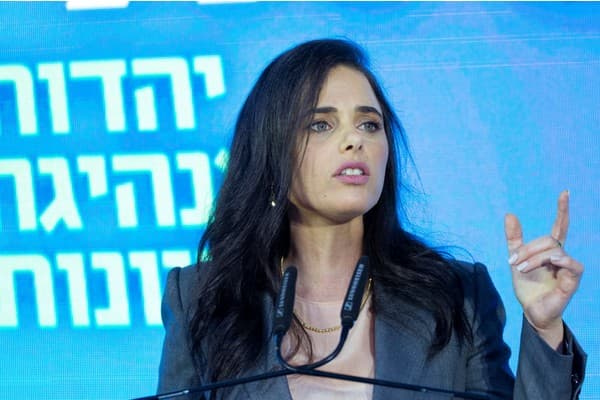
Yamina's Ayelet Shaked has positioned herself as the leader of the right-wing attempts to limit the court's power, while the left has attempted to protect the court's independence.

The relevant portion of the coalition agreement, as quoted in the Israeli press, states, "the sides agree to establish a committee, led by the justice minister and made up of members of all the coalition's parties, in order to legislate the Basic Law on Legislation." In Israel, which has no constitution, Basic Laws encode the structure of the government in civil rights.

With regard to social, religious and human rights, this government holds little promise.  Surprisingly, given its makeup, the agreements states that it will promote issues of concern to the LGBTQ community and will “all the tools at their disposal to advance the gay community’s rights,” including by finding a solution for couples who currently can’t marry legally."

Ayelet Shaked, likely to be Interior Minister

As Interior Minister, Ayelet Shaked is likely to continue the efforts against asylum seekers and refugees. Earlier this year, Shaked announced that she would attempt to deport them to Sudan now that Israel and Sudan have signed peace accords, and to promote a law "to prevent infiltration," even though Israel's High Court of Justice has knocked down similar legislation three times.

As Interior Minister, Ayelet Shaked is likely to continue the efforts against asylum seekers and refugees.

And in other ministries, we can hope to see what Carmiel Arbit, a Fellow with the Atlantic Council, refers to as technocratic tranquility, that is, ministers who actually work on their portfolios and seek to "make their mark" through public service rather than through politicking. 

As some publicists have noted, for example, Tamar Zandberg (Meretz) who will be serving as Minister of the Environment, "actually cares about the environment”.

With regard to foreign policy, Lapid's appointment as foreign minister leads to hope for better relations with the US administration, especially in tone as well as in substance.  We can also hope that this government will align itself with more progressive governments, rather than with the authoritarian, populist governments throughout the world, such as Hungary, Brazil, and India, with which Netanyahu sought to ally. 

The stand of this government towards Iran, however, is unlikely to be different than its predecessors', although, once again, we can assume that the tone of that stand will be less aggressive and belligerent than Netanyahu's.

Indeed, tone may be one of the most important differences between this government, if it lasts, and Netanyahu's governments.  One can hope that this government will show respect for the rule of law and democratic process and discuss issues in a more human, humane and perhaps even humble way. 

And if it can, it will serve as an example to all of Israel that it is possible to find a way to coexist in a heatedly polarised society, with each group giving up on some of its dreams while never crossing its ideological red lines.

READ MORE

This is what we know so far about the Bennett-Lapid government agreements (Haaretz)

Although the terms under which the new coalition deals were finalized will only be revealed in proximity to when the new government is sworn in, the agreements' key elements are clear

The Bennett-Lapid coalition is a historic opportunity for Israel (Jerusalem Post)

YAAKOV KATZ: Everyone understands this government will not be able to make major moves on Israel’s most contentious political issues. But it will be able to take steps that make better conditions on the ground.

Photo: Blue and White party leader Benny Gantz (left) speaks to Yamina leader Naftali Bennett (2-L) during a special session of the Knesset, June 2 (Ronen Zvulun/Reuters/EPA)

You might also like
  • UK’s dramatic policy change on Israel-Palestine
    Colin Shindler
  • Fear of Netanyahu victory may drive big surge in Palestinian voter turnout
    Ben Lynfield
  • Segalovitz decision to join Arab party is a paradigm change for Israel
    Eetta Prince-Gibson
logomark.67a07ee3
We believe in the free flow of information

Republish our articles for free, online or in print, by using our Creative Commons licence

You might also like

    tame kostakidis west
    AnalysisAustralia

    How not to apologise

    Zac Klugman
    Jewish-diversity copy
    Feature

    The three questions that will define the Jewish future

    Shahar Burla 1
    Feature

    While still holding off the ground invasion, Israel praises Qatar over hostage talks

    TJI Wrap

About the author

Eetta Prince-Gibson

Eetta Prince-Gibson, who lives in Jerusalem, was previously Editor-in-Chief of The Jerusalem Report, is the Israel Editor for Moment Magazine and a regular contributor to Haaretz, The Forward, PRI, and other Israeli and international publications.

More from the author

AnalysisIsrael

Segalovitz decision to join Arab party is a paradigm change for Israel

AnalysisIsrael

Netanyahu pre-election juggling act

AnalysisIsrael

Women disadvantaged by new powers for Israel’s religious courts

AnalysisArts & Culture

The Sea: deserving award-winning film or one-sided disgrace?