Aa
  • Read, Watch, Listen
  • TJI Series
  • Community Action
  • Events
  • Zedi
Follow us and continue the conversation
  • LinkedIn
  • Instagram
  • FaceBook
  • X
  • YouTube
Test yourself with the TJI Quiz!

Adjust size of text

Aa

Follow us and continue the conversation

  • LinkedIn
  • Instagram
  • FaceBook
  • X
  • YouTube

Your saved articles

You haven't saved any articles

What are you looking for?

Original reporting, insightful analysis and diverse views, delivered straight to your inbox

  • LinkedIn
  • Instagram
  • FaceBook
  • X
  • YouTube
Your support fuels our mission to inform, entertain and inspire.

The Jewish Independent is bound by the Standards of Practice of the Australian Press Council. If you believe the Standards may have been breached, you may approach The Jewish Independent or make a complaint to the Australian Press Council in writing at www.presscouncil.org.au. The Council may also be contacted on 1800 025 712.

  • Our Story
  • Contact us
  • Our Team
  • Support us
  • Guidelines
  • Pitch your idea
  • Republishing us
  • Community Action
  • Our Awards
  • LinkedIn
  • Instagram
  • FaceBook
  • X
  • YouTube
Aboriginal FlagTorres Strait Islanders Flag

The Jewish Independent acknowledges Aboriginal and Torres Strait Islander peoples as the Traditional Owners and Custodians of Country throughout Australia. We pay our respects to Elders past and present, and strive to honour their rich history of storytelling in our work and mission.

© The Jewish Independent 2026All Rights Reserved
Website design and development by Your Creative, MelbourneTerms & ConditionsPrivacy Policy
HomeRead, Watch, ListenIsrael
Israel Votes 2026AnalysisIsrael

Segalovitz decision to join Arab party is a paradigm change for Israel

The crucial coalition negotiations that follow this election may be more inclusive as a result of Segalovitz's unprecedented decision
Eetta Prince-Gibson
Print this
Segalovitz Abbas

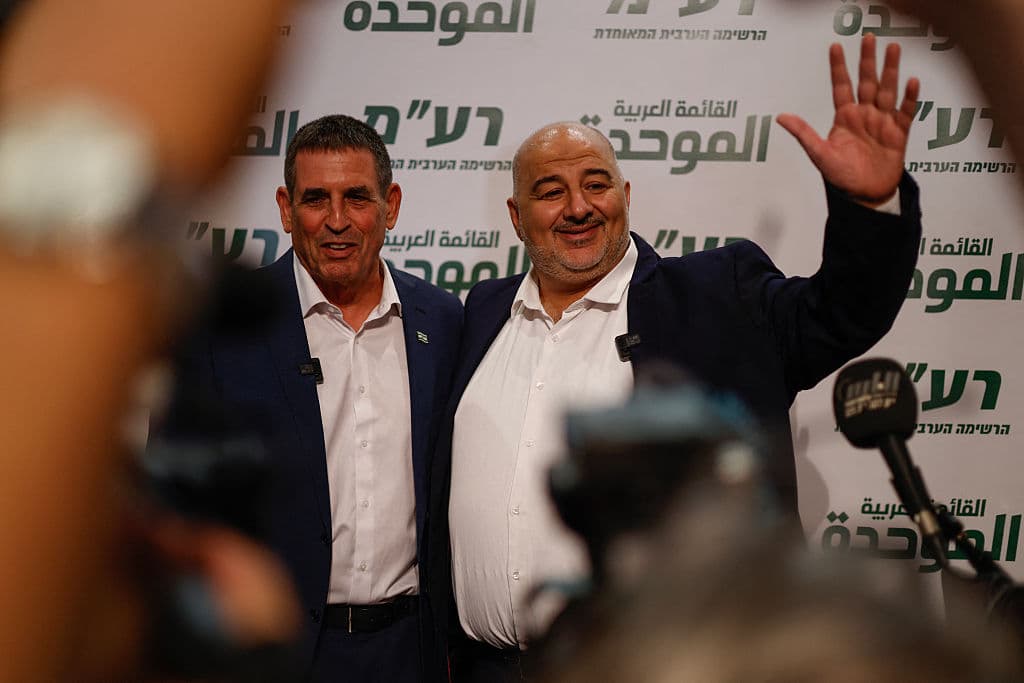
Leader of the Arab Israeli party Ra’am Mansour Abbas (R) and Israeli politician Yoav Segalovitz (L) announcing Segalovitz’ decision to join Ra’am (Jalaa Marey/AFP via Getty Images)

Published: 3 September 2026

Last updated: 3 September 2026

After two months of negotiations, Yoav Segalovitz, a former high-ranking police officer and MK, has joined Ra’am, an Islamist party and will hold the second slot on the party’s slate in the upcoming elections. This is an extraordinary development, a paradigm change that may have a direct effect on the elections.

Ra’am, whose name is an Arabic acronym meaning United Arab List, was once allied with the southern, strongly ideological branch of the Islamic movement; deeply committed to the one-state solution, it had also been part of the traditional bloc of Arab parties. Over the past decade, however, Ra’am, led by Abbas Mansour, has disassociated from the Islamic movement and played down his party’s involvement in the Israeli-Palestinian conflict. Rather, the party has emphasised civil problems Israeli Palestinians face, including rising crime and violence, inadequate housing, persistent unemployment, poor levels of education, and unequal government investment.

Segalovitz has been an MK since 2019, as part of Yesh Atid. Prior to entering politics, he served in the Israeli police, attaining the rank of nitzav (deputy commissioner), establishing the police anti-corruption unit and serving as head of investigations and intelligence. During the Lapid-Bennett Government, he served as deputy minister of internal security and is universally credited with minimising criminality and violence in the Arab sector.

Until 2021, Jewish majority parties generally regarded Arab parties as unsuitable to form a government with, especially since most of these parties called for the establishment of a single, bi-national state, a non-starter in Israeli politics. This exclusion was challenged for the first time when Ra’am joined the Lapid-Bennett coalition (2021-2022).

Nor is this the first time a Jew has been part of an Arab party or an Arab has served in a Jewish party. But the Jews serving in these parties have most often identified as non-Zionists, widely seen as “predictable, radical far-lefties” who rarely garnered votes from the Jewish majority or changed the political status of the Arab parties.

The current situation is entirely different. Abbas has publicly declared his acceptance of Israel as a Jewish state while simultaneously calling for the establishment of a separate, independent Palestinian state. Segalovitz, who comes straight out of Israel’s security and political elite, publicly defines himself as a Zionist. This paradigm change could change the future of Israeli politics and of relationships between Israeli Jews and Israeli Arabs.

Segalovitz has joined Ra’am in a manner almost unprecedented in Israeli politics: he has joined as an individual, unbound by party discipline over issues of security and religion and state. Thus, he may be contributing to the end of the divisive prioritisation of identity politics that has plagued the Israeli political system. When he joined the coalition in 2021, Abbas was signalling that Arab parties could become part of the Israeli political establishment without giving up their identity. Segalovitz is similarly signalling that he can be part of an Arab party without giving up or minimising his Jewish identity. 

The Jewish Independent

Indeed, in the press conference announcing his joining the party, Segalovitz said, “I want to break the paradigm of boundaries … and of how political partnership is created.  Our partnership is based on understanding of our differences rather than similarity or identity … we share one central principle – advancement of Israeli society, change and progress in all areas of life.”

By shifting from ideology to the pragmatism of common interests, Abbas and Segalovitz are challenging accepted boundaries not only between Arab and Jew, but also between right and left, religious and non-religious, hawks and doves, and centre and periphery. And they are generating hope that political cooperation can produce practical results.

Responses to the union have varied. Some Israeli Palestinians believe that Abbas has gone too far in his attempts at legitimisation by the Jewish majority.     

In a published statement, the Joint List, composed of the other three Arab parties that are running together, wrote that Abbas prefers the possibility of joining the government to upholding his Palestinian identity. Similarly, writing in Haaretz, educator Qassem Bakri wrote, “Abbas has no mandate to squander the collective rights and identities of Arab society, in exchange for budgetary allocations.”

The responses from the right have continued their campaign of delegitimisation against any coalition that might include an Arab party. Knesset chairman Amir Ohana (Likud) published a statement in which he wrote that Segalovitz’s decision to join Ra’am has only one intention: to enable that party to join a coalition that will be unable to fight against Hamas, Hezbollah, or Iran.

At the same time, the responses from the opposition remain weak and defensive, reflecting their concern that the right’s delegitimisation may carry weight, despite Segalovitz’s background and achievements.

How will all this affect election results?

The focus on violence as a crime in the Arab sector could be a game-changer.  A report published by the NGO, The Abraham Fund Initiatives, in July stated, “2026 is shaping up to be the bloodiest year [for Arab society] since the founding of the state. The Israeli government and the police are in total collapse. Criminal organisations are massacring citizens unchecked, and the silence of the Prime Minister and the Minister of Public Security effectively sanctions the bloodletting of Israel’s Arab citizens.”

According to media reports, Segalovitz, with his record of fighting crime in the Arab sector, has increased Palestinian Israeli support for Ra’am.  A recent Channel 13 poll found that Ra’am could rise from approximately five seats to seven now that Segalovitz has joined the party. The polling analysis suggested that most of this additional support would come from Arab voters.

At the same time, while Segalovitz will not be likely to bring Jewish votes to Ra’am, the inclusion of Segalovitz on the slate has made Ra’am a more legitimate – or at least palatable – candidate for inclusion in a coalition government in the eyes of Jewish voters.

According to Israeli law, the party that has the most likely chance of forming a coalition, which need not be the largest party in terms of the popular vote. And thus, in the arithmetic of Israeli coalition-building, Abbas could become the kingmaker.

As The Jewish Independent has been reporting, these elections are crucial for Israel’s future – and no less so because the elections, and the coalition negotiations that follow them will indicate whether Israel’s political system has become more inclusive and less brittle, whether Jewish Israelis can view an Arab party as a legitimate representative of the Arab minority, and whether Israeli society can begin to accept social and political changes so necessary for its future.

You might also like
  • Because of my Zionist values, I’m joining an Arab party
    Yoav Segalovitz
  • Mansour Abbas’s bold bid to reshape Israeli politics
    Shahar Burla
  • How Netanyahu can stay in power without winning
    Shahar Burla
logomark.67a07ee3
We believe in the free flow of information

Republish our articles for free, online or in print, by using our Creative Commons licence

You might also like

    Activists attempt to deliver supplies to Palestinian families near Nablus
    OpinionIsrael

    Qusra siege exposes shared agenda of IDF and settler extremists

    Ben Lynfield
    Ibrahim Khatatbe
    NewsIsrael

    Abuse by IDF soldiers humiliates Muslim Palestinians

    Ben Lynfield 3
    settler outpost west bank
    NewsIsrael

    Israel is cementing its control over the West Bank and East Jerusalem while the world is distracted

    Martin Kear

Comments

No comments on this article yet. Be the first to add your thoughts.

About the author

Eetta Prince-Gibson

Eetta Prince-Gibson, who lives in Jerusalem, was previously Editor-in-Chief of The Jerusalem Report, is the Israel Editor for Moment Magazine and a regular contributor to Haaretz, The Forward, PRI, and other Israeli and international publications.

More from the author

AnalysisIsrael

Netanyahu pre-election juggling act

AnalysisIsrael

Women disadvantaged by new powers for Israel’s religious courts

AnalysisArts & Culture

The Sea: deserving award-winning film or one-sided disgrace?