Aa
  • Read, Watch, Listen
  • TJI Series
  • Community Action
  • Events
  • Zedi
Follow us and continue the conversation
  • LinkedIn
  • Instagram
  • FaceBook
  • X
  • YouTube
Test yourself with the TJI Quiz!

Adjust size of text

Aa

Follow us and continue the conversation

  • LinkedIn
  • Instagram
  • FaceBook
  • X
  • YouTube

Your saved articles

You haven't saved any articles

What are you looking for?

Original reporting, insightful analysis and diverse views, delivered straight to your inbox

  • LinkedIn
  • Instagram
  • FaceBook
  • X
  • YouTube
Your support fuels our mission to inform, entertain and inspire.

The Jewish Independent is bound by the Standards of Practice of the Australian Press Council. If you believe the Standards may have been breached, you may approach The Jewish Independent or make a complaint to the Australian Press Council in writing at www.presscouncil.org.au. The Council may also be contacted on 1800 025 712.

  • Our Story
  • Contact us
  • Our Team
  • Support us
  • Guidelines
  • Pitch your idea
  • Republishing us
  • Community Action
  • Our Awards
  • LinkedIn
  • Instagram
  • FaceBook
  • X
  • YouTube
Aboriginal FlagTorres Strait Islanders Flag

The Jewish Independent acknowledges Aboriginal and Torres Strait Islander peoples as the Traditional Owners and Custodians of Country throughout Australia. We pay our respects to Elders past and present, and strive to honour their rich history of storytelling in our work and mission.

© The Jewish Independent 2026All Rights Reserved
Website design and development by Your Creative, MelbourneTerms & ConditionsPrivacy Policy
HomeRead, Watch, ListenIsrael
ReflectionIsrael

Picking olives, I hope to return with an olive branch

Abdallah’s land has been occupied by a settlement, but Israeli volunteers are ensuring he will still get the fruits of the harvest.
Gadia Zrihan
Print this
Picture 3

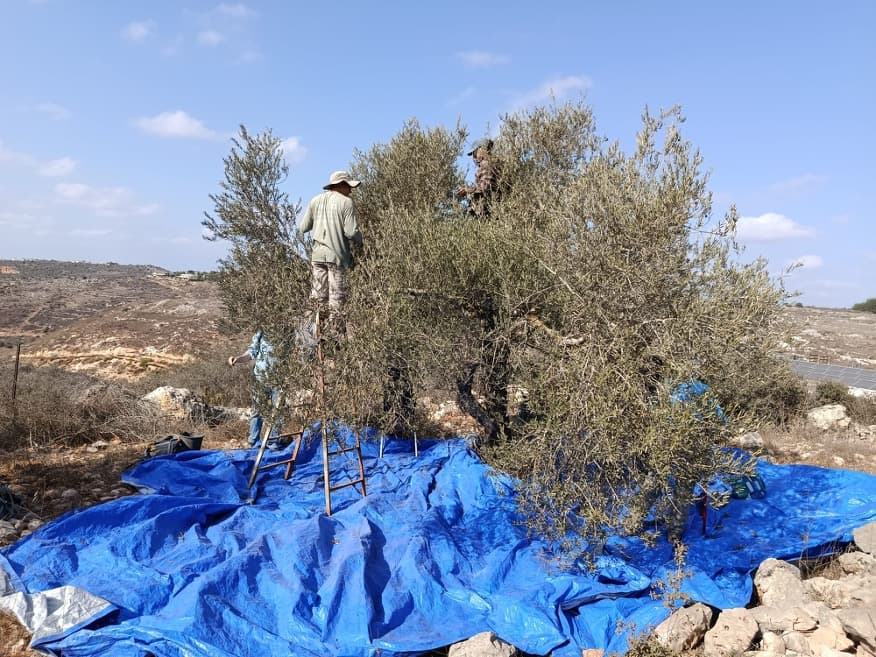
Harvesting olives Abdallah’s land, the West Bank (Image: Gadia Zhiran)

Published: 9 December 2025

Last updated: 9 December 2025

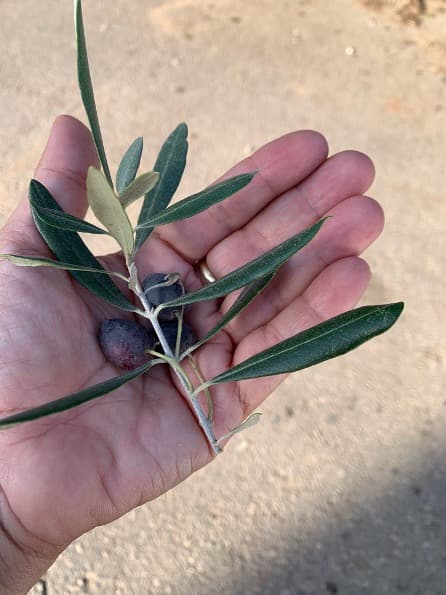
It is now the very last weeks of the olive harvest season in Israel and Palestine, that brief window in autumn when the plumb little orbs dot the trees in hues of green, purple and black, ripe for the picking.  

The olive harvest should be a time of celebration, the continuation of a tradition that has spanned generations, families coming together in an annual ritual to gather the olives, resting only to take breaks of mint or sage tea under the shade of the rambling branches before sackfuls of olives are turned through the olive press and transformed into precious oil, a staple ingredient that nourishes family and supports tens of thousands of families in the West Bank alone. 

This year I am seeing up close how the continuum of the olive harvest collides with a devastating political reality, disrupting lives and livelihoods and turning it into a time of fear and apprehension as harvest is marred by violence and escalated efforts to uproot Palestinian families from their land.  

The increase in violence during the olive harvest season is not a new phenomenon; every year, extremist settlers descend upon Palestinian villages destroying property, uprooting trees, and physically assaulting farmers and their families. This year, however, the severity has been unprecedented and incidents of settler violence against Palestinians in the West Bank have surged. 

Israeli security forces often actively cooperate with settler intimidation or refuse to stop the attacks as they occur, so many civilian groups have taken it upon themselves to step up. I am participating in the olive harvests under the auspices of Rabbis for Human Rights and Standing Together, organisations that support Palestinian famers and serve as a protective presence as they harvest their olives, helping deter or reduce the severity of attacks, and building solidarity between Palestinian partners and those in Israel who believe in a shared future of equality and cooperation. 
The Jewish Independent
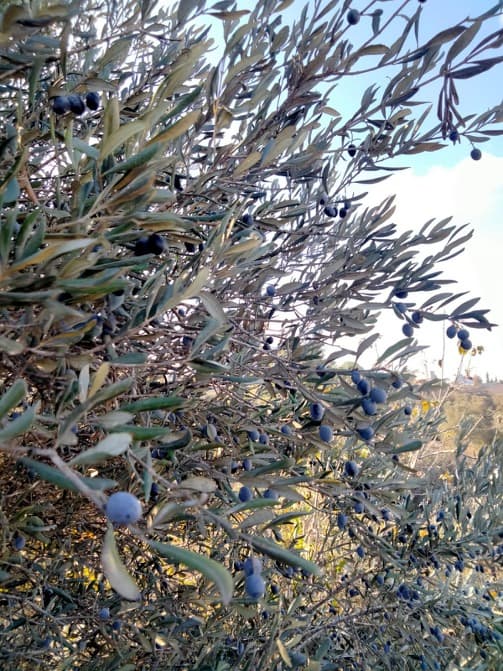
(Images: Gadia Zhiran)

Today sadly, we will be picking for the farmer but not with him or his family. His olive grove has been appropriated by a nearby settlement, and he is not allowed to enter their grounds. 

Leaving Jerusalem and entering the West Bank through the checkpoint feels like a passage to another planet, jarring against my sensibility with its contradictions. A biblical landscape with its own harsh beauty, a rocky cascade of hills dotted with heavily secured Jewish settlements, and Palestinian towns and villages interspersed with patches of green olive groves. The proximity does not breed neighbourliness, but in a strange twist of necessity, it is mostly Palestinians building Jewish settlements. Everywhere bulldozers are carving out new roads. Signs in Hebrew proudly call on those passing through to “Come Settle the Land,” but nothing can hide the fact that this is occupied land. 

We stop on the road between the settlement and the village of Hares to meet Abdallah, the farmer whose olives we are about to pick, using our hands as proxies on his land I am startled by his equilibrium. His constancy reminds me that the olive tree is equated with sumud, steadfastness in Palestinian culture. He is as rooted to the land as his olive trees. As we enter the gated grounds of the settlement, he directs us to the entrance to his plot by face-timing with our field coordinator. 

In Jewish culture, the olive branch is one of the oldest symbols of peace and hope, harkening back to the story of Noah and the flood

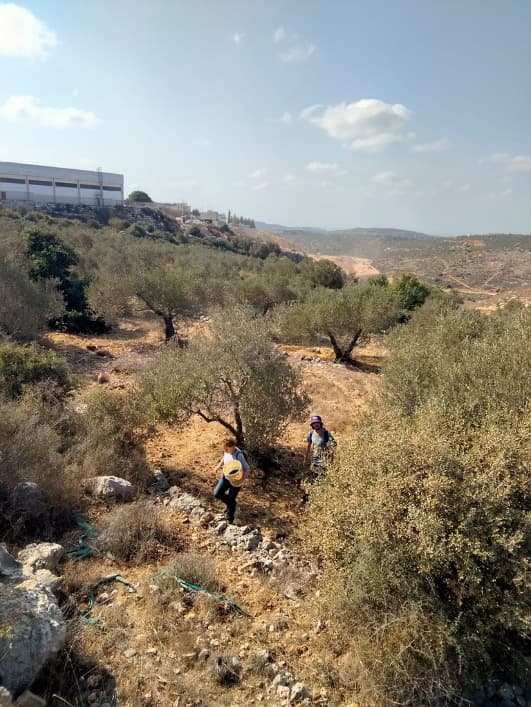
His plot of land almost feels like a forgotten space; a vestige crammed between two large buildings in the industrial area of the settlement. We get in through a small dirt path that’s easy to miss. No one notices us. Abdallah has not been able to reach his land for three years. The trees hug the side of a terraced sloping hill, and the land is pitted with rocks and thorny bushes. We get out of the van and scramble across the rocks, scanning the landscape and looking for the trees heaviest with olives. This year has been a difficult harvest in many ways, and very few trees on this plot hold olives.  

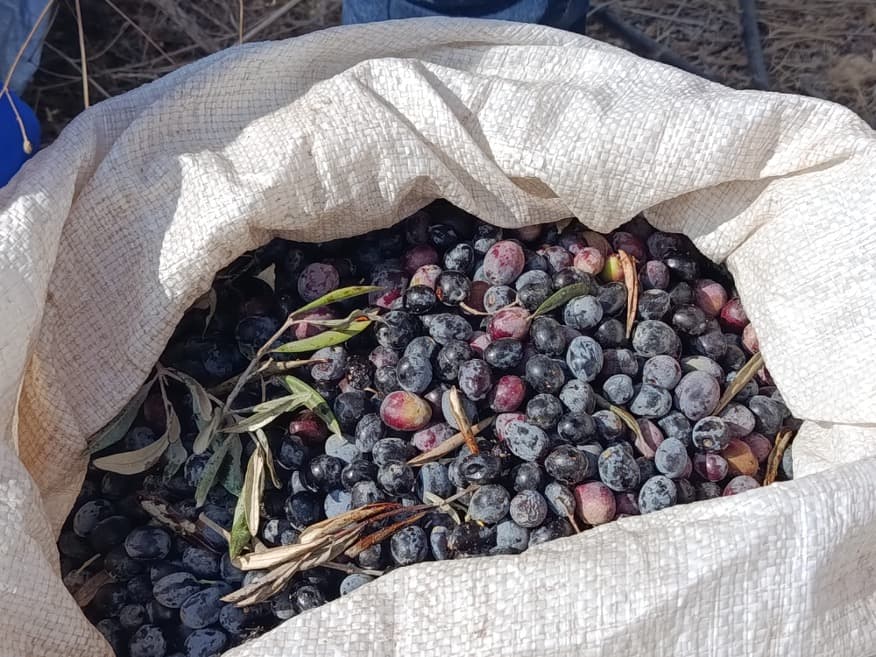
 When we find a tree laden with fruit, we lay the blue tarpaulin beneath and get busy picking. Some olives are accidentally crushed underfoot. I gather these too, the sticky purple fruit staining my fingers like wine. I hope that despite the meagre pickings from so many trees, we will still have collected enough olives for Abdallah and his family to turn into a few bottles of oil, providing some sustenance from the fruit of his land. We are lucky that today’s harvest has unfolded without any drama or disturbance. 

(Image: Gadia Zhiran)

Every day during this olive season, volunteers are going out to share this labour with Palestinian families, to be a protective presence, to break bread together, to make a joint oath to this land and its two peoples.  

There is a way we can both belong here. As I pick the small black fruit from the branches, I feel the trees lean towards me, offering their olives for the taking. They have not been tended in so long and they almost bend to our hands in thankfulness. 

In Jewish culture, the olive branch is one of the oldest symbols of peace and hope, harkening back to the story of Noah and the flood.  

In the act of participating in the olive harvest with all those who share this land, perhaps we are a little like Noah’s doves, sent out to find where we can make shelter in the flood. I hope soon we will return with an olive leaf in hand, knowing that one day the land will welcome us all home again.

READ MORE

Palestinian Prime Minister Warns Israel Is Making West Bank 'Unlivable' for Palestinians (Haaretz)
PA Prime Minister Mohammad Mustafa says Netanyahu's policies seek to undermine the PA and expand settlements, aiming 'to eventually convince the rest of the world there's no place for a state.' He warned that financial pressure, raids, and settler violence are making life unbearable.

'They Behave Like an Army:' Israeli Settlers Ramp Up Their Annual Onslaught on Palestinian Olive Growers (Matan Golan, Haaretz)
During the recent olive harvest in the West Bank, a surge in settler violence, the most severe since 2006, has disrupted Palestinian farmers' access to their lands, particularly in Area B, which is legally under Palestinian civilian control.

Netanyahu said to order 14 illegal outposts evacuated; PM’s spokesperson issues flat denial (Jeremy Sharon, The Times of Israel)
Report says PM’s move is part of effort to curb wave of settler attacks and bar central agitators from West Bank.

Christmas festivities return to Bethlehem after 2 years of war in Gaza (The Times of Israel)
Tourism-reliant city sees crowds travel from Israel, West Bank and beyond, seeks to ‘reignite hope’ after celebrations were muted amid war, and before that during COVID.

Palestinian who sped car toward troops in Hebron killed, as is passerby; soldier lightly hurt (Emanuel Fabian, The Times of Israel)
Paratroopers targeted while operating near a checkpoint in flashpoint West Bank city, less than a week after ramming attack in the area that lightly wounded soldier.

You might also like
  • ‘Israel is systemically eliminating Palestinian collective life’:  B’Tselem
    Deborah Stone
  • Tame apologises – but with little grace
    Deborah Stone
  • Confronting Richard Flanagan and the myth of the Israel lobby
    Mary Garden
logomark.67a07ee3
We believe in the free flow of information

Republish our articles for free, online or in print, by using our Creative Commons licence

You might also like

    Erdogan Turkey
    AnalysisIsrael

    Turkey emerges as military threat to Israel

    Dror Doron
    Arab Israeli Palestinian election vote
    Israel Votes 2026FeatureIsrael

    Fear of Netanyahu victory may drive big surge in Palestinian voter turnout

    Ben Lynfield
    Segalovitz Abbas
    Israel Votes 2026AnalysisIsrael

    Segalovitz decision to join Arab party is a paradigm change for Israel

    Eetta Prince-Gibson

About the author

Gadia Zrihan

Gadia Zrihan

Gadia Zrihan is a freelance writer and editor who works in community engagement. She has a foothold in Israel and Australia and is currently based in Jerusalem. She is a storyteller at heart, interested in building bridges between communities and exploring notions of homecoming.

More from the author

ReflectionIsrael

Under fire in Jerusalem

ReflectionLifestyle

Revisiting my grandmother’s kitchen

World

DC Diary: Picking berries, spotting bears and escaping white supremacism

Comments

No comments on this article yet. Be the first to add your thoughts.