Aa
  • Read, Watch, Listen
  • TJI Series
  • Community Action
  • Events
  • Zedi
Follow us and continue the conversation
  • LinkedIn
  • Instagram
  • FaceBook
  • X
  • YouTube
Test yourself with the TJI Quiz!

Adjust size of text

Aa

Follow us and continue the conversation

  • LinkedIn
  • Instagram
  • FaceBook
  • X
  • YouTube

Your saved articles

You haven't saved any articles

What are you looking for?

Original reporting, insightful analysis and diverse views, delivered straight to your inbox

  • LinkedIn
  • Instagram
  • FaceBook
  • X
  • YouTube
Your support fuels our mission to inform, entertain and inspire.

The Jewish Independent is bound by the Standards of Practice of the Australian Press Council. If you believe the Standards may have been breached, you may approach The Jewish Independent or make a complaint to the Australian Press Council in writing at www.presscouncil.org.au. The Council may also be contacted on 1800 025 712.

  • Our Story
  • Contact us
  • Our Team
  • Support us
  • Guidelines
  • Pitch your idea
  • Republishing us
  • Community Action
  • Our Awards
  • LinkedIn
  • Instagram
  • FaceBook
  • X
  • YouTube
Aboriginal FlagTorres Strait Islanders Flag

The Jewish Independent acknowledges Aboriginal and Torres Strait Islander peoples as the Traditional Owners and Custodians of Country throughout Australia. We pay our respects to Elders past and present, and strive to honour their rich history of storytelling in our work and mission.

© The Jewish Independent 2026All Rights Reserved
Website design and development by Your Creative, MelbourneTerms & ConditionsPrivacy Policy
HomeRead, Watch, ListenAustralia
ReflectionAustraliaZedi

‘Pick a side’: Progressive Jews face crisis of belonging

Caught between their values and their identity, many progressive Jews feel politically orphaned, navigating rising antisemitism, social isolation, and a deepening disillusionment with the very movements that once promised inclusion.
Ruby Starr Miller
Print this
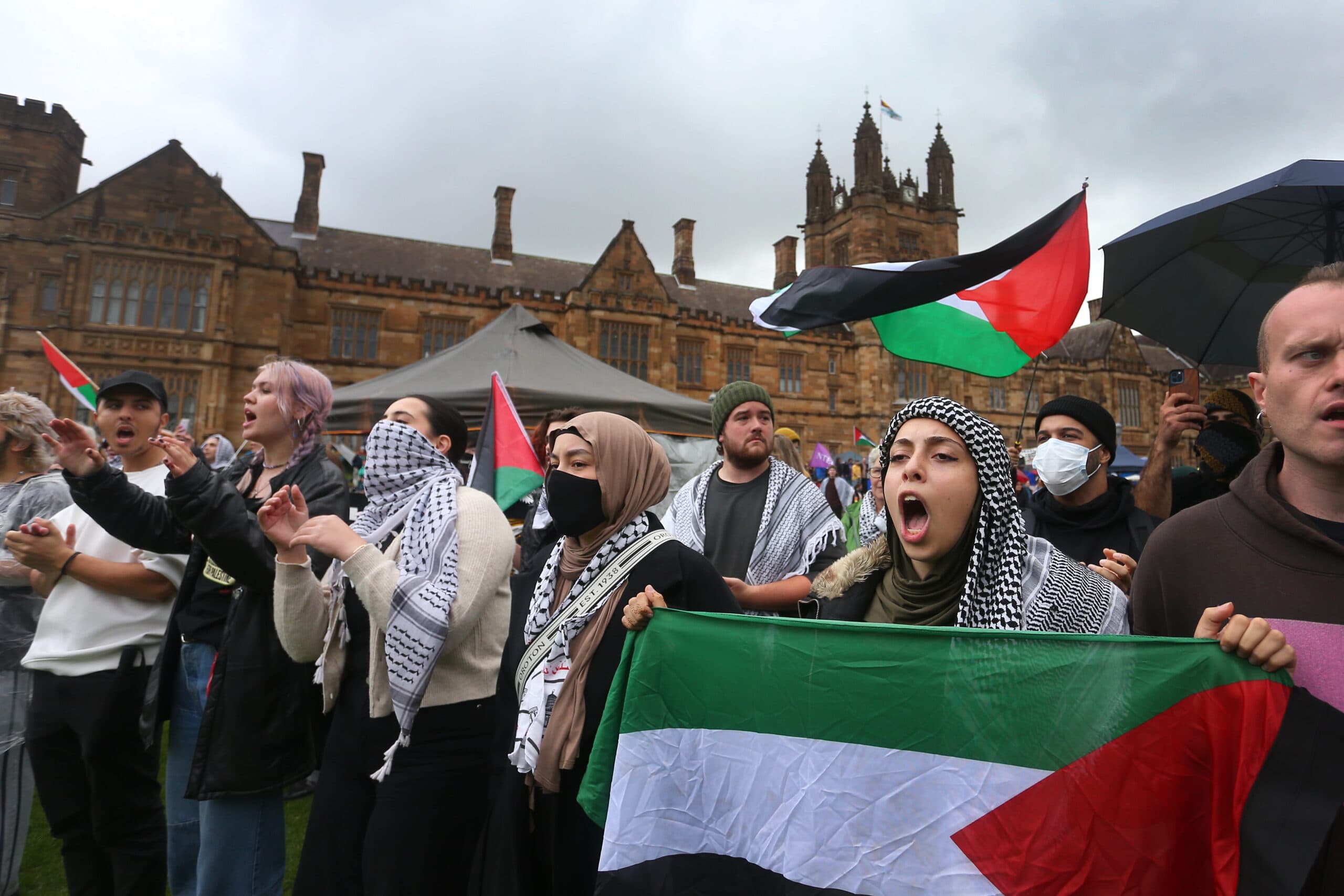
Gaza protest Sydney University As Israel-Gaza War Sows Division

Pro-Palestinian protesters at the University of Sydney during the Gaza war (Lisa Maree Williams/Getty Images)

Published: 8 April 2026

Last updated: 8 April 2026

Diaspora Jews face multiple crises today: antisemitism, hostility, exclusion, and isolation. Alongside this a new crisis emerges – one that is quiet and passive yet no less damaging – a crisis of belonging. For many progressive Jews the politics and ideology they once trusted now ostracise them. What happens when the morality and language they embrace suddenly excludes them?

In particular, younger generation Jews are struggling with political disillusionment in ways that feel unprecedented. Conversations with my community reveal a clear crisis – not just geopolitical tensions, but a deeply personal, identity-based one.

Progressive Jews aligned with left-wing ideals now face exclusion from the very political spaces that once offered solidarity, demanding conformity on demonising Israel while ostracising nuance. They grapple with wanting to stay progressive, yet feeling politically orphaned.

In conversation with a young left-wing Jew, she described her community's isolation and societal anomie as a "very pervasive issue”. Progressive Jews face this in Australia's current political climate, feeling drawn to Greens or Labor on immigration, fiscal policy, or environmental issues, yet unable to commit due to misalignment on Jewish security. 

She feels forced to confront whether she is a "Jewish Australian or an Australian Jew," needing to compartmentalise her identity and being ultimately left factionless. This identity-tangled alienation is a burden for her and many others. No longer prioritising political affiliation because it feels “impossible”, this embodies a broader disillusionment with Australia’s partisan stances and leaves many feeling politically and socially adrift.

If intersectionality refuses to acknowledge the vulnerability of Jews  to exclusion, how can its notion of “inclusion” hold any real meaning? This “wokeism paradox” demonstrates that progressive ideologies  designed to dismantle oppression now exclude communities unless they publicly disavow their identity. In turn,  embracing such values leaves them doubly alienated – rejected by the Left on religious grounds and branded with the pejorative 'Zionist’ by activists they’d have hoped to call allies. 
This may reflect political fatigue, or the consequences of performative activism – either way, it is deeply problematic. Jewish students who  embrace “woke” values now feel those frameworks turned against them, with progressive discourse selectively validating certain pain, while muzzling others. Stark moral binaries around Israel create social pressure to “pick a side”, driven by harmful reductionism.

Feeds are saturated with outrage and moral inconsistencies, yet devoid of any empathy for Jews

This crisis of belonging has many origins – Australian universities among them. First-hand accounts from Jewish students at the University of Technology Sydney reveal left-wing and socialist groups approaching many students unprompted – a common experience for students across universities and backgrounds. Upon learning of their Jewish identity via a Magen David necklace or simple disclosure, they are instantly branded "brainwashed," propaganda victims, even "complicit in genocide”, before sharing any stance on the war or state actors involved.

Such assumptions of politics based on religion, culture or ethnicity further reveal the wave of harmful reductionism sweeping conversations around Israel in Australia. Jewish students who would have wanted to engage these communities on shared policy issues instead withdraw, feeling shunned, unwelcome, and profoundly unseen – closing down spaces where dialogue should thrive.

Last week, The Australian National University's Centre of Arab and Islamic Studies, partnering with the College of Arts and Social Sciences, hosted a roundtable discussion: Middle East Update: US/Israel's War on Iran. The moderator began with sympathies for affected countries, naming only Arab nations. Throughout, academics analysed the war and referred to the “crisis of Zionism”. 

One speaker described Israel as "obsessive" towards Iran, implicitly downplaying its existential threat. Yet since his 1989 election, Ayatollah Khamenei has been explicit. Exiled Iranian dissident Akbar Ganji documents: in 1991, "we believe the solution is destroying the Israeli regime… Israel must disappear, and will"; in 2012, "Israel will go, it must not survive, and it will not"; and in 2018, "the Zionist regime will perish".

University students tend to accept professors' framing and ostensible objectivity without question. I attended this panel to learn and gauge messaging but left disappointed. One academic listed two main issues with Israel: Netanyahu’s career as the minor, and “the broader problem which is Zionism itself”. As one of two Jewish students present, it confirmed my suspicion – academic discourse often indulges selective, contested perspectives. 

By leaving "Zionism" undefined and assuming shared negative understandings, these forums  strip Zionists of autonomy to articulate their own meaning. Whether innocent or intentional, this perpetuates damaging views of Jewish statehood, robbing  the conversation of crucial nuance and entrenching existing biases among attendees.

Secondly, social media plays a central role in driving this crisis. The power of comments, short-form videos, and posts – real or AI-generated – cannot be understated. As a young Jew on Instagram and TikTok, I regularly encounter unspeakable hatred directed at Jews. 

Recently, a Jewish woman shared an aspect of her culture – a simple challah-baking video. The comments were flooded with “Free Palestine”, alongside the vitriolic “I hope you get drowned while eating this,” “F Israel,” “Zionist pig”, “Zio-nazi” and “this is satanism”.

This type of response is commonplace. While some say “just don’t engage,” for young Jews it is truly inescapable. Even unrelated educational content from Jewish creators is labelled “Zionist propaganda”. This online hate profoundly damages mental health, fostering isolation, hopelessness, and vilification.

Feeds are saturated with outrage and moral inconsistencies, yet devoid of any empathy for Jews. These pressures breed moral exhaustion. Jews seeking both Palestinian justice and Jewish safety find themselves exiled from wider society – disillusioned and alone for rejecting rigid moral binaries and zero-sum discourse. This constant hatred fosters self-censorship, shame, and numbness.

Yet disillusionment does not need to signal defeat. It provides a space for independent Jewish engagement – reclaiming spaces to voice nuance without shame, building moral frameworks that honour complexity over conformity, and creating communities where Jewish security and progressive values can coexist unapologetically. 

From apparent isolation, individual agency can emerge to embrace a new politics rooted in resilience. Progressive Jews can reclaim moral leadership by honouring identity, values, and safety – without bowing to anti-Zionist demands from the political communities that have orphaned them.

You might also like
  • Tame apologises – but with little grace
    Deborah Stone
  • Confronting Richard Flanagan and the myth of the Israel lobby
    Mary Garden
  • Facing a new year with the knowledge life can be better
    The Jewish Independent
logomark.67a07ee3
We believe in the free flow of information

Republish our articles for free, online or in print, by using our Creative Commons licence

You might also like

    ANNIKA WELLS PRESSER
    Israel Hamas WarNewsAustralia

    No action to stop Hezbollah ally beaming antisemitic and anti-Israel content into Australia

    Michael Visontay
    vandalism car woollahra fuk israel farhat
    Australia

    Court decision fails to understand when ‘Fuk Israel’ becomes antisemitic

    Jeremie Bracka 6
    Albanese Bondi
    Royal CommissionAnalysisAustralia

    Prime minister’s absence exposes weakness in Royal Commission hearings

    Michael Visontay

About the author

Ruby Starr Miller

Ruby Starr Miller

Ruby Miller studies Political Science and International Relations at the Australian National University in Canberra. She works across marketing and communications roles and is passionate about how political media drives meaningful change in Australia.

More from the author

OpinionAustralia

Navigating language minefields in pursuit of civil conversation 

Comments3

  • Avatar of Mark Ian

    Mark Ian24 April at 03:11 am

    If the Israelis are going to be condemned as Primordial Tribal then this applies to all the Nations .
    There are very few Multinational International Humanists
    An answer to the Insults is that the majority of the Zionists were willing to share the Land with the Palestinians in 1937 before the Holocaust and in 1947
    after the Holocaust in the UN Partition Plan November 29 1947 .

  • Avatar of Rosie

    Rosie17 April at 09:00 am

    Maybe because it’s inconsistent to claim you’re progressive while also supporting a genocidal apartheid ethnonation state?

  • Avatar of Madison

    Madison15 April at 04:48 am

    This article has put incredibly succinct, intelligent and thoughtful words to sentiments I have been entirely struggling to explain or express for years. I have found my new Hero. Thank you Ruby Starr Miller. I anticipate big things will continue to come out of this deeply in touch, observant new voice!