Aa
  • Read, Watch, Listen
  • TJI Series
  • Community Action
  • Events
  • Zedi
Follow us and continue the conversation
  • LinkedIn
  • Instagram
  • FaceBook
  • X
  • YouTube
Test yourself with the TJI Quiz!

Adjust size of text

Aa

Follow us and continue the conversation

  • LinkedIn
  • Instagram
  • FaceBook
  • X
  • YouTube

Your saved articles

You haven't saved any articles

What are you looking for?

Original reporting, insightful analysis and diverse views, delivered straight to your inbox

  • LinkedIn
  • Instagram
  • FaceBook
  • X
  • YouTube
Your support fuels our mission to inform, entertain and inspire.

The Jewish Independent is bound by the Standards of Practice of the Australian Press Council. If you believe the Standards may have been breached, you may approach The Jewish Independent or make a complaint to the Australian Press Council in writing at www.presscouncil.org.au. The Council may also be contacted on 1800 025 712.

  • Our Story
  • Contact us
  • Our Team
  • Support us
  • Guidelines
  • Pitch your idea
  • Republishing us
  • Community Action
  • Our Awards
  • LinkedIn
  • Instagram
  • FaceBook
  • X
  • YouTube
Aboriginal FlagTorres Strait Islanders Flag

The Jewish Independent acknowledges Aboriginal and Torres Strait Islander peoples as the Traditional Owners and Custodians of Country throughout Australia. We pay our respects to Elders past and present, and strive to honour their rich history of storytelling in our work and mission.

© The Jewish Independent 2026All Rights Reserved
Website design and development by Your Creative, MelbourneTerms & ConditionsPrivacy Policy
HomeRead, Watch, ListenArts & Culture
Arts & Culture

Talk straight and sing: Musicians find inspiration in cross-cultural understanding.

Batool Aljafri
Print this

Published: 23 June 2023

Last updated: 20 April 2026

BATOOL ALJAFRI explores the potential of music to resolve conflicting narratives and build bridges for Jews and Arabs.

“Growing up, I never understood those Arabs,” Uriya stated candidly, reflecting a viewpoint held by many Jewish-Israelis. “And growing up I didn’t understand their fear from us, why are they so afraid from us?,” Sameh, a Palestinian citizen of Israel, responded.

Uriya and Sameh are co-founders of the “Dugri” project, which sees a united future for Jews and Arabs, leveraging music and education to encapsulate the personal experience of identities in an intractably divided region.

“I grew up so intertwined within my Israeli narrative … I was in constant fear of the other side,” said Uriya. Sameh grew up in Ramle, home to a mixed demographic of Jews and Arabs who experiences ongoing tensions, but he describes his collaborations with Jewish musicians positively.

“It’s amazing how much you can be exposed through music to the ‘other’s’ culture and to their perspective.”

Music has a transcending power that moves beyond boundaries and brings people from polarised backgrounds together. Professor Kim Cunio, an Australian of Iraqi-Indian-Jewish heritage, is an activist composer and Head of the School of Music at the Australian National University. He gives a deeper insight into the mechanics of musical creation.

“Music is the most elegant way to inhabit a shared space,” he said, drawing on his extensive portfolio of co-creating with the "other".

 “It’s going to take a new generation to make a change through art”

Inspired by the "third stream" model of music, which combines conflicting dichotomous elements to create new music forms, Cunio found the best way to break down social barriers was through the language of music.

“It’s basically impossible when you sit next to someone … to really hate them very much. The music will sound really bad,” he explained.
Sameh echoed the same sentiment about Uriya. “It was hard for me to hate him, to look at him as the enemy. It was kind of impossible.”

The Dugri duo have fostered a musical dialogue in which Sameh expresses his emotions and Uriya challenges mainstream narratives – with neither shying away from embracing discomfort and harsh realities as part of their co-creation.

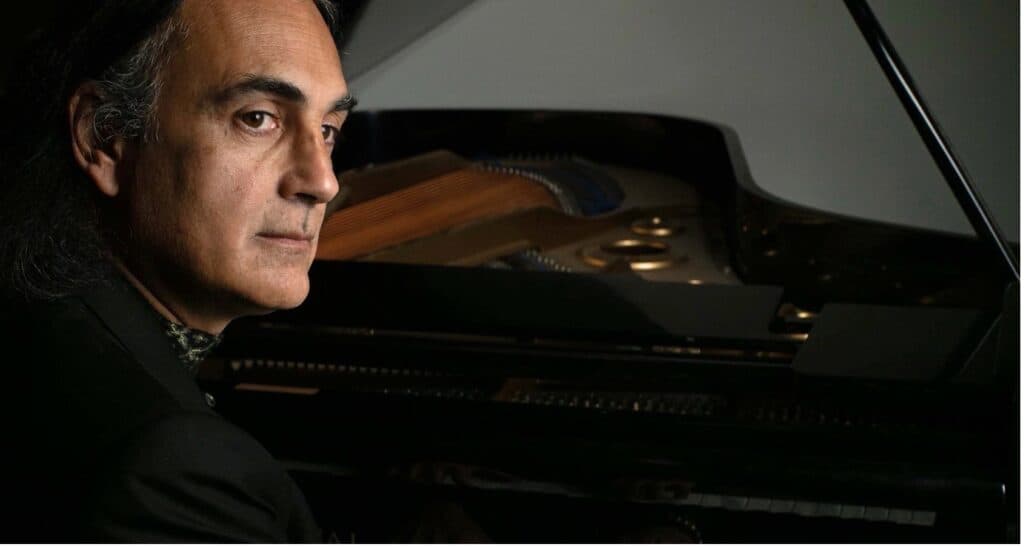
Kim Cunio (Peter Damo)

Dugri, meaning “straightforward” in Arabic and used similarly in Hebrew slang, is an approach providing cathartic musical performances; a conduit for cultural and political exchange. Cunio uses this approach when embedding confronting political statements in his own music to advocate for Muslim and refugee rights in Australia.

“Sometimes we should and can be political,” Cunio says. “We actually have to make people feel deeply, deeply uncomfortable to bring about social change.

“I think musicians have the ability … to bear witness to what doesn’t work in the world and hold up the mirror to others.”

Cunio referred to the method of “participant observation” – a process of “triangulation” that involves fully immersing oneself in the respective culture, observing as a detached participant, and drawing from existing literature to create meaningful work.

Uriya used this methodology when creating the Dugri project. Learning the Arabic language, interviewing Arabs and Jews across the country, and taking inspiration from the song “I’m not racist” by Joyner Lucas. Uriya’s immersion into the Palestinian narrative on a personal level, led to the collaboration with his Arab partner and into song.

“I came into music from an educational, social, activism standpoint, much more than an artist wanting to articulate himself. It was research.”

Music as education

Cunio and the Dugri-duo know the complementary importance of education and music, working on social inclusion for the younger generation.

 “It's going to take a new generation to make a change through art,” Cunio said about his ambition to integrate music programs in mainstream educational institutions, to foster collaboration. 

“We may not see it in our lifetime, but music will play its part.”

Similarly, Dugri’s educational programs serve as a catalyst for discussion, allowing youth to express their frustrations and feel heard. Their workshops of storytelling, performing and active engagement of rap writing can help the youth navigate the maze of dichotomous narratives.

Dugri’s motto is to provide an approach rather than a solution, universal to a global audience, including in the US.

“What we’re able to do is to bring our Dugri-ness, our Middle Eastern-ness, our Israeli and Palestinian-ness, and encourage them to start talking straight,” Uriya said.

Simply by sitting together, overcoming the "enemy narrative" and listening to each other’s stories, conflicts can be dissipated.  

Cunio also sees the spectrum of music for social advocacy, extending from harsh and political to beyond politics and as a tool for healing.

“It doesn’t always have to be doom and gloom ... Sometimes I try to work on the side of humour when I think that the serious, earnest side doesn’t work.”

Dugri’s next song Sabab (“reason” in Arabic) fulfils this aspiration. “We have so many reasons to hate ... We don’t need a reason to celebrate our similarities,” said Uriya.  

“Instead of blaming each other or being tied to a chair, we want to be about the potential of being Jews and Arabs together.”

Photo: Uriya and Sameh - the "Dugri" duo - visualising the tensions between Arabs and Jews by being tied to each other, unable to break free for their song Munfas (Photo: Courtesy).

You might also like
  • Sanctioning settlements is a defence of Israel, not an attack
    Elisheva Madar
  • ‘Israel is systemically eliminating Palestinian collective life’:  Israeli human rights report
    Deborah Stone
  • Antisemitism, homophobia and a radical response to both
    Dennis Altman
logomark.67a07ee3
We believe in the free flow of information

Republish our articles for free, online or in print, by using our Creative Commons licence

You might also like

    haredi street guitar
    Photo EssayArts & Culture

    Jerusalemites through the lens

    Sharon Gabay
    Article Image
    FeatureArts & Culture

    What to see at the 2026 Jewish International Film Festival

    Kathy Laster
    Pearly Spurtle
    FeatureArts & Culture

    Israeli ingredients a recipe for ‘Pearly Spurtle’

    Gideon Cohen

About the author

Batool Aljafri

Batool Aljafri

Batool Aljafri is a media insights analyst, pursuing a master's in journalism and communication at UNSW. She focuses on topics relating to social justice, climate change, and on arts and culture.