Aa
  • Read, Watch, Listen
  • TJI Series
  • Community Action
  • Events
  • Zedi
Follow us and continue the conversation
  • LinkedIn
  • Instagram
  • FaceBook
  • X
  • YouTube
Test yourself with the TJI Quiz!

Adjust size of text

Aa

Follow us and continue the conversation

  • LinkedIn
  • Instagram
  • FaceBook
  • X
  • YouTube

Your saved articles

You haven't saved any articles

What are you looking for?

Original reporting, insightful analysis and diverse views, delivered straight to your inbox

  • LinkedIn
  • Instagram
  • FaceBook
  • X
  • YouTube
Your support fuels our mission to inform, entertain and inspire.

The Jewish Independent is bound by the Standards of Practice of the Australian Press Council. If you believe the Standards may have been breached, you may approach The Jewish Independent or make a complaint to the Australian Press Council in writing at www.presscouncil.org.au. The Council may also be contacted on 1800 025 712.

  • Our Story
  • Contact us
  • Our Team
  • Support us
  • Guidelines
  • Pitch your idea
  • Republishing us
  • Community Action
  • Our Awards
  • LinkedIn
  • Instagram
  • FaceBook
  • X
  • YouTube
Aboriginal FlagTorres Strait Islanders Flag

The Jewish Independent acknowledges Aboriginal and Torres Strait Islander peoples as the Traditional Owners and Custodians of Country throughout Australia. We pay our respects to Elders past and present, and strive to honour their rich history of storytelling in our work and mission.

© The Jewish Independent 2026All Rights Reserved
Website design and development by Your Creative, MelbourneTerms & ConditionsPrivacy Policy
HomeRead, Watch, ListenAustralia
InterviewAustralia

The man behind those newspaper ads condemning antisemitism

VIC ALHADEFF meets TIM ROSSANIS, the driving force behind the initiative that called on Australians to speak out.
Vic Alhadeff
Print this
Tim Rossanis

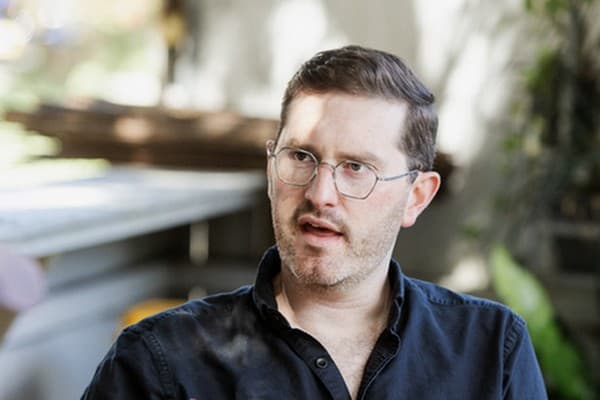
Tim Rossanis (Giselle Haber)

Published: 2 February 2024

Last updated: 21 March 2024

VIC ALHADEFF meets TIM ROSSANIS, the driving force behind the initiative that called on Australians to speak out.

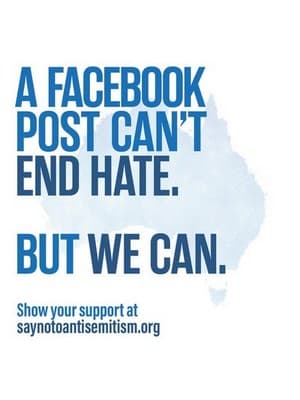
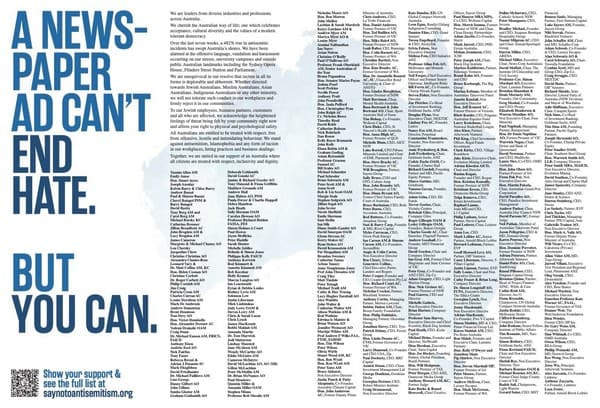
Tuesday, November 28, 2023, was a day unprecedented in the annals of Australian Jewry: double-page advertisements in the front of the nation’s major newspapers condemning antisemitism.

“A NEWSPAPER AD CAN’T END HATE,” declared the headline on the advertisement in capital blue letters; “BUT YOU CAN.” In the centre, an inclusive statement denouncing the spike in antisemitism and other forms of bigotry which were, and still are, threatening social cohesion across the nation. 

More than 600 men and women from Australian corporate and public life, from a range of faiths and backgrounds, agreed to sign the advertisement, although space limitations meant only about 400 names were printed. But almost 20,000 people signed online variations of the theme.

The impetus for the initiative? The alarming surge in antisemitic incidents across the nation in the aftermath of the barbaric Hamas assault of October 7, generating profound concern across the Jewish community, as well as disquiet at the silence of many of the interfaith leaders with whom the community had been engaging for decades. 

The driving force behind the campaign was Tim Rossanis, whose name is little-known within the Jewish community but whose enterprise will be long remembered.

“My hope is that the campaign shone a light on the reality of the experience that thousands of Jewish employees had been having,” reflects Rossanis. “The objective was also to prompt employers to think about what was happening in their workplace and to focus on their human resources policies and how they impacted Jewish employees.
My hope is that the campaign shone a light on the reality of the experience that thousands of Jewish employees had been having.

“Of course, the issues are still there and still vexed, and employers have varying levels of willingness to insert themselves into situations that might be polarising or political or both.”

Rossanis was born in Perth to an Israeli father, Ilan, whose original name was Rozanes, and a Perth-born mother, Loretta. The couple had met at Lucky Divers - a dive shop in the Israeli resort of Eilat where Loretta was working and Ilan was a lifeguard next-door. "My mother always felt a deep connection to Judaism, hence her interest in travelling to Israel." Three months later, they were engaged to be married.

The Jewish Independent

Relocating to Perth, Ilan anglicised his surname to Rossanis, even though there are streets in Israel with the Rozanes name and the family is believed to have part-owned the concourse at the Western Wall – although that could be folklore, Tim hastens to add.  

After attending Carmel School in Perth, Tim served as national president of Bnei Akiva and spent a year in Israel on a Bnei Akiva program. In quick succession he spent time in Kenya on a volunteer grassroots program, worked at Flight Centre, moved to New York with his wife and obtained an MBA at Yeshiva University.

“I had exposure to venture capital and tech companies, and that was the pathway which changed the direction of my life – people with chutzpah who don’t think anything is impossible. I wanted to be part of that world. We moved back to Perth, where I got a corporate role at Uber, which brought us to Sydney.

After almost five years there in various leadership roles, I joined Turo as their founding employee in Australia. Turo is the world’s largest car-sharing company, like Airbnb for renting a vehicle. We launched here in November 2022.”

The day after October 7, Rossanis flew to San Francisco on business. “It was very isolating to be on the other side of the world at that moment,” he recalls. “People didn’t understand the stress, the emotion, the anxiety, the impact on one’s well-being. I was open with my Australian colleagues in our Zoom meetings and even broke down at one point.” 

On a flight to Perth a short while later, Rossanis “stared out of the window for almost two hours in a Zen-like meditative state, reflecting on how disappointing the business world was in the wake of the massacre and how silent the Australian tech community had been.

“Antisemitism was surging and the ‘Gas the Jews’ incident had just happened. We kept our kids at home and I wasn’t seeing leadership from civil society such as happened during the marriage-equality debate.

The Jewish Independent

“I expressed my thoughts on LinkedIn and got hundreds of messages of support. That’s when the realisation hit me - recognition that thousands of people were thinking and feeling the same as me.”

After agonising over how to translate this new-found awareness into action, Rossanis drafted a letter that business leaders – both Jewish and from wider society - might sign. “The message was that we shouldn’t allow events on the other side of the world to dictate what happens here and that multiculturalism is one of this country’s biggest gifts.”

A three-person WhatsApp consultative group mushroomed as businesspeople and community leaders offered advice and expertise in terms of the content of the proposed advertisements, where they should be published and when. And equally significantly, how wide-ranging the content should be.

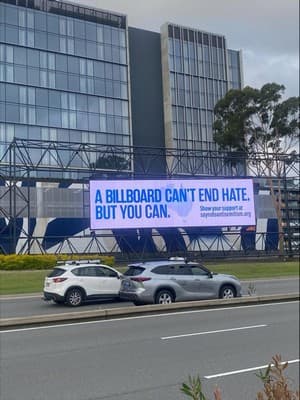
The outcome was double-page advertisements in the Australian Financial Review, The Australian, Sydney Morning Herald, The Age, Brisbane Times, Courier Mail, West Australian and others. In addition, billboards were purchased nationally and several newspapers published front-page stories on the campaign.

People saw the language in the ads and the breadth of names, and realised there was no longer a silent hostile majority.

“I’m proud of what we achieved,” says Rossanis. “It provided a momentary sense of relief from the anxiety over what it means to be Jewish at this point in history. People saw the language in the advertisements and the breadth of names who had put their hands up, and realised there was no longer a silent hostile majority. The message was the magic of diversity and that the Jewish community is an indelible part of our multicultural society.

“The bigger impact is that we shone a light on the issue. We used tech know-how and viral marketing tactics to take over social media for a period. The campaign created impetus for conversations at executive level in boardrooms across the country.  

“Every employer should be able to create an environment that’s safe for everyone. That’s what the statement was about and what the advertisement was about. It was balanced and inclusive. I’ve been thinking about what’s next.”

Rossanis has started exploring several new projects but says it’s too early to discuss them publicly. “I’m passionate about this issue and am looking to engage a group of like-minded but not homogeneous business and Jewish communities intent on fighting antisemitism. We need to diagnose the scope and magnitude of the problem before we can deal with it further.”

You might also like
  • Freedom Rides: Allyship for dark times
    Eliezer Rubenstein Sturgess
  • Traditional antisemitic myths dominate online antisemitism: new study
    Deborah Stone
  • When security clashes with hospitality
    Jarod Rhine-Davis
logomark.67a07ee3
We believe in the free flow of information

Republish our articles for free, online or in print, by using our Creative Commons licence

You might also like

    Nadia
    ReflectionAustralia

    Between communities: finding Jewish belonging after migration

    Florencia Tuchin
    Zoe Better pillars of light crop
    FeatureAustralia

    NDIS changes threaten disabled participation in community life

    Jarod Rhine-Davis
    Emergency Exit
    FeatureAustralia

    Learning from the Jewish refugee story

    Peter Kohn

About the author

Vic Alhadeff

Vic Alhadeff

Vic Alhadeff OAM is former CEO of the NSW Jewish Board of Deputies and former editor of the Australian Jewish News.

More from the author

InterviewArts & Culture

‘The battle for the future of Jews will be fought in the cultural arena’

InterviewWorld

IHRA head: discrediting definition means ‘turning a blind eye’ to anti-Zionism

OpinionArts & Culture

40 years since Lanzmann’s Shoah, his central question remains: When is it too late?

OpinionAustralia

A shocking moment at Sydney Writers’ Festival